US 12th graders’ reading and math scores fall to lowest levels on record


A new batch of student test scores indicates a collapse of preparation for college and career, as well as a drop in scientific knowledge. These two may have deep implications for the country’s economic future.
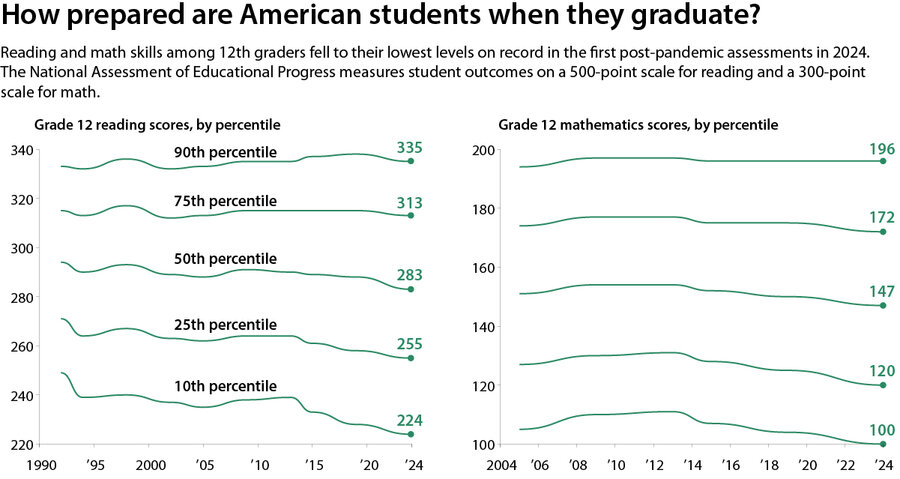
The average reading and mathematics scores among the 12th year students fell to their lowest levels ever recorded in 2024, according to the latest results from the National Evaluation of Educational Progress (NAEP), often called “the country’s bulletin”. Meanwhile, the scores of eighth students on a scientific test also slipped.
Last year marked the first time that these three assessments were presented from the pandemic, offering a new – although sober – envisages continuous learning struggles for American schoolchildren. The results of the NAEP published in January showed disturbing drops of reading scores among fourth year students and eighth year students. During the three tests, the scores for more efficient students continued a downward trajectory and hit historic stockings.
Why we wrote this
The latest scores of the test called “The Nation Bulletin” raise concerns concerning the state of STEM education and preparation for college in the United States that the results suggest certain education improvements must be concentrated.
“This means that students take their next stages in life with less skills and less knowledge in basic academics than their predecessors ten years ago,” said Lesley Muldoon, executive director of the National Assessment Governing Board. “And this happens at a time when rapid progress of technology and society more require future workers and citizens, no less.”
The average mathematical score for 12th year students – 147 on a 300 -point scale – was the lowest since the start of the evaluation in 2005. 22% of 12th year students resolved mathematical problems at a level deemed or above the skill in 2024. Meanwhile, 45% performed below the most fundamental level of success of the test.
This drop was fed by almost in mind struggles. The scores for 12th year students occurring in the 90th centile – the most efficient students – remained stable compared to 2019. Students of all other centiles saw declins, expanding the gap between the most efficient and less efficient learners.
National Center for Education Statistics
|
Jacob Turcotte / Staff
Similar trends have emerged on the assessment of reading. The average reading score of twelfth year students – 283 on a scale of 500 points – was the lowest in more than three decades.
Only 35% of the elderly in secondary school in 2024 read at the competent level or above the test, against 37% in 2019. Some 32% lacked the reading skills necessary to operate at a basic level, as drawing general conclusions from concepts presented explicitly in the text.
The scores suggest that an increasing number of students will not be prepared for entry -level college courses and, instead, may need to take repair lessons that could slow their path to a certain measure.
This could require a change in the way education systems work together to meet the needs of students, explains Michelle Cantú-Wilson, who sits on the San Jacinto College board of directors in Texas and is also a member of the board of directors of the national assessment. In Texas, a Coréquis model appeared which mixes development teaching and at the level of college courses granted by the credit.
“When we say that students may need remediation or development education, it is of course certainly to decorate, right?” Mrs. Cantú-Wilson says. “And we have to think about the reason why it happens, but in Texas, in particular, we also make sure that the model works for students and their objectives.”
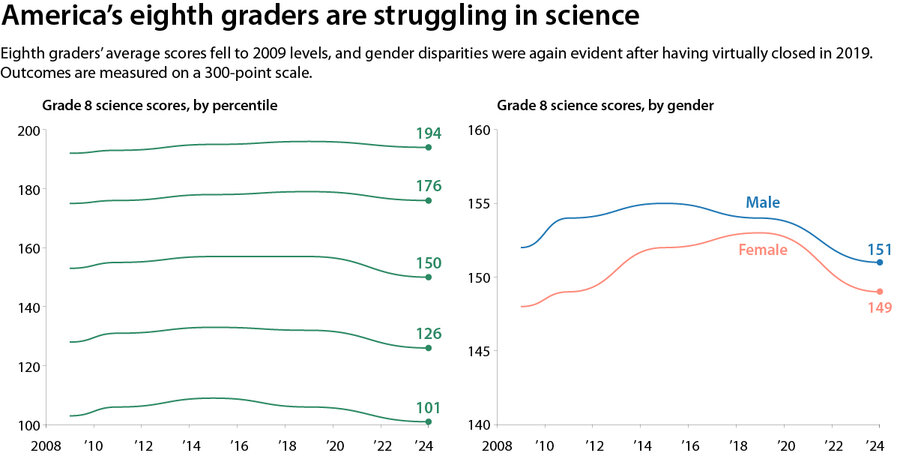
On the scientific level, the scores of eighth students are just as annoying. Scientific assessment, also taken in 2024, measured the knowledge of students in physical sciences, life sciences and earth and space sciences.
The average scientific score of eighth students has decreased by four points since 2019 and fell to the same level recorded in 2009. The decline occurred through the centiles, which means that higher and more efficient students are struggling in science.
Only 31% of the scientific scores of eighth students placed them at the competent or higher level. Thirty-eight percent of students, meanwhile, won scientific scores below the basic level of the test.
And, after the gap of the scientific sexes has essentially disappeared in 2019, the last evaluation again shows that girls are late the boys.
National Center for Education Statistics
|
Jacob Turcotte / Staff
“We certainly know this stem [science, technology, engineering, and mathematics] has important implications for national economic competitiveness and national security, and we cannot pay attention to these eighth year scientific results, “explains Matthew Soldner, acting commissioner for the National Center for Education Statistics, which administers NAEP tests.
The downward trajectory of scientific scores could reflect a post-pandemic emphasis on reading and mathematics that have reduced time for other content areas, explains Christine Cunningham, main vice-president of STEM learning at the Boston museum of sciences and member of the National Evaluation Board of Directors.
But Dr. Cunningham says that students’ motivation is another concern. A survey given alongside the science assessment has revealed that the interest of students in science has dropped since 2019, as is their participation in class activities promoting a scientific investigation.
“If we really want to help children learn science, we have to cut off time,” she says. “We must think about the experiences of children who are motivating and significant.”
Students do better, says Dr. Cunningham, when they are interested in the subject and can find relevance in their own life or in the world around them. This could lead to integration with mathematics and reading. An interesting scientific subject, for example, could encourage children to know more about this.
“We are going to have to think carefully about how to do this in the future,” she says.


