US and China end ‘constructive’ trade talks without breakthrough



 EPA
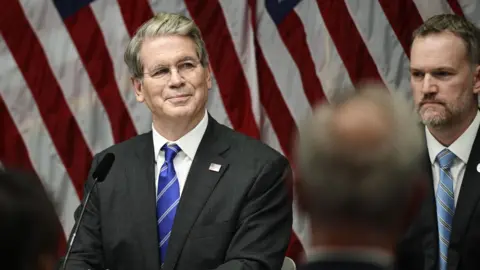
EPAThe United States and China have completed another series of commercial talks without any major breakthrough, despite discussions that the two parties described as “constructive”.
Negotiations, held in Stockholm, Sweden came while a truce established in May should expire next month, threatening to rekindle the disorders that hit in April when the two countries exchanged prices in clip-for-for-tat.
The American secretary of the Treasury, Scott Bessent, said that any extension of this truce, in which the two parties agreed to drop certain measures, would be President Donald Trump.
Chinese sales negotiator Li Chenggang said the two parties pushed this agreement.
Beijing and Washington were in Loggerheads on a range of problems as well as prices, including the American requirements of China, the sale of China sells Tiktok and China accelerates its export of critical minerals.
Trump began to hike Chinese products shortly after returning to the White House. China finally responded with its own prices. Tensions have intensified, With pricing prices reaching triple figures, before a commercial truce in May.
This left Chinese products faced at an additional 30% rate compared to the beginning of the year, with American products faced with a new 10% price in China.
Without the prolonged break by the deadline of August 12, the prices could “boomerang”, said US officials.
“Nothing has been agreed until we speak with President Trump,” said Bessent, while minimizing the risk of climbing.
“Just to encroach this rhetoric, the meetings were very constructive. We simply did not give the sign,” he said.
It was the third meeting between the United States and China since April.
The negotiators for the two parties said they had discussed each other’s savings, the implementation of terms previously contained by Trump and Chinese President Xi Jinping and Rare Terre, a key snack because of their importance in new technologies, including electric vehicles.
The United States has also pressed China on its relations with Russia and Iran.
Li Chenggang said that the two parties were “fully aware of the importance of safeguarding a trade and economic relationship of stable and solid China-US”.
Bessent said he thought the United States had momentum after the recent agreements that Trump had obtained with Japan and the European Union.
“I think they were more mood for a major discussion,” he said.
President Trump has long complained about the trade deficit with China, which saw the United States last year buy $ 295 billion in more in China than the reverse.
US trade representative Jamieson Greer said the United States was already on the right track to reduce this $ 50 billion gap this year.
But Bessent said the United States did not try to “decouple completely”.
“We just need to manage with certain strategic industries, be it rare earths, semiconductors, drugs,” he said in a briefing for journalists after the conclusion of talks.