US campus activists relieved – and anxious


Brandon DrenonWashington And
Grace Eliza GoodwinNew York City

 Getty Images
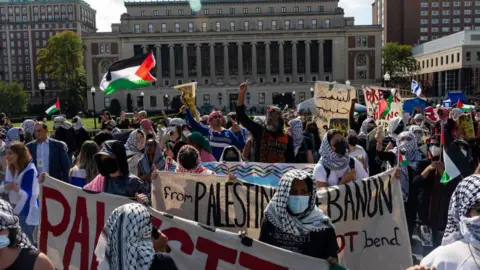
For months last year, protests swept major college campuses across the United States as tens of thousands of students called for an end to the war between Israel and Gaza.
The protests reached their peak in the spring, when pro-Palestinian activists staged sit-ins and launched encampments. Many demonstrations took place peacefully, but others were marked by violent clashes with armored vehicles. police while students occupied the buildings. More than 3,000 people were ultimately arrested.
The most common song during these demonstrations, it was “ceasefire now!” “. More than a year later, a ceasefire agreement was signed, which prompted US President Donald Trump to declare on Monday that “the war is over”.
For many students who have been calling for this moment since the war began on October 7, 2023, news of a peace deal brought mixed emotions.
“My first reaction was relief, knowing that my extended family, or everyone in Gaza, would be able to breathe,” said Khalid, a student activist at Earlham College in Richmond, Indiana, who, like others, asked the BBC not to use his last name.
Dozens of his family members in Gaza were killed during the war, he said.
“On the other hand, there is a certain level of apprehension and a certain sense of hesitation to be fully optimistic about what comes next,” he said.
When Ahmad, a student at Georgetown University, first heard the news of the peace agreement, he said “a feeling of joy came over me.”
But he quickly adds: “You still feel that uneasy feeling.”
“Maybe this is the end. All I can do is hope,” said Mr. Ahmad, of Palestinian origin.
Thomas, a graduate student at Columbia University in New York, where protests which broke out last year before spreading across the country, has also expressed some skepticism.
“Even though there is a ceasefire at the moment, there is still a lot of work to be done,” he told the BBC.
He added that although the largest protests in Colombia have long since died down, the war in Gaza remains a difficult topic on campus.
“People are now afraid to speak out,” he said. “They think that if they speak out about what they believe in, regardless of which side they are on, it will create more conflict in the social atmosphere.”
Elisha Baker is also a student at Columbia University. A self-described Zionist, he told the BBC that he “protested the anti-Israel movement” on campus last year. He welcomed the return of hostages held in Gaza following the peace agreement.
“The fact that we brought 20 hostages home alive, after two years of captivity in tunnels, is just cause for celebration,” he said.
“It also pains me to think of the murderers and terrorists who are being released,” he added, referring to Palestinian prisoners and detainees released by Israel under the terms of the peace agreement.
The release included around 250 prisoners convicted of crimes including murder and deadly attacks against Israelis, and around 1,700 detainees from Gaza who had been held by Israel without charge.
Long before the recent ceasefire announcement, pro-Palestinian protests, which at one point engulfed about 500 American universities, had mostly cooled down.
Universities had come under pressure from the president and Republican lawmakers to suppress pro-Palestinian protests. They said universities were failing to combat anti-Semitism on campus.
Three university presidents – from Harvard, Columbia and the University of Pennsylvania – resigned following heated congressional hearings into the protests.
The Trump administration has frozen billions of dollars in funds from universities deemed non-compliant, and undercover agents have arrested pro-Palestinian student activists such as Mahmoud Khalil and Rümeysa Öztürk.
Although the momentum and energy behind the protests may have waned, some students said their efforts were worth it. Mr. Ahmad, a student activist at Georgetown University, welcomed the announcement of a peace agreement.
“Looking on the Internet, seeing the smiles of people knowing that the crisis is over and the war has been stopped, it’s joyful,” he said.
“In recent years, all we have seen is massive bombings, destroyed buildings and lost families.”
But Mr Ahmad added that “the threat of violence is never far away”.
“There is always this uncertain feeling that (the war) will resume,” he told the BBC.
At least seven people in Gaza were killed Tuesday by Israeli drone strikes after crossing a border established by the ceasefire plan.
“I am reluctant to fully accept that this is the end of the killings and the violence,” said Mr Khalid of Earlham University.
Mr. Baker, a pro-Israel student at Columbia University, also shared his concerns about the fragility of Trump’s 20-point peace plan.
“All the innocent people killed by Hamas and whose bodies are still held in captivity deserve to be buried with dignity and their families pay them a final tribute,” he said.
“The fact that Hamas did not do so constitutes a violation of the agreement,” he said.
Some bodies of deceased hostages were returned to Israel this week, but around 20 are still believed to be in Gaza.
Mr. Baker, co-chair of Colombia’s pro-Israel Aryeh Public Affairs Committee, said advocacy for Israel must continue even after the ceasefire.
“The Jewish student movement, the Jewish people, we will continue to defend the Israel that we love and our rights as a people,” he said.
Mr. Khalid also said that activism on behalf of Palestinians in Gaza must not weaken.
“Now that there is a ceasefire, we can breathe a little and, of course, celebrate the immediate victory that a ceasefire is,” he said.
“But that doesn’t change the fact that we will continue to work to achieve the rest of our goals.”
Jadd Hashem, a student of Palestinian descent at the University of Texas, said: “People can maybe be pessimistic… but I think it’s more like the most optimism any of us have felt in over two years.”
He believes this will be the start of lasting peace.
Mr. Hashem is a member of the University of Texas Atidna International, an organization focused on promoting Israeli-Palestinian dialogue.
He thinks cross-cultural communication will be key.
“Now is our opportunity to talk to each other, to have conversations and ultimately to promote dialogue between Israelis and Palestinians, between Jews and Arabs,” he said.
“We must learn to know and humanize each other to ensure that a conflict like the one we have experienced over the past two years cannot happen again.”


