US jobs market weakens further in August



 Getty images
The American job market has weakened in August in August, which raises new fears about the health of the greatest world economy.
Employers added only 22,000 jobs last month, less than expected, while the unemployment rate increased from 4.2% to 4.3%, according to the Labor Department.
The figures bear a series of trembling data this week on the job market and add to the concerns that increased last month, when the Labor Department said that hiring in May and June had been much lower than it initially estimated it.
On Friday, the department said that its latest estimates showed that the United States has lost jobs in June, the first drop of this type since 2020.
Investors, who already parked that the American central bank would respond to the weakening of the labor market with a drop in interest rates at its meeting this month, said the decision was now almost sure.
“The warning bell that sounded on the job market a month ago has become stronger,” said Oli Sonola, head of American economic research for Fitch Ratings.
US President Donald Trump responded to signs of slowdown in August in the licensee, the head of the work statistics office, accusing him, without proof, of fueling the figures to make him look bad.
But analysts claim that problems on the labor market are partly due to the radical changes of the president in the pricing and immigration policy, which, according to economists
Its administration has also reduced public spending, dismissed thousands of civil servants.
The Labor Department said that the federal government had lost 15,000 jobs last month. Manufacturing and construction companies have also declared payroll drops, compensating for health care gains.
“Four consecutive months of manufacturing job losses,” said Sonola. “It is difficult to argue that price uncertainty is not a key engine of this weakness.”
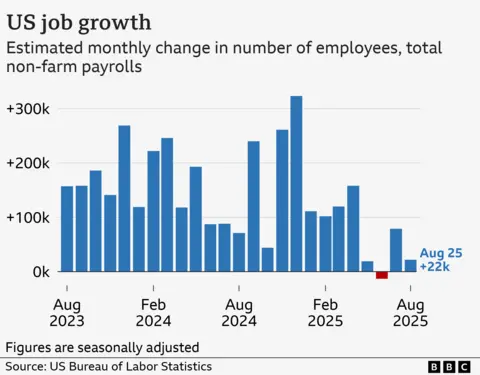
The number of jobs created each month slows regularly from the boom which followed the reopening of the pandemic.
But analysts said that the economy only needed to create 50,000 jobs each month to follow demographic growth – much less than in the past – like Trump’s repression against immigration invites the flow of new workers who have entered the United States in recent years to dry.
The stock markets opened slightly more following the report, which also showed that the average hourly wage increasing by 3.7% in the past year.
In the global bond markets, the rates that investors demand for the loan have dropped sharply, reversing an increase earlier in the week, while confidence increased in a drop in Fed rates.
“The initial reaction suggests that the markets focus on Fed rate reductions rather than concerns about a cooling economy,” said Ellen Zentner, chief economic strategist of Morgan Stanley Wealth Management.
“The bad news looks like good news, at least this morning.”
Addressing the CNBC broadcaster, the White House economic advisor Kevin Hasset conceded that the August employment numbers were “disappointing”, but said that he expected the revisions in the coming months to have a better image.
Earlier this week, the government reported that job offers had fallen at the lowest level since 2024, while job seekers were more numerous than posts from the pandemic.
Complaints for unemployment payments have also reached the increase this week, while Friday’s report has put the unemployment rate at the highest level since October 2021, although it is still not far from the lowest.


