US stock market ends 2025 on a high note after volatile year


Danielle KayeEconomic journalist

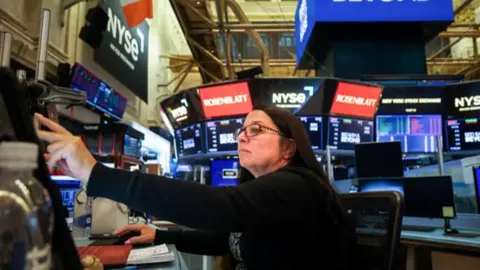 Michael Nagle/Bloomberg via Getty Images
It’s been a turbulent year for financial markets, but U.S. stock investors are heading into 2026 on a high note.
The customs tariffs imposed by US President Donald Trump on global trade caused shock waves on the markets in the spring. But by the summer, the United States posted record highs, fueled by strong corporate profits and confidence in investments in artificial intelligence.
The S&P 500 is on track to finish the year up about 17%, the third straight year of double-digit gains.
Next year could prove to be another big year for stock investors, analysts say. Yet with changes in leadership at the US central bank and While there are growing concerns that AI stocks are overvalued, the road ahead could be rocky.
The tech-heavy Nasdaq Composite index is expected to see a 21% gain this year, while the Russell 2000 index of smaller companies is up about 12% year to date.
In early April, when Trump announced drastic tariffs on the United States’ trading partners, the S&P 500 fell to the brink of the bear market — Wall Street’s term for a 20% decline from its last high. The Nasdaq Composite and Russell 2000 indexes briefly fell in bear markets.
But major indexes quickly rebounded after Trump backed away from his highest tariffs, easing Wall Street’s fears of a tariff-induced economic slowdown.
Since then, stocks have reached new highs.
This is despite continued concern about the economy, Robert Edwards, chief investment officer at Edwards Asset Management, said in a note.
“The market continues to climb the wall of worry into next year,” he said.
He added that 2026 “should be another record year for stocks,” pointing in part to expectations for lower borrowing costs, which could boost corporate profits and send stock prices higher.
Strong profit growth at U.S. companies has been a key driver of the stock market rally since the tariffs were passed. boost in the spring, said Parag Thatte, equity strategist at Deutsche Bank.
At the same time, geopolitical tensions, Trump-imposed tariffs and expectations of lower interest rates have bolstered investor demand this year for safe-haven assets, such as gold and other commodities. The price of gold is on track to increase by almost 70% per year.
Bitcoin, on the other hand, has struggled to keep pace with strong returns from stocks and gold.
Despite receiving a boost earlier in the year from the Trump administration’s support for digital assets, the world’s largest cryptocurrency is poised to finish 2025 slightly lower, following a sharp decline from its October highs.
 Reuters
Expanding beyond technology
Investor enthusiasm for massive spending on AI has helped several technology companies outperform the broader S&P 500.
The top five companies – Nvidia, Apple, Microsoft, Amazon and Alphabet – account for almost 30% of the overall index.
But in recent months, fears have grown in Silicon Valley and beyond that the AI bubble is bursting, as the values of AI-related technology companies have soared and companies continue to spend heavily in the booming sector.
Analysts note that corporate profit growth appears to extend beyond the technology sector. That could provide a cushion for investors as tech companies’ valuations remain under scrutiny.
Deutsche Bank’s Mr. Thatte said growth accelerated for mid-sized companies in the third quarter of 2025, not just tech giants. He called it a “key development.”
But even with increasingly strong gains in the U.S. stock market, it remains to be seen whether the S&P 500 can maintain its momentum if the tech sector’s recovery slows.
“The rotation is already happening,” Mr. Thatte said, referring to investors moving away from big tech stocks. “It might be noisy along the way.”
Professional investors are also concerned that some non-tech stocks are also overvalued.
Vanguard analysts predict annualized returns of around 3.5% to 5.5% for U.S. stocks over the next decade – a relatively tame outlook compared to recent gains.
 JOHN G. MABANGLO/EPA/Shutterstock
Political risk does not “reduce”
In 2025, the U.S. economy “has probably held up better than most people expected,” said David Sekera, chief U.S. market strategist at Morningstar.
The world’s largest economy accelerated in the three months to September, with annual growth of 4.3%, up from 3.8% in the previous quarter – the strongest growth in two years.
But that doesn’t mean there won’t be big economic question marks in the months to come.
It is still possible that Trump’s tariff policies will cause another shock to the markets. Negotiations between Washington and its major trading partners will be “headlines,” Sekera said.
The US labor market has also shown signs of weakness. The unemployment rate reached its highest level in four years, at 4.6% in November, compared to 4.4% in September, according to figures from the Ministry of Labor.
“As political risk will not subside anytime soon,” Charles Schwab analysts wrote in a research note, “the bar for a pullback or mini-correction in early 2026 is not very high.”
Trump is also expected to name a new Federal Reserve chairman in the coming weeks, to succeed Jerome Powell after his term ends in May.
The move poses “the big uncertainty” for investors heading into 2026, Paul Stanley, chief investment officer at Granite Bay Wealth Management, said in a note.
Trump, who has pressured Powell to lower interest rates, has said he would choose a Fed chair he sees as committed to easing borrowing costs.
Wall Street investors will be scrambling to understand how the change in leadership will impact monetary policy going forward.
“Fed chair transitions come with volatility,” Mr. Stanley said.
That leaves investors facing plenty of unpredictability, even as analysts anticipate another strong year ahead.