US Supreme Court appears poised to expand Trump’s power to fire federal official



 Getty Images
The U.S. Supreme Court’s conservative majority appeared to side with the Trump administration on Monday in a case that could have major implications for the independence of the White House’s long-protected federal agencies.
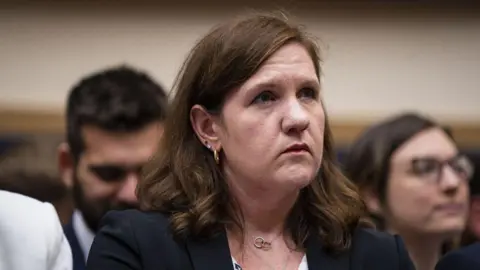
The Trump v. Slaughter case stems from President Donald Trump’s March firing of Rebecca Slaughter, along with another Democratic member of the Federal Trade Commission (FTC).
The court heard more than two hours of argument over whether Trump could fire her, since federal law says a commissioner can only be fired for “inefficiency, neglect of duty, or malfeasance in the performance of his or her duties.”
The court’s decision is not expected to be announced for several months.
Ms. Slaughter sued Trump after she was ousted earlier this year for being “incompatible with [the] Administration priorities.
Trump argued that a president should be able to exercise complete control over government agencies, even those created by Congress to be free from presidential interference.
When the FTC was created in 1914 – to protect the public from deceptive business practices and unfair competition – Congress passed a law stating that a president could only remove commissioners for cause and that the five-member commission could have no more than three members from the same political party.
Trump nominated Ms. Slaughter in 2018 to fill a Democratic position at the FTC, and she was later reappointed by former President Joe Biden.
Similar termination rules exist for other independent agencies like the National Labor Relations Board.
The law was tested in 1935, when President Franklin Roosevelt attempted to remove a member of the FTC, leading the Supreme Court to uphold the independence of some federal agencies like the Trade Commission.
In the 90-year-old decision known as Humphrey’s Executor, the court held that while the president has the ability to remove executives without cause, such power does not apply to agencies like the FTC that are “neither political nor executive, but primarily quasi-judicial and quasi-legislative.”
During oral arguments on Monday, the court’s four conservative justices appeared to disagree with arguments by Ms. Slaughter’s lawyers that this would constitute an unacceptable expansion of Trump’s powers.
Arguing in favor of the Trump administration, U.S. Solicitor General John Sauer called the Humphrey rule an “indefensible outlier” and a “rotting husk” of a Supreme Court decision that should be overturned.
“I think broad delegations to unaccountable independent agencies raise enormous constitutional and real problems for individual liberty,” conservative Justice Neil Gorsuch said.
The three liberal justices pressed on why the court would overturn 90-year-old precedent.
“You are asking us to destroy the structure of government,” Justice Sonia Sotomayor said, “and to strip Congress of its ability to protect its idea that government is best structured with some independent agencies.”
Justice Elena Kagan suggested that allowing Trump to impeach Ms. Slaughter could have far-reaching consequences, asking: “The question is: Where does this leave? »
“Employees exercise executive power everywhere, and yet we have had civil service laws that have afforded them substantial protection from termination for over a century,” she said.
Lawyer Amit Agarwal, representing Ms. Slaughter, said independent auditing groups like the FTC have a long history in American politics.
“Multi-member commissions, whose members enjoy some sort of protection from removal, have been a part of our history since 1790. So if the petitioners are right, all three branches of government have been wrong all along,” he said.
The court has already ruled against Ms Slaughter, which analysts say could indicate how it would ultimately rule.
A lower court ruled that Ms. Slaughter was illegally expelled from the FTC, leading the Trump administration to appeal the decision to the Supreme Court.
In a 6-3 decision, the conservative-majority court in September issued an emergency order maintaining his dismissal until the case could be heard.
The Supreme Court is also expected to later consider a separate case on whether Trump had the authority to remove Lisa Cook, a member of the Federal Reserve Board of Governors.


