US Supreme Court lets Trump administration require gender at birth be listed on passports



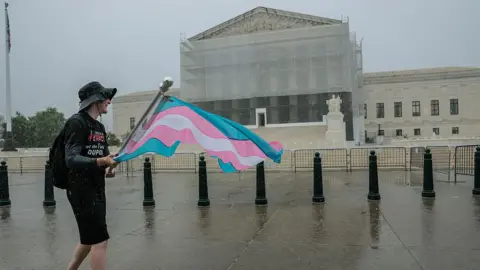 Getty Images
The U.S. Supreme Court will, for now, allow the Trump administration to require all new passports to indicate an individual’s biological sex at birth.
The conservative-majority court on Thursday froze a lower Massachusetts court order that had blocked the U.S. government from changing its policy while legal proceedings were underway.
“Displaying passport holders’ gender at birth does not undermine the principles of equal protection any more than displaying their country of birth,” the court said.
On his first day in office, Trump signed an executive order recognizing only two genders, leading the United States to issue passports with only male or female designations, based on a person’s sex recorded at birth.
The Biden administration had allowed people to choose their own gender on passports and added a third option – X – to the travel document, issued by the State Department.
The Trump administration’s victory – the latest on the high court’s emergency docket – means that individuals will no longer be able to show their chosen identity on their new or renewed passports for the foreseeable future.
The unsigned order specifies that the government, with its new policy, “is content to attest to a historical fact without subjecting anyone to differential treatment”.
The Supreme Court also said the administration “is likely to succeed on the merits,” indicating that the justices are inclined to issue a final ruling that would uphold that requirement when the case comes to them.
The three liberal justices dissented.
The plaintiffs in the case are transgender activist Ash Lazarus Orr, four other transgender Americans and two non-binary people. They argued that gender limitations amounted to harassment and could lead to violence against transgender people.
Shortly after Trump issued his executive order on passport gender designation, American actor Hunter Schafer said she was shocked when she received a new passport listing her gender as male instead of female, criticizing the policy.
“It really doesn’t change anything about me or my trans character, however, it does make life a little more difficult,” the Euphoria star said.
The high court’s decision comes as the Republican president continues to roll back his predecessor’s policies on transgender Americans as well as diversity, equity and inclusion, or DEI.
Since 1992, the State Department has allowed gender designations in passports to differ from the sex assigned at birth with medical documents.
In April, a judge in Boston, Massachusetts, ruled that the Trump administration’s policy was likely discriminatory on the basis of gender. Judge Julia Kobick, a Biden appointee, said the policy was rooted in “irrational bias” against transgender Americans and violated their equal protection rights under the Fifth Amendment to the U.S. Constitution.
In June, Kobick issued an order blocking enforcement of the policy.
Disagreeing on Thursday, Supreme Court Justice Ketanji Brown Jackson accused the Supreme Court’s six conservative justices of “mindlessly circumventing the obvious fair outcome,” saying it had become an “unfortunate trend.”
“This Court has once again cleared the way for the immediate infliction of harm without adequate (or, really, any) justification,” she wrote. “Because I cannot accept this unnecessary but painful perversion of our equitable discretion, I respectfully disagree.”
Trump’s top prosecutor, Attorney General Pam Bondi, celebrated the court stay as the Justice Department’s “24th victory on the Supreme Court’s emergency case.”
Secretary of State Marco Rubio called it “a great victory” for the president and “for common sense!”
The high court has ruled in favor of the president in similar cases dealing with gender ideology in recent months.
In May, he temporarily authorized the administration to enforce its ban on transgender people serving in the military, which Trump implemented through a separate executive order.
The administration has also pushed for policies to restrict certain types of health care for minors who identify as transgender and to prevent transgender women from playing on women’s sports teams.
In August, the Supreme Court also allowed the administration to terminate various National Institutes of Health grants related to research related to DEI goals, gender identity, and Covid.


