Using pollen to make paper, sponges, and more


Soften the shell
To start working with pollen, scientists can eliminate the sticky coating around the grains in a process called swing. Undressing these lipids and allergenic proteins is the first step to create empty capsules for the administration of drugs that CSABA is looking for. Beyond that, however, the apparently impenetrable shell of pollen – has raised the sporopollenine biopolymer – longtime researchers and have limited its use.
A breakthrough occurred in 2020, when Cho and its team reported that pollen incubation in an alkaline solution of potassium hydroxide at 80 ° Celsius (176 ° Fahrenheit) could considerably change the surface chemistry of pollen grains, which allows them to easily absorb and keep water.
The resulting pollen is as flexible as Play-Doh, explains Shahrudin Ibrahim, researcher in the Cho laboratory who helped develop the technique. Before treatment, pollen grains are more like balls: hard, inert and largely unrealed. Afterwards, the particles are so soft that they remain easily together, allowing more complex structures to form. This opens many applications, says Ibrahim, proudly holding a bottle of yellow melting snow in the laboratory.
When sunk on a flat and dried mold, the microgel assembles paper or film, depending on the final, strong but flexible thickness. It is also sensitive to external stimuli, including changes in pH and humidity. Exposure to the alkaline solution means that the constitutive polymers of pollen become more hydrophilic or that love water, therefore depending on the conditions, the frost will swell or shrink due to the absorption or expulsion of water, explains Ibrahim.
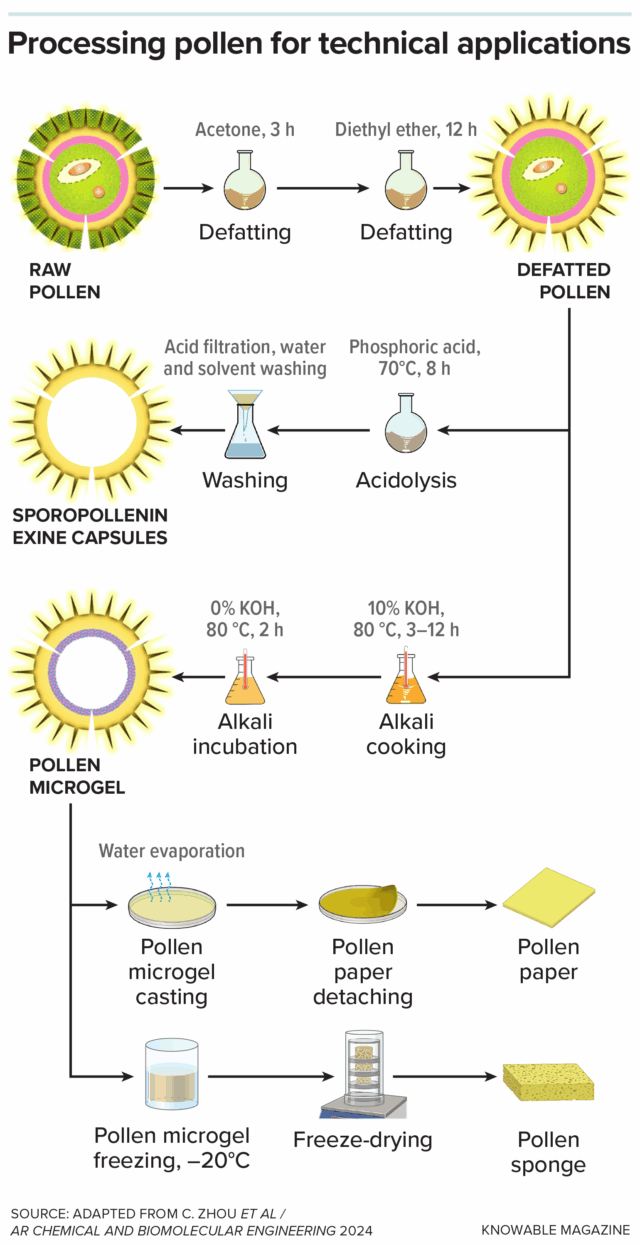
For technical applications, pollen grains are first stripped of their sticky coating inducing allergies, in a process called surge. Then, if they are treated with acid, they form hollow sporopollenin capsules which can be used to deliver medication. If they are treated instead with an alkaline solution, disgruntled pollen grains are transformed into a soft microgel which can be used to make thin films, paper and sponges.
Credit: Knowable magazine
This winnings of properties, according to Singaporean researchers, make the film based on pollen a perspective for many future applications: intelligent actuators that allow devices to detect and react to changes in their environment, portable health trackers to monitor heart signals, and more. And because pollen is naturally protected by UVs, it is possible that it can substitute for certain substrates photonically active in perovskite solar cells and other optoelectronic devices.


