USS Ford has seen war, fire and plumbing woes as it nears a record long deployment : NPR

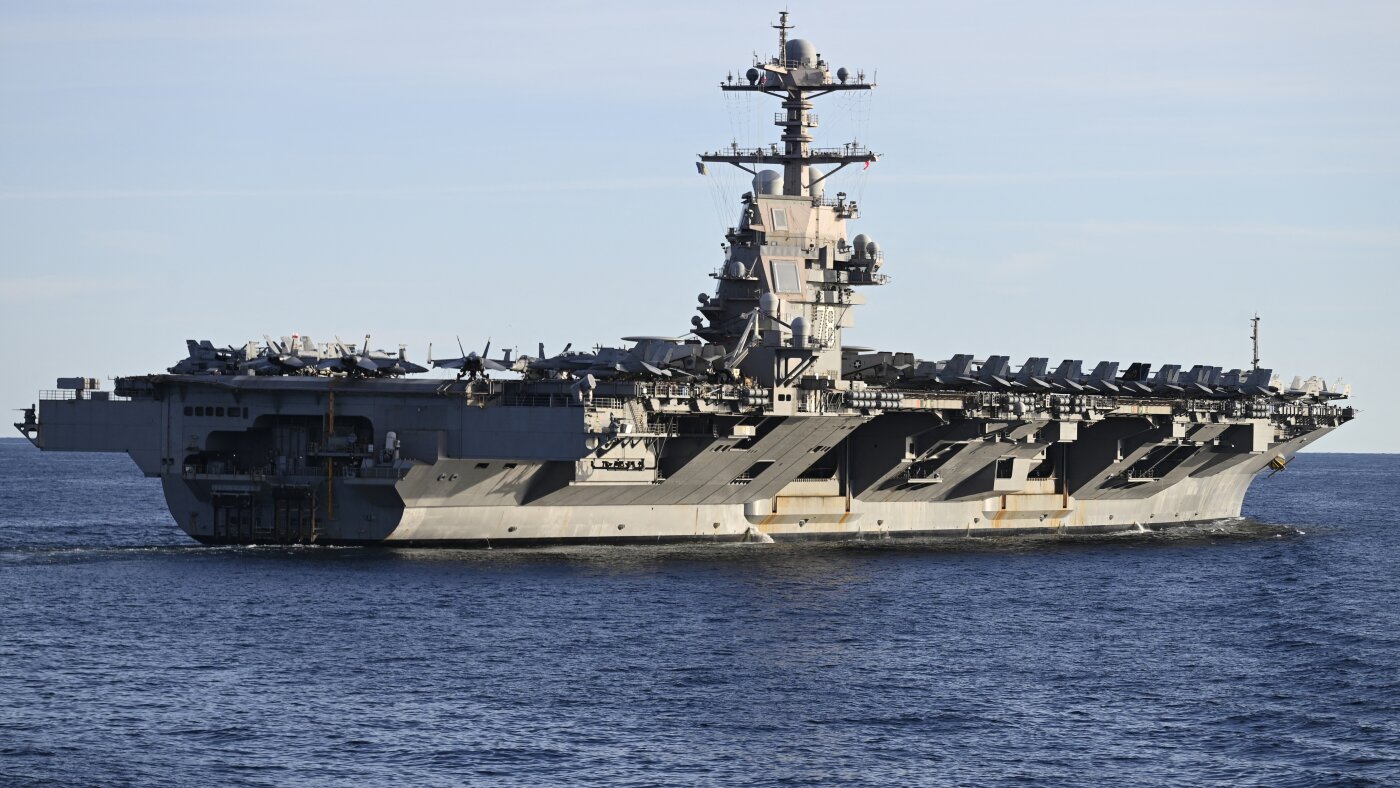

The world’s largest aircraft carrier, the USS Gerald R. Ford, sighted in the North Sea on September 24, 2025.
Jonathan Klein/AFP via Getty Images
hide caption
toggle caption
Jonathan Klein/AFP via Getty Images
After heading to the Red Sea to participate in operations against Iran, the USS Gerald R. Ford, America’s newest and largest aircraft carrier, is nearing a record deployment.
The Ford is on track to surpass the longest aircraft carrier deployment since the end of the Vietnam War. The USS Nimitz was kept at sea for 321 days before returning in 2021, but this deployment took place during the height of the COVID-19 pandemic and was designed as a way to quarantine ships by keeping them at sea.
As of Tuesday, the Ford was on day 266 of its current deployment, and it will be at least several more weeks before it returns. Vice Chief of Naval Operations Admiral James Kilby recently confirmed to lawmakers that the Navy does not expect the carrier to return until May.
Chairman of the Joint Chiefs of Staff Gen. Dan Caine acknowledged the mission expansion during a recent Pentagon briefing.
“The crews aboard this strike group have already endured months at sea to see their extended deployment. These exceptional Americans, all supported by their families, continue to stand guard, leading the fight against the enemy,” Caine said.
The Ford’s crew departed Norfolk, Virginia, on June 24, initially bound for the Mediterranean. They were redeployed to the Caribbean in November, where the Ford became part of the Trump administration’s operation to capture Venezuelan leader Nicolás Maduro in January. The carrier remained in the Caribbean as the United States continued to pursue sanctioned tankers and destroy small boats that the administration said were carrying drugs.
A few weeks later, the Ford was moved to the Middle East. It was first sent off the Israeli coast in the Eastern Mediterranean, before heading to the Red Sea for the start of the US-Israeli operation against Iran.
The crew was informed during the second week of February that they would be home in early March, according to the relative of a crew member who spoke to NPR. They did not wish to be identified for fear of reprisals against the sailor.
Less than 12 hours later, the crew learned that the carrier was being diverted from the Caribbean to the Mediterranean and that they likely would not return home until May. Some sailors are considering whether they want to stay in the Navy, according to the parent.
“If they’re worried about people wanting to re-enroll, that doesn’t help them stay,” the parent said.
In response to a request for comment, the Navy referred NPR to a February statement praising the Ford’s sailors for their “resilience, professionalism and sustained morale while serving far from home.”
A crew tested by war, fire and sewage
The long deployment constitutes a test for the Ford crew. Last week, U.S. Central Command reported that three sailors were injured when a fire broke out in the aircraft carrier’s laundry room. According to the Navy, the fire was not related to the fighting. Stars and Stripes initially reported that a sailor had been airlifted from the ship.
U.S. Central Command confirms the sailor is in stable condition and the fire remains under investigation. The other two sailors were allowed to return to duty. The New York Times reported that the damage was much greater than the Navy had reported and that 600 sailors were displaced from their bunks.
“They are tired. The fire has obviously impacted morale, degrading it even further after their last extension,” said the parent, after speaking with his sailor aboard the aircraft carrier. “The longer they are at sea, the more scheduled maintenance is postponed. And if they can’t do laundry, what impact will that have on sanitation? Coupled with the problem of toilets, this constitutes a huge hygiene problem.”
NPR previously reported problems with the ship’s sewage treatment system that left the crew without a working toilet. Navy memos show the problems worsened during the carrier’s first months of deployment. The breakdowns multiplied every day and the sailors on board had difficulty finding a solution. The Navy says the problems improved after that time, but it still receives an average of one maintenance call per day.
During a stop in Norfolk the day after the start of the bombing campaign in Iran, Senator Mark Warner, Democrat of Virginia, expressed concern about the objectives of the Iranian operation. He said sailors and their families deserved clearer justification for a mission that kept the Ford at sea for so long.
“It kind of adds insult to injury if you’re deployed now for months beyond what you expected and the sewer system isn’t working,” Warner said. “What kind of stress are we putting on these sailors?”
The cost of long deployments
The Navy prefers to limit aircraft carrier deployments to six to seven months. During the pandemic, the Navy essentially quarantined ships by keeping them at sea, with several ships remaining deployed for approximately 10 to 11 months.
Long deployments take a toll on both the ship and the crew. COVID-era crews called it “droning,” where sailors worked almost on autopilot while they completed tasks, slept and stood guard, said John Cordle, a recently retired Navy captain and human factors engineer. He specializes in the impact of fatigue and stress on board ships.
Cordle worked on a Navy report on the USS Harry S. Truman, which saw a crash and three F/A-18 Hornets lost during a turbulent eight-month deployment in the Red Sea that ended in June 2025. One of the problems they discovered was the pressure the crew was putting on to keep the ship running, while being under constant stress.
“There’s a difference between the positive attitude and the do-something attitude that was noted in the areas of the Truman report, where people are taking shortcuts,” he said.
The number of sailors also tends to decrease the longer the ship remains at sea, increasing the workload. When an aircraft carrier is deployed, the Navy makes sure it is almost fully equipped, but sailors leave throughout the deployment and are not replaced as quickly, which can leave the ship short-handed, Cordle said.
“Once the ship leaves port, the next ship in line becomes the first priority,” he said.
In January, Chief of Naval Operations Adml. Daryl Caudle said he did not want to see the USS Ford extended, citing the impact on the crew and their families, as well as the wear and tear on the ship. As the Navy built up a massive armada in the Middle East, Caudle issued a message claiming that the carrier was ready and that its problems with the sewer system and other maintenance issues were under control.
The next aircraft carrier, the John F. Kennedy, is still under construction. The new aircraft carrier was supposed to be delivered to the Navy last year, but is now scheduled for delivery in 2027, according to Huntington Ingalls Industries, which builds all Ford-class aircraft carriers at its Newport News, Virginia, facility. The late delivery put more pressure on existing aircraft carriers like the Ford.
A story of sewer problems on the Ford
Sewer problems date back to before the USS Ford was commissioned. The vacuum system used to discharge sewage into the ship’s plumbing was new on aircraft carriers, although it had been used by cruise ships.
The Ford was also designed without urinals, which use less water than toilets. Designers underestimated how much water the system would use, Cordle said.
The USS George HW Bush was the first aircraft to have a similar sewage system and it suffered massive breakdowns until 2013. The aircraft carrier was overhauled in 2015 to alleviate some problems. He spent two more months at the shipyard to install the fix.
The Navy did not respond to questions about how the crew is handling the problems. Memos reviewed by NPR indicate that the hull department used high-pressure water to remove calcium deposits. They were also cutting and replacing sections of pipe to keep the system running.
Once its deployment is complete, the USS Ford is expected to undergo a maintenance overhaul at the Norfolk Naval Shipyard, where it is expected to receive a similar upgrade to the USS Bush. Ironically, the Bush is the next aircraft carrier ready for deployment. It completed its pre-deployment exercises in Norfolk, after emerging from an 11-month maintenance period in late 2024, according to the Navy.


