How do the biggest black holes in the universe form? Ripples in spacetime provide a clue

When you purchase through links on our articles, Future and its syndication partners may earn a commission.
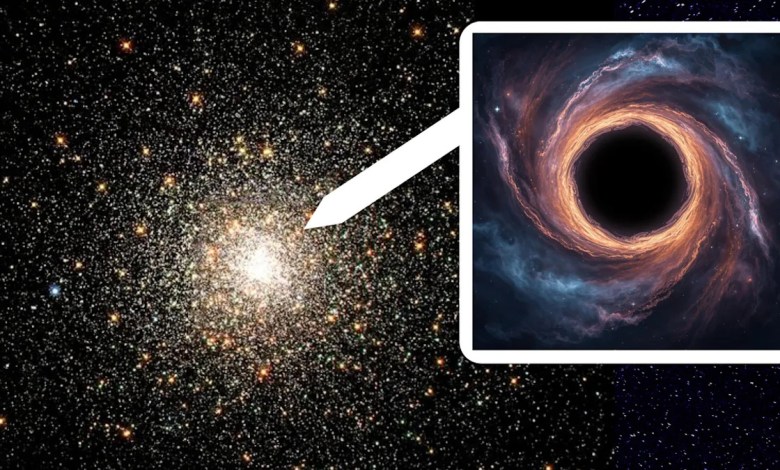
Scientists have discovered that the most massive black holes in the universe can form in the densest stellar environments, or globular clusters. It is in these clusters that violent collisions are frequent, suggesting a new chaotic origin for these cosmic titans of our cosmos.
Scientists have identified this potential birthplace of enormous black holes by studying ripples in space and time – unified into a single entity called space-time – otherwise known as gravitational waves. The waves were heard” on Earth by our highly sensitive gravitational wave detectors, the Laser Interferometer Gravitational-Wave Observatory (LIGO), KAGRA and Virgo. Gravitational waves were first predicted by Albert Einstein in 1915 as part of his theory of gravity, known as general relativity. They are launched when powerful events such as the collision and merger of black holes resonate the very structure of space-time.
The team behind this research analyzed 153 black hole merger detections contained in version 4.0 of the LIGO-Virgo-KAGRA Gravitational Wave Transient Catalog (GWTC4) in an effort to determine whether the heaviest black holes are formed by the repeated merger of successively larger black holes in dense stellar environments rather than directly from massive masses. star collapses.
“Gravitational wave astronomy now does more than count black hole mergers,” team leader Fabio Antonini of Cardiff University in the United Kingdom said in a statement. “This begins to reveal how black holes grow, where they grow, and what this tells us about the life and death of massive stars. This is exciting because we can use this information to test our understanding of how stars and clusters evolve in the universe.”
Watch out for the gap!
The team’s gravitational wave study of the origins of the most massive black holes revealed two distinct populations of black holes. Antonini and his colleagues discovered a population of lower-mass black holes that appear to have been born when massive stars died in supernova explosions and their cores underwent gravitational collapse. They also observed a population of black holes rotating in such a way that indicates they formed via a chain of hierarchical mergers between smaller black holes in dense star clusters.
It’s a revelation that shocked even the team behind this study.
“What surprised us most was how clearly high-mass black holes stood out as a distinct population,” said team member Isobel Romero-Shaw from Cardiff University. “Unlike the lower mass systems we analyzed, which generally rotated slowly, the higher mass systems are consistent with faster rotations, oriented in seemingly random directions. This is the exact signature we would expect if black holes repeatedly merged into dense star clusters. This makes the origin of the cluster much more convincing than it was in previous catalogs.”

Artist’s impression of two black holes rotating around each other before merging. | Credit: NASA
The team’s research suggests evidence of a long-theorized “mass gap” regarding life after stars die. This suggests that the most massive stars do not collapse to form black holes when they die, but rather experience a supernova explosion that completely obliterates them.
This suggests that there is a forbidden mass range for stellar-mass black holes born from collapsing stars, resulting from very massive stars being disrupted before a black hole can be created. The team estimates that this forbidden mass range begins with a mass 45 times that of the human body. sun. Higher-mass black holes, the researchers propose, are formed by mergers.
“In our study, we find evidence for the long-predicted pair instability mass gap – a range of masses in which stars should not leave behind black holes at all. Gravitational wave detectors have managed to find black holes that appear to be in or near this gap, which we identify at around 45 solar masses,” Antonini explained. “So the key question now is: Are these black holes telling us that our models of stellar evolution are wrong, or are they created in some other way?”
The team’s findings could also reveal more about the death throes of the largest stars and how stellar bodies behave when stuck in regions millions of times denser than the Sun’s cosmic backyard.
“The larger black holes in the current sample seem to tell us about cluster dynamics, not just stellar evolution,” Antonini said. “Above about 45 solar masses, the spin distribution changes in a way that is difficult to explain with normal stellar binaries alone, but this is naturally explained if these black holes have undergone previous mergers into dense clusters.”
These results were published Thursday May 7 in the journal Natural astronomy.


