Vast web of cold gas observed at the heart of the Milky Way

By Will Dunham
WASHINGTON, Feb 27 (Reuters) – Astronomers have produced the largest and most detailed map ever of the vast network of cold cosmic gas that lies at the heart of our galaxy, showing threadlike filaments resembling rivers of material flowing through space and sometimes converging into bright clouds where new stars are forming.
Using the Chile-based ALMA telescope, researchers examined the dynamics and chemistry of the central region of the Milky Way, a chaotic and energetic expanse that serves as a huge reservoir of raw material for making stars.
The region is home to dense clouds of gas and dust. The gas is mostly hydrogen, along with helium and others in trace amounts, all at freezing temperatures just above absolute zero. Stars form when clumps of gas and dust collapse under their own gravitational pull.
The supermassive black hole called Sagittarius A* resides at the center of the galaxy. It lies in a region measuring about 650 light years that was observed using ALMA as part of a project exploring how gas condenses into stars in the extreme environment of the galactic core. A light year is the distance traveled by light in a year, or 9.5 trillion kilometers.
“For the first time, we can track this gas continuously across the entire region at high resolution. This allows us to link large-scale gas flows to the dense clouds where stars form, and to see how stellar explosions and radiation reshape the environment,” said astronomer Ashley Barnes of the European Southern Observatory in Germany, one of the leaders of the research, published in six scientific articles in the journal Monthly Notices of the Royal Astronomical. Company.
The region, called the Central Molecular Zone, is about 26,000 light years from Earth. The mapped area, towards the constellation Sagittarius, is about three times the width of the Moon, as seen from Earth.
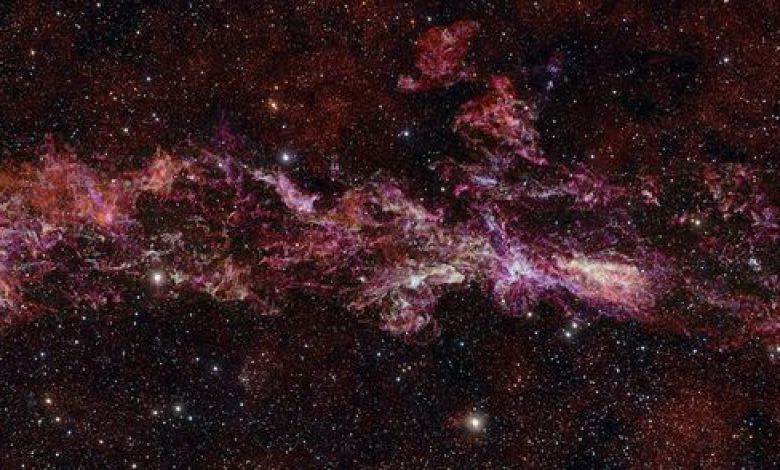
Researchers have released an image showing ALMA observations.
“Even though the image depicts a cold gas invisible to our eyes, when we assign colors to different (chemical) signals, it reveals a striking and complex landscape. There is a natural beauty in seeing the structure of our own galaxy presented in such detail. What makes it particularly powerful is knowing that these delicate-looking filaments are actually enormous structures, each spanning dozens of light years,” Barnes said.
In addition to gas filaments, the image shows large cavities and bubble-like structures carved out by powerful winds and supernova explosions from massive stars populating the region.
There is a star formation anomaly in this region.
“Although it contains enormous amounts of gas, it forms far fewer stars than expected. It’s one of the great puzzles of astrophysics,” said astrophysicist Steven Longmore of Liverpool John Moores University in England, another leader of the research, and the current project provides the data needed to “solve it.”
Unlike the Milky Way’s quieter spiral arms, like the one inhabited by the Sun, the dynamics of its central region appear to interfere with star formation.
“The pressures are an order of magnitude higher. The magnetic fields are stronger,” Longmore said.
“It is bathed in intense cosmic rays and radiation from the supermassive black hole and the young massive stars that live there. And the turbulence is “extraordinary. The gas is moving at very supersonic speeds, the clouds are colliding, and the gravitational forces from the black hole and surrounding stars are constantly shearing and stretching the gas,” Longmore said.
Sagittarius A* has a mass approximately 4 million times that of the Sun.
Researchers have sketched out the complex chemistry of the region. For example, they spotted silicon monoxide, produced in violent shock waves when gas clouds collide at supersonic speeds.
There are also complex organic molecules such as methanol, ethanol and acetone.
“These are particularly interesting because some of them are thought to be precursors to amino acids and other molecules essential for life,” Longmore said. “Finding them in such great abundance at the center of the galaxy tells us that even in these violent and extreme conditions, the chemistry of complexity – the chemistry that ultimately leads to biology – thrives.”
(Reporting by Will Dunham; editing by Daniel Wallis)


