Voting Integrity Messages Fight Misinformation in the Lab. But What about the Real World?


August 29, 2025
4 Min read
Voting integrity messages fight against disinformation in the laboratory. But what about the real world?
To say people exactly how the voting security functions help to overcome the disinformation of the elections, suggest experiences. But external experts wonder how it works well in the real world
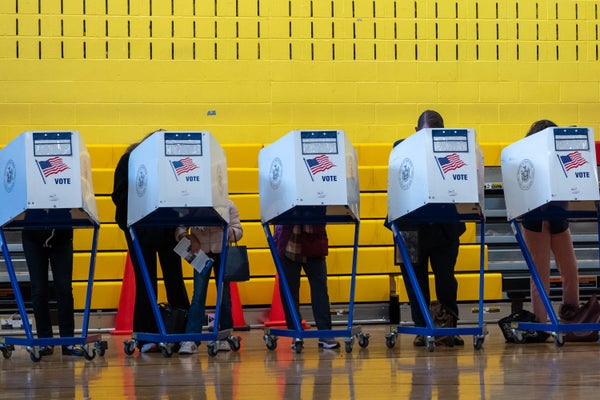
People voted on November 5, 2024 in New York.
Wang Fan / China News Service / VCG / Getty Images
Backings prevent false account ballots from the account. Elections managers regularly update the lists of voters. The voting machine software undergoes rigorous tests.
To say the voters that such simple facts help to fight against the disinformation of the elections, suggests a Scientific advances Study published Friday. In the survey, the researchers carried out messaging experiences with voters in the United States before the country’s mid-term elections in 2022 and Brazil after its presidential election of the same year. With false allegations of results of the simulated elections having appeared in January 6, 2021, the assault on the crowd on the American Capitol and re -elected US President Donald Trump having made false statements on postal bulletins and voting machines in August 2025, fighting against electoral lies, according to the authors of the new study.
“In the world, we have seen attacks on the integrity of the elections, and it has become clear that the defense of democracy requires demystify or effectively counter this disinformation,” explains the co-author of the study, Brian Fogarty, political scientist at the University of Notre-Dame. What he and his colleagues have found the most effective was “truly new information”, he says – as details on how voting security is ensured in the polls and in the counting of votes.
On the support of scientific journalism
If you appreciate this article, plan to support our award -winning journalism by subscription. By buying a subscription, you help to ensure the future of striking stories about discoveries and ideas that shape our world today.
“The facts are actually counting,” said professor of psychology Gordon Pennycook at Cornell University, who was not co-author of the study. “This is a very strong set of experiences, and I think that the conclusion is very important: the best way to help people with disinformation is to provide precise compensatory information.”
Although Pennycook and other external experts applaud experiences as excellent research, they question their relevance during real elections. In the United States and Brazil, these experts note that voters are immersed in a disinformation of the speech radio, television personalities and, in the case of the United States, even the current president of the country-and this hooks the information environment in which simple messages on election security can be delivered to them.
“We know that people are poorly informed. A single message in a sea of disinformation compensates for a diet of disinformation on social networks “, and cable television, asks the Nathan Walter communications researcher of the Northwestern University, who was not part of the study. “Eating a protein shake does not counter all the cheeseburgers you had.”
The study consisted of three experiences. The first two, which included nearly 3,800 respondents in the United States and more than 2,900 in Brazil respectively, tested attacks on the integrity of the votes of political leaders of the loss of parties against information on the “prebration” on the way in which the votes are guaranteed which have been preceded by warnings on conspiracy theories. As control measurement, some participants heard messages with information that was not linked to the vote. Prebunking has worked in the United States and Brazil, and was particularly effective among the most skeptical about electoral security and had a more sustainable effect. In particular, information on the security of the United States has been drawn from the section (now deleted) “rumor against reality” from the website of the cybersecurity and infrastructure of the US Department of Internal Security.
The third experience of 2,000 participants from the first experience tested pre -buying messages with and without the additional plot. In a somewhat surprising way, the messages of prebrit without the pre-act on the theories of the conspiracy were the most effective to counter disinformation, showed the study. Beliefs in false declarations increased from 19.5% in the 12.3% control group in the warning group and 10.6% among participants who received simple explanations without warning.
With the 2026 US Midterms Ahead, Voting Groups, Civil Society Organizations and Journalists can Take the Study’s Results as Pointers to Better Showing People The Lengthy Steps Take to Ensure That Voting Fraud is Unbelievably Rare in Elections, Writes Natália Bueno of Emory University published in Scientific advances.
“What seems to have importance is that this new factual information is provided in the Prébunking message, which helps people understand how the elections are secure,” said Fogarty. “We believe that these are encouraging results with important implications on how to communicate with the public on the integrity of elections in the future.” Although the Trump administration has deleted the DHS web page with facts on the integrity of the elections that has been used in one of the experiences, the study authors suggest that the voting rights groups could turn to the National Association of State Election Director or National Conference of State assembled for similar prebunking explanations.
The American federal government can no longer be considered as a good faith actor to ensure fair elections, however, says cognitive scientist Stephan Lewandowsky at Bristol University in England, highlighting the Trump administration administration for false elections of 2020. This even makes prebunking the most scientific less useful as a tool to stabilize democracy. was not involved in the new study. “The United States is now characterized the best as an emerging autocracy with a very tenuous grip on democracy and legality,” he adds.
It’s time to defend science
If you enjoyed this article, I would like to ask for your support. American scientist has been a defender of science and industry for 180 years, and at the moment can be the most critical moment of this two -centuries story.
I was a American scientist The subscriber since the age of 12, and that helped shape my way of looking at the world. Sciam Educates me and always delights me, and inspires a feeling of fear for our vast and magnificent universe. I hope that does this for you too.
If you subscribe to American scientistYou help make sure that our cover is focused on significant research and discoveries; that we have the resources necessary to report the decisions that threaten laboratories in the United States; And that we support the budding scientists who work at a time when the value of science itself does not become often again.
In return, you get essential news, Captivating podcasts, brilliant infographics, Maybe not miss newsletters, videos to watch, Difficult games and the best writings and reports in the scientific world. You can even Give someone a subscription.
There has never been more time for us to get up and show why science counts. I hope you will support us in this mission.


