VST Spots ‘Cosmic Bat’ in Southern Sky


Astronomers using ESO’s VLT survey telescope have captured a beautiful image of a large nebula, whose fascinating appearance resembles the silhouette of a bat.
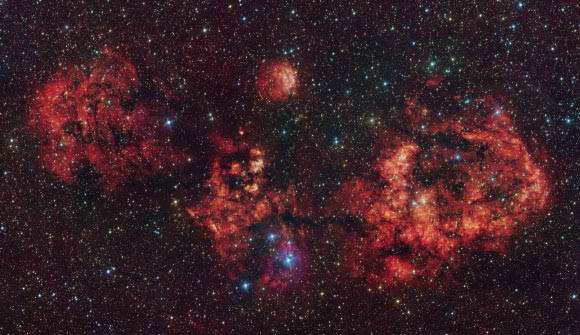
This VST image shows a cloud of gas and dust, shaped like a cosmic bat. The intense red glow comes from hydrogen atoms ionized by the intense radiation of young stars within the cloud. The most striking objects here are RCW 94, which represents the right wing of the bat, and RCW 95, which forms the body, while the other parts of the bat have no official designation. Image credit: ESO / VPHAS+ Team / VVV Team.
“Located around 10,000 light years away, this ‘cosmic bat’ flies between the southern constellations of Circinus and Norma,” ESO astronomers said in a statement.
“Spanning an area of the sky equivalent to four full moons, it appears as if it is trying to chase the point of light above it for food.”
“This nebula is a star nursery, a vast cloud of gas and dust from which stars are born.”
“The budding stars within it release enough energy to excite the hydrogen atoms surrounding them, causing them to glow with the intense shade of red seen in this eye-catching image.”
“The dark filaments of the nebula resemble the skeleton of our space bat.”
“These structures are accumulations of gas colder and denser than their surroundings, with dust grains that block visible light from stars behind.”
“Named after a large catalog of bright star-forming regions in the southern sky, the most prominent clouds here are RCW 94, which represents the right wing of the bat, and RCW 95, which forms the body, while the other parts of the bat have no official designation.”
This new image was captured with ESO’s VLT Survey Telescope (VST) at the Paranal Observatory in Chile’s Atacama Desert.
“The VST has the perfect capabilities to capture these large, scary creatures,” the astronomers said.
“Onboard is OmegaCAM, a state-of-the-art 268-megapixel camera, which allows the VST to image large areas of the sky.”
“This image was pieced together by combining observations through different filters, transparent to different colors or wavelengths of light.”
“Most of the bat’s shape, including the red glow, was captured in visible light as part of the Hα VST Photometric Survey of the Southern Galactic Plane and Bulge (VPHAS+).”
“Additional infrared data add a splash of color in the densest parts of the nebula and were obtained with ESO’s Visible and Infrared Survey Telescope for Astronomy (VISTA) as part of the VISTA variables of the Vía Láctea (VVV) survey.”
“Both surveys are open to anyone who wants to dive deep into this infinite pool of cosmic photographs.”