
Senior Science Journalist
The moment that Oceangate’s Titan submersible was lost has been revealed in footage recorded on the sub’s support ship.
Titan imploded about 90 minutes into a descent to see the wreck of the Titanic in June 2023, killing all five people on board.
The passengers had paid Oceangate to see the ship, which lies 3,800m down.
On board were Oceangate’s CEO Stockton Rush, British explorer Hamish Harding, veteran French diver Paul Henri Nargeolet, the British-Pakistani businessman Shahzada Dawood and his 19-year-old son Suleman.
The BBC has had unprecedented access to the US Coast Guard’s (USCG) investigation for a documentary, Implosion: The Titanic Sub Disaster.
The footage was recently obtained by the USCG and shows Wendy Rush, the wife of Mr Rush, hearing the sound of the implosion while watching on from the sub’s support ship and asking: “What was that bang?”
The video has been presented as evidence to the USCG Marine Board of Investigation, which has spent the last two years looking into the sub’s catastrophic failure.
The documentary also reveals the carbon fibre used to build the submersible started to break apart a year before the fatal dive.
Titan’s support ship was with the sub while it was diving in the Atlantic Ocean. The video shows Mrs Rush, who was a director of Oceangate with her husband, sitting in front of a computer that was used to send and receive text messages from Titan.
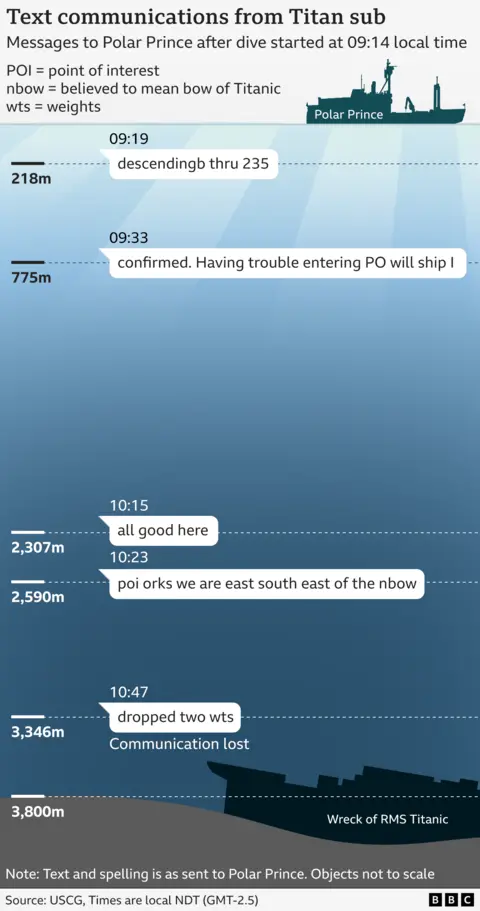
When the sub reaches a depth of about 3,300m, a noise that sounds like a door slamming is heard. Mrs Rush is seen to pause then look up and ask other Oceangate crew members what the noise was.
Within moments she then receives a text message from the sub saying it had dropped two weights, which seems to have led her to mistakenly think the dive was proceeding as expected.
The USCG says the noise was in fact the sound of Titan imploding. However, the text message, which must have been sent just before the sub failed, took longer to reach the ship than the sound of the implosion.
All five people on board Titan died instantly.

Prior to the fatal dive, warnings had been raised by deep sea experts and some former Oceangate employees about Titan’s design. One described it as an “abomination” and said the disaster was “inevitable”.
Titan had never undergone an independent safety assessment, known as certification, and a key concern was that its hull – the main body of the sub where the passengers sat – was made of layers of carbon fibre mixed with resin.
The USCG says it has now identified the moment the hull started to fail.
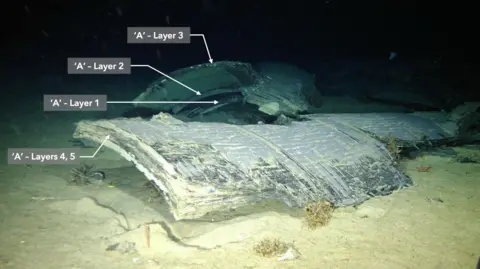
Carbon fibre is a highly unusual material for a deep sea submersible because it is unreliable under pressure. A known problem is that the layers of carbon fibre can separate, a process called delamination.
The USCG believes that the carbon fibre layers of the hull started to break apart during a dive to the Titanic, which took place a year before the disaster – the 80th dive that Titan had made.
Passengers on board reported hearing a loud bang as the sub made its way back to the surface. They said that at the time Mr Rush said that this noise was the sub shifting in its frame.
But the USCG says the data collected from sensors fitted to Titan shows that the bang was caused by delamination.
“Delamination at dive 80 was the beginning of the end,” said Lieutenant Commander Katie Williams from USCG.
“And everyone that stepped onboard the Titan after dive 80 was risking their life.”
Titan took passengers on three more dives in the summer of 2022 – two to the Titanic and one to a nearby reef, before it failed on its next deep dive, in June 2023.
 US Coastguard
Businessman Oisin Fanning was onboard Titan for the last two dives before the disaster.
“If you’re asking a simple question: ‘Would I go again knowing what I know now?’ – the answer is no,” he told BBC News.
“A lot of people would not have gone. Very intelligent people who lost their lives, who, had they had all the facts, would not have made that journey.”
Deep sea explorer Victor Vescovo said he had grave misgivings about Titan and that he had told people that diving in the sub was like playing Russian roulette.
“I myself warned people away from getting into that submersible. I specifically told them that it was simply a matter of time before it failed catastrophically. I told Stockton Rush himself that I believed that.”
After the sub imploded, its mangled wreckage was discovered scattered across the sea floor of the Atlantic.
The USCG has described the process of sifting through the recovered debris – and said clothing from Mr Rush had been found, as well as business cards and stickers of the Titanic.
 Supplied via Reuters / AFP
Later this year, the US Coast Guard will publish a final report of the findings from its investigation, which aims to establish what went wrong and prevent a disaster like this from ever happening again.
Speaking to the BBC’s documentary team, Christine Dawood, who lost her husband Shahzada and son Suleman in the disaster, said it had changed her forever.
“I don’t think that anybody who goes through loss and such a trauma can ever be the same,” she said.
The ripples from the Oceangate disaster are likely to continue for years – some private lawsuits have already been filed and criminal prosecutions may follow.
Oceangate told the BBC: “We again offer our deepest condolences to the families of those who died on June 18, 2023, and to all those impacted by the tragic accident.
“Since the tragedy occurred, Oceangate permanently wound down its operations and focused its resources on fully cooperating with the investigations. It would be inappropriate to respond further while we await the agencies’ reports.”
You can watch Implosion: The Titanic Sub Disaster on 9pm on Tuesday 27 May on BBC Two. It will also be available on the BBC iPlayer.

Get our flagship newsletter with all the headlines you need to start the day. Sign up here.


