James Webb telescope finds a warped ‘Butterfly Star’ shedding its chrysalis — Space photo of the week


Rapid facts
What is: A planet training record around a star
Where is it: 525 light years from there, in the Taureau constellation
When it was shared: August 29, 2025
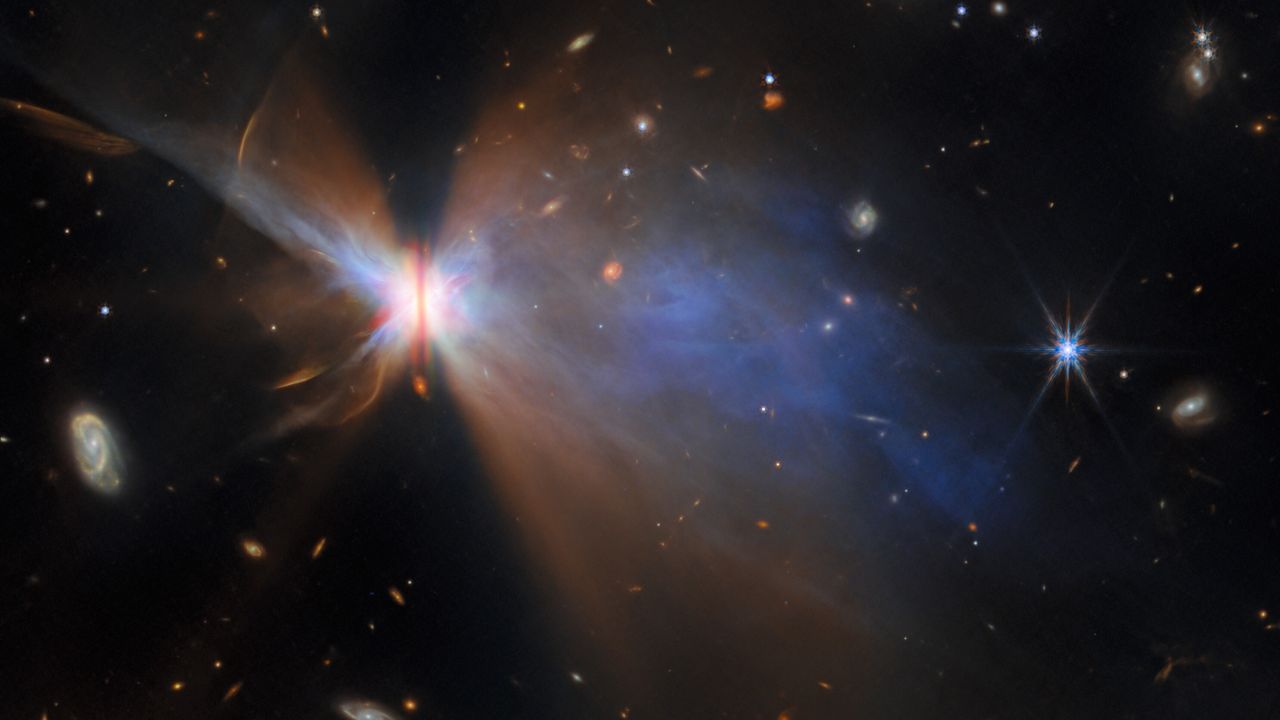
This new spectacular image of James Webb space telescope (JWST) shows a cocooned star in a massive disc of gas and dust. It is a protoplanetary disc – a ring of dense gas and dust surrounding a young star – where the planets are likely.
The star is iSS 04302 + 2247, better known as “Butterfly Star” because of how our view on board separates the brilliant nebula into two lobes.
The Star system is around 525 light years, in the Taurus stars formation region, or Molecular bull cloudwhich is in the Taurus constellation in the night sky. It is the star formation region closest to the solar system, and is rich in molecular hydrogen, dust and heavier elements of past supernovas. These are raw materials for new stars and planets.
A large part of this region is invisible for optical telescopes but is revealed in infrared light. This image is a combination of mainly optical data from the Archives of the Hubble Space Telescope and new infrared data from the almost infrared camera of JWST and the Middle Infrarouge Instrument (MIRI), the European Space Agency (ESA) wrote in a Image description.
In relation: Will the James Webb telescope lead us to extraterrestrial life? Scientists say we get closer that ever.
Miri revealed a dark and dusty path – the protoplanetary disc – which divides the nebula. It blocks the light of the star, while surrounding the gas and the dust dispersing the light of the star. It is enormous – around 40 billion miles (65 billion kilometers), or several times wider than the solar system, according to ESA.
The line of view determines what astronomers can learn images like this. In the front -to -face images of protoplanetary discs, scientists can sometimes see rings, spirals or gaps in which the planets are formed. With a view on board like this, it is possible to study the thickness of a protoplanetary disc and how dust is distributed around it, which are both essential to understand how the planets form and accumulate the mass. Here, the dust should settle towards the median plan, creating conditions where the grains can enlarge and develop in planetésimals.
The image comes from a paper published Last year in the astrophysical newspaper. The study revealed that the brightness of the nebula is changing, which suggests that the inner disc can be distorted or poorly aligned. It is an overview of the processes that may have shaped our own billion solar systems billions of years ago.
For more images of sublime space, consult our Archives week space photo.


