NASA’s Artemis II reveals why humans still love the moon


April 11, 2026
5 min reading
 Add us on GoogleAdd SciAm
Artemis II reveals why humans still love the moon
The triumph of NASA’s first crewed lunar mission in half a century reminds us what the Moon really means to Earth and why we return.
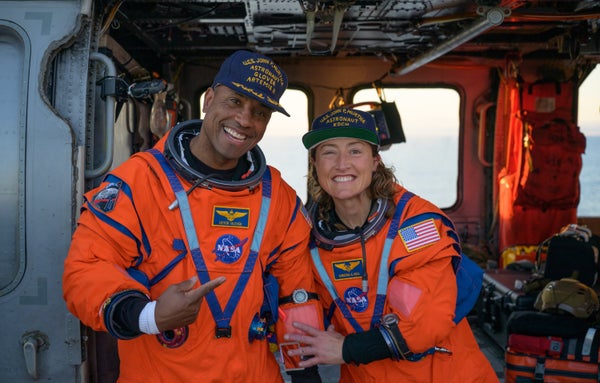
from NASA Artemis II astronauts Victor Glover (LEFT) and Christine Koch (RIGHT) pose aboard the flight deck of the USS John P. Murtha on April 10, 2026 after their successful landing and recovery in the Pacific Ocean off the coast of California. Glove, Artemis IIThe pilot of , is the first black astronaut to fly to the moon; Koch, a Artemis II mission specialist, is the first female lunar explorer.
NASA launched four astronauts on a pioneering journey around the Moon: the Artemis II assignment. Follow our coverage here.
from NASA Artemis II This mission heralds a new era of space exploration. It’s no exaggeration to say that, for many, the mission’s astronauts — Reid Wiseman, Victor Glover, Christina Koch and Jeremy Hansen — returned to Earth Friday as heroes. Their journey around the Moon and back transfixed the world as they traveled further from our planet than any human had ever done before.
“This is a huge moment for everyone,” NASA Administrator Jared Isaacman said during a broadcast by the space agency shortly after the Artemis II crew landed off the coast of San Diego. “This is just the beginning. We’re going to start doing this regularly again, sending missions to the Moon until we land there in 2028 and start building our base.”
NASA’s 10-day round-trip trip around the Moon was a milestone for U.S. human spaceflight, which has since languished in low-Earth orbit. Apollo 17 Commander Eugene Cernan spoke these parting words on the lunar surface in 1972: “We leave as we came and, God willing, when we return, with peace and hope for all mankind.” »
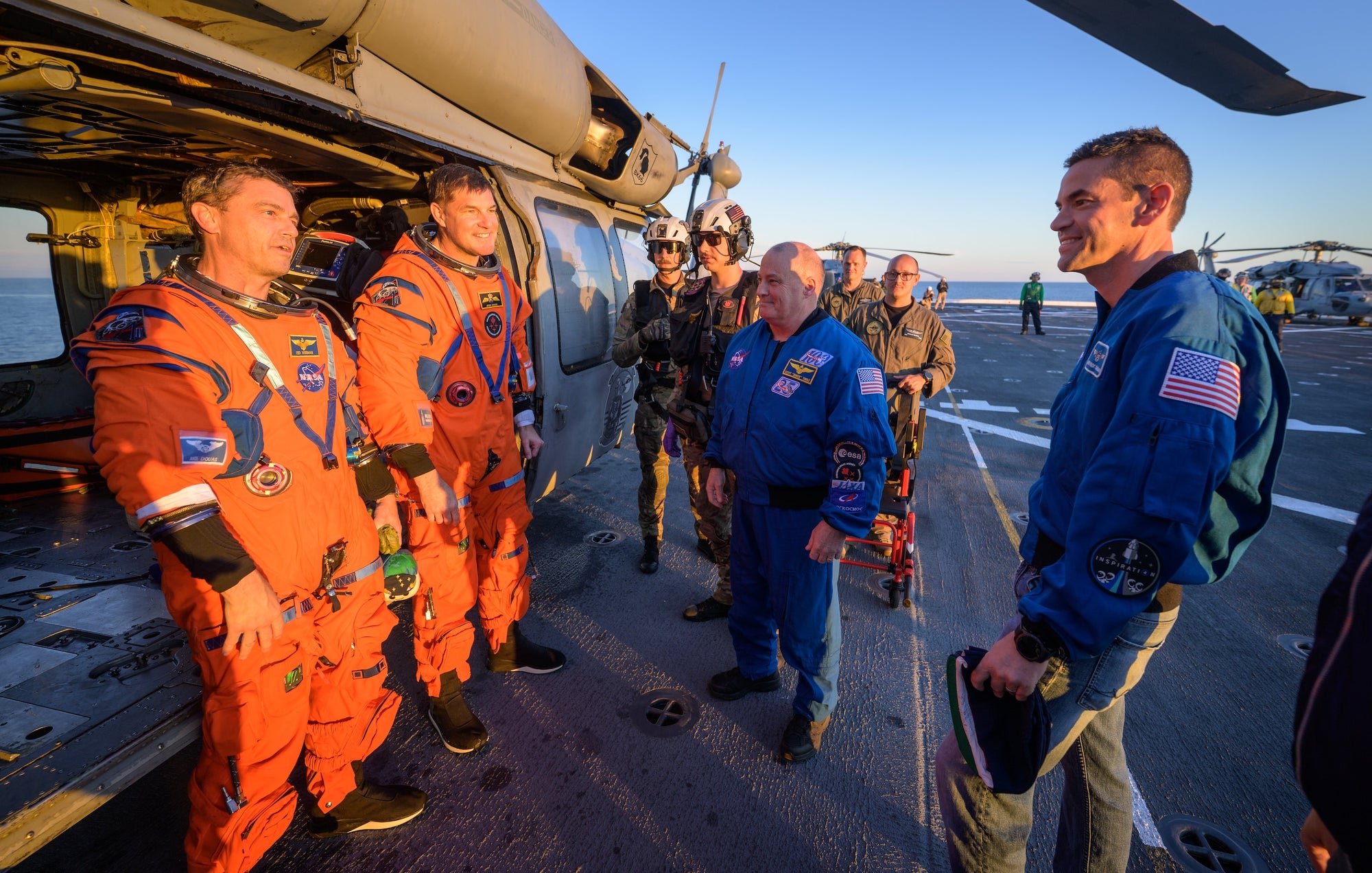
NASA astronaut and Artemis II Commander Reid Wiseman and Canadian Space Agency astronaut and Artemis II mission specialist Jeremy Hansen (both on the left) chat with NASA Administrator Jared Isaacman (RIGHT) and other personnel (center) aboard the flight deck of the USS John P. Murtha on April 10, 2026 after the successful landing of the mission and recovery of the crew.
On supporting science journalism
If you enjoy this article, please consider supporting our award-winning journalism by subscription. By purchasing a subscription, you are helping to ensure the future of impactful stories about the discoveries and ideas shaping our world today.
It took more than fifty years to come back. The reason is as cultural as it is political or technical. Peace and hope aside, the Apollo program was created by conflict, born of the technological advances of World War II and the extreme anxiety of the Cold War over the terrifying prospect of nuclear annihilation. Without competition from the Soviet Union, which had launched the first human into space and was pursuing its own lunar program, Apollo might have been abandoned – or even never existed. Apollo 11the American mission that landed humans on the Moon for the first time was the high point of the program. The Americans, momentarily satisfied and overwhelmed by the Soviet Union, left. Inertia allowed Apollo to continue six additional lunar missions before the program ended.
Today, collective Western anxiety over the rise of China’s space program and the desire to reach further into space beyond the Moon are pushing Artemis forward. If Artemis II had suffered serious problems or ended in failure, it would have delayed, but perhaps not ended, the ongoing US lunar thrust, as would the tragic fire which claimed the lives of the Apollo 1 the astronauts did not derail this program.
It remains to be seen how far Artemis will go. With Artemis, NASA aims to build a sustainable human outpost on the Moon, or even go to Mars. But none of this is taken for granted.
Much work remains to be done before astronauts set foot on the Moon in the 21st century. There is no guarantee that the US timetable for a human landing in 2028 or the Chinese target of 2030 will be met. But Artemis II is a positive signal. By once again sending crews close to the Moon and returning them safely to Earth, NASA has shown that some of the faded glory of the Apollo era can be revived – and perhaps yet surpassed.
But any geopolitical calculation does not fully account for all the motivations for going to the Moon, which are as innumerable as they are subjective.
On the one hand, we go there because it is there: an alien Everest to climb. On the other hand, we go there because of the thrill of exploration and discovery, feeding the curiosity that makes us human. Or maybe we’re going because lawmakers — foremost among them recent U.S. presidents and congressional appropriators — see the powerful allure of history, realizing they can become names for the ages while strengthening the aerospace industry. Indeed, perhaps we will, because of industry, mine the Moon or exploit its resources for profit, although this is unlikely to benefit the lives of everyone on Earth equally.
But I keep coming back to a reason so fundamental it’s almost ineffable, a pull as sure as the Moon’s gravity forcing the rise and fall of Earth’s tides.
It must be said: our lunar companion is today as much a part of our living world as any organism on Earth – and always has been.
Many cultures throughout history have stated this in both mystical and spiritual ways. Yet the lunar rocks brought back by the Apollo astronauts confirm this truth in the cold light of scientific rigor: the Earth and its Moon share an astronomically improbable origin. A Mars-sized protoplanet, Theia, accidentally collided with proto-Earth 4.5 billion years ago, with the Moon merging from a mixture of each body orbiting our injured world. You and all life on Earth have also eventually emerged from this historic collision. This means, among other things, that the atoms of Theia – essentially what became the moon – are in every cell of your body.
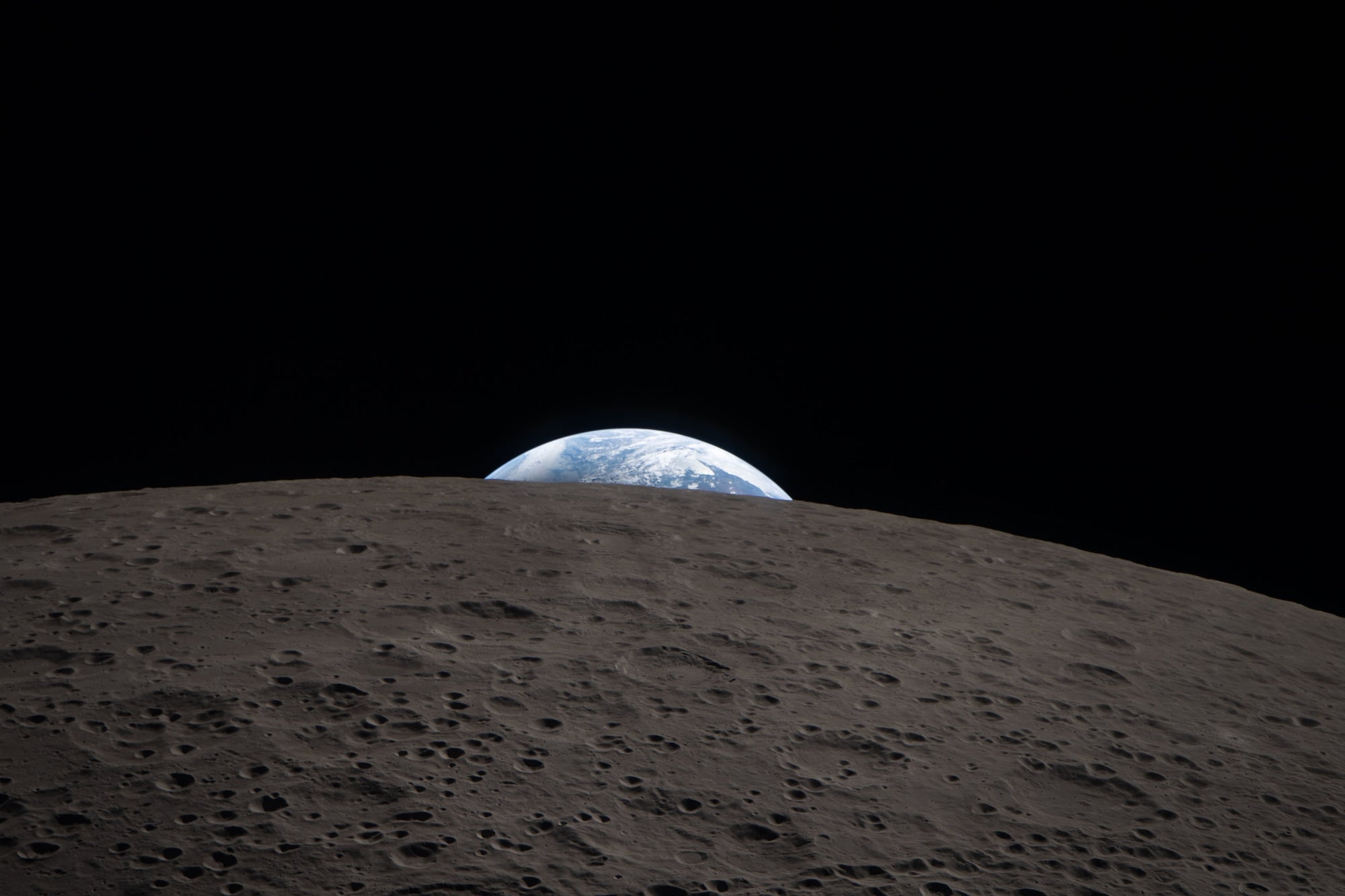
A sliver of distant Earth appears above the Moon’s limb in this view captured by the Artemis II crew during its record-breaking lunar flyby on April 6, 2026 aboard NASA’s Orion spacecraft.
Earth without the Moon would not be Earth as we know it, but an entirely different planet, perhaps devoid of life. Our lunar companion always stirs the oceans, stabilizes our seasons and gives rhythm to our days, marking the rhythms of our biosphere. Eons of otherwise lost cosmic history can be found within its craters, their silent secrets never erased by Earth’s wind and rain.
There may be myriad other ways, barely known, in which the Moon shapes life on Earth and the great cycles of our planet’s history. Perhaps, just like the Apollo crews before them, American and Chinese astronauts will spark a new era of world-changing discoveries with whatever they find during their lunar explorations.
Perhaps, indeed, the unifying message of this wonderful moment of “lunar joy” lies in the multiplicity of explanations for its existence – that the beautiful complexity of the moon’s influence on us all is too great and yet too subtle for a single answer to suffice.
The astronauts of Artemis II know that. Looking at the Moon from the closest anyone has seen it in half a century, they all spoke of their feelings of awe, wonder and joy, as well as their nostalgia for Earth. Seeing the blue-green jewel of our tiny, distant planetary home after an arc around the far side of the Moon – a maneuver that had been triggered by a six-minute “translunar injection burn” of Orion’s main engines in Earth orbit – mission specialist Christina Koch put it particularly succinctly:
“We hear you can look up and see the moon right now. We see you too,” she said by radio to NASA’s Mission Control Center in Houston. “When we burned this burn towards the Moon, I said that ‘we are not leaving the Earth, but we are choosing it.’ And it’s true. We will explore. We will build. We will build ships. We will come back. We will build scientific outposts. We will drive rovers. We will do radio astronomy. We will start companies. We will support the industry. We will inspire. But in the end, we will always choose Earth. We will always choose each other.


