Watch a robot swarm “bloom” like a garden


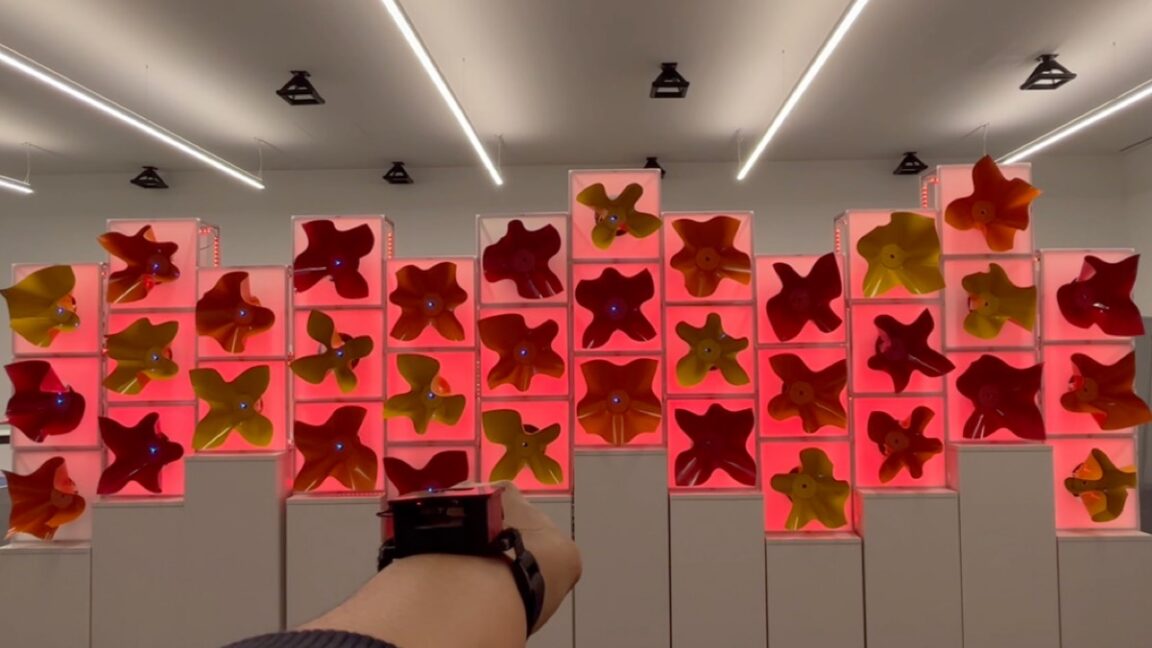
Researchers at Princeton University have built a swarm of interconnected mini-robots that “bloom” like flowers in response to changing light levels in an office. According to their new paper published in the journal Science Robotics, such robotic swarms could one day be used as dynamic facades in architectural designs, allowing buildings to adapt to changing climate conditions and interact creatively with humans.
The authors were inspired by what we call “living architectures”, such as beehives. Fire ants provide a classic example of this type of collective behavior. A few well-spaced ants behave like individual ants. But pack some close enough together and they behave more like a single unit, exhibiting both solid and liquid properties. You can pour them into a teapot like ants, as Goldman’s lab demonstrated several years ago, or link them together to build floating towers or rafts—a handy survival skill when, say, a hurricane floods Houston. They also excel at regulating their own traffic flow. We almost never see ant traffic jams.
Naturally, scientists want to imitate such systems. For example, in 2018, researchers at Georgia Tech built ant-like robots and programmed them to dig into 3D-printed magnetic plastic balls designed to simulate wet soil. Swarms of robots that can efficiently dig underground without getting stuck would be extremely beneficial for mining or disaster recovery efforts, where the use of humans might not be feasible.
In 2019, scientists discovered that flocks of wild jackdaws changed their flight patterns depending on whether they returned to roost or grouped together to chase predators. This work could one day lead to the development of autonomous robotic swarms capable of modifying their interaction rules to perform different tasks in response to environmental cues.
The authors of the latter paper note that plants can optimize their shape to get enough sunlight or nutrients, thanks to individual cells that interact with each other via mechanical and other signals. In contrast, architecture designed by humans is largely static, composed of rigid fixed elements that hinder the ability of building occupants to adapt to daily, seasonal, or annual variations in climatic conditions. There have been only a few examples of applying swarm intelligence algorithms inspired by flocked plants, insects and birds to the design process to achieve more creative structural designs or better energy optimization.


