“We Have Covered Events No Human Can Bear”


World
/
A day for Gaza
/
February 3, 2026
Gaza’s journalists have traded their lives to tell a truth that much of the world still does not want to hear.
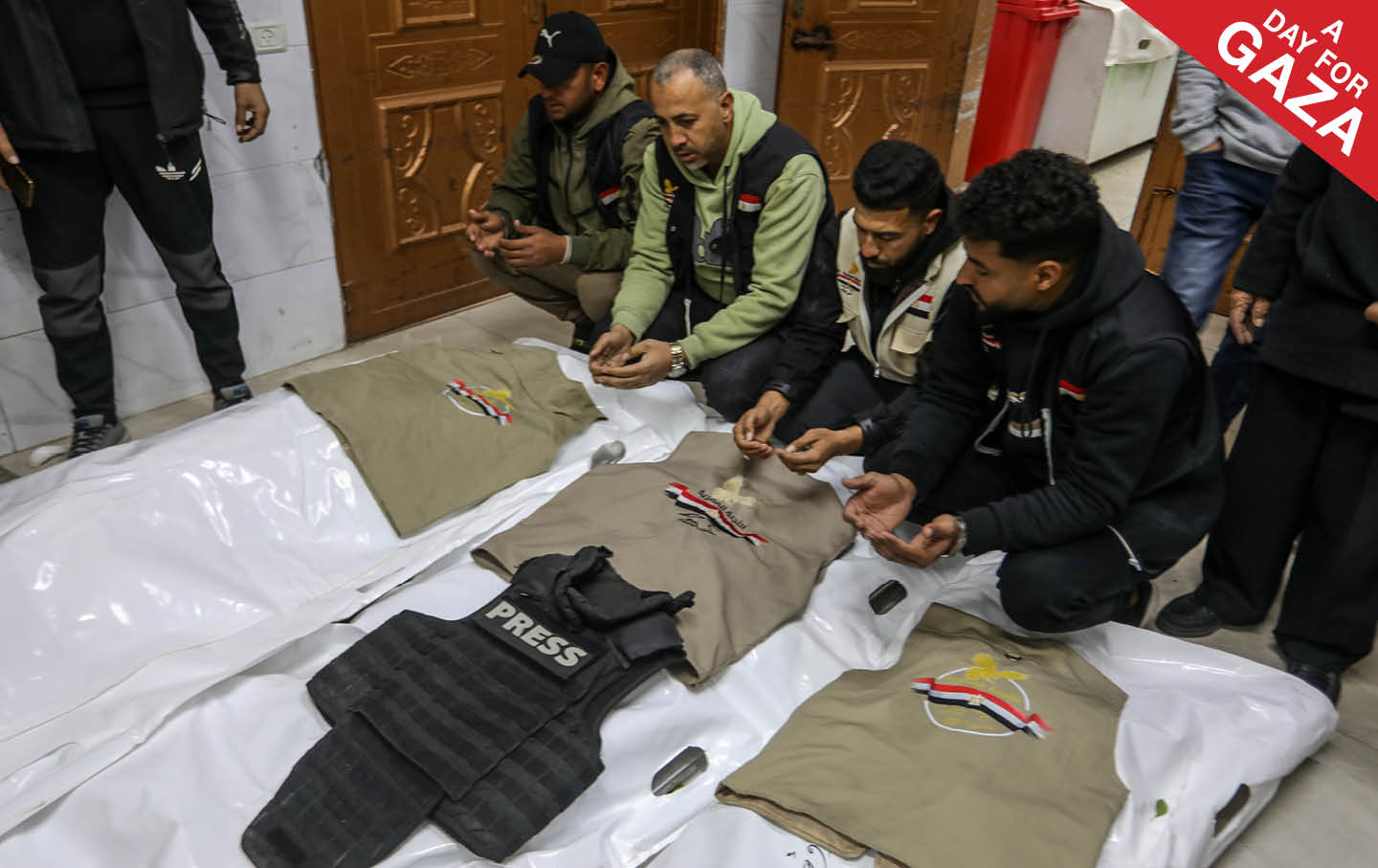
Relatives and colleagues bid farewell to Palestinian journalists Abdel Raouf Shaath, Mohammed Qashta and Anas Ghoneim, killed in an Israeli airstrike.
(Abed Rahim Khatib/Picture Alliance via Getty Images)
This piece is part of A day for Gazaan initiative in which The Nation entrusted its website exclusively to voices from the Gaza Strip. You can find all the works in the series here.
Can you understand what it means to be a journalist in Gaza? Going months without holding your children just because their proximity to you could get them killed?
Before the war started, I worked as an English-speaking correspondent in Gaza. Above all, I looked for success stories: the ambition that shone in the eyes of our children, the enduring cultural traditions of the Gaza Strip and its monuments. We were a people exhausted by the lack of choice. But we were determined to survive, eager for a better future, our souls nourished with hope and love.
Then, overnight, in October 2023, I was pushed to become a war correspondent. Some of my first reports came from inside the emergency room of Al-Shifa Hospital, where I encountered a never-ending procession of victims. I shuddered at the sound of bombings and belts of fire, I trembled at the sight of a charred child, a wounded woman, a mutilated boy.
Shortly after, the army declared that northern Gaza had been transformed into a military zone – and I was forced to make a decision. A car was ready to take me south where I could continue doing more formal reporting, protected by the supposed security of my press jacket and my profession. This would mean abandoning my home and family indefinitely, their fate being completely unpredictable. But there was another option. I could stay, stand in front of a camera without any protection and explain to the world what was happening to us. I told them I wasn’t leaving.
Let me tell you something I’ve never admitted: I knew, at that moment, that the world was going to betray us. I knew that everything that had happened and everything that was going to happen would not be enough to move the people of the world. My heart wrings with pain because of what I endured in the North. And yet, here I am, after all these long months, still pleading with the world, still proclaiming my belief in your humanity.
Since the start of the genocide, Israel has systematically targeted journalists. It has destroyed our images, strangled our voices and uprooted our words. These transgressions against Palestinian journalists have only one goal: to allow Israel to carry out its plans in the dark, giving its army carte blanche to commit whatever bloody atrocities it desires.
Each of the 245 journalists killed by Israel had a life, a family, a dream, ambitions. Some were awaiting the birth of their child, others were killed when they barely knew their newborn. My friend Yahya Sobeih was murdered hours after spending an afternoon handing out candy to celebrate the birth of his daughter. Mohammed Salameh planned to marry his fiancée, Hala, just days after his assassination. Here, death swallows us whole. One by one, our colleagues and friends are falling like leaves in autumn.
Current number
Remember the morning of August 25, 2025: the Israeli army bombed the Nasser medical complex. Two consecutive taps: a “double-tap”. The first cost the lives of journalists, civilians and doctors who had taken refuge in the hospital. The second strike anticipated the arrival of rescue teams and other journalists who had rushed to the site. This was a coordinated crime that took place before the eyes of the entire world. Twenty civilians were murdered and countless others injured, including five of my colleagues, including my friend Mohammed Salameh.
How can this world live with the reality that there is an entire people whose hospitals are continually bombarded, hospitals that are overflowing with doctors, patients, those who have been forced to take refuge within its walls? Hospitals that hold journalists forced to document, moment by moment, the realities of a brutal, dirty, greedy war? Have our souls really become so cheap?
Shortly after Al-Ghad TV broadcast live the second strike on the Nasser Medical Complex, its correspondent in Gaza, Ibrahim Qanan, took to Instagram to explain the predictability of these types of attacks. “Israel has very precise weapons,” he wrote. “They undoubtedly knew that members of the Civil Defense were present in the building when it was struck. But, in their view, no one stands in their way. Israel is committing war crimes directly simply because they understand that no one in the international community is willing to confront them.”
Journalism is supposed to be the fourth estate. The safety of its practitioners is considered sacred, even in times of war or conflict. But in Gaza, journalists benefit from no protection. Instead, they were left to die while they broadcast their daily appeals.
Popular
“Swipe left below to see more authors”Swipe →
Our practice has not fundamentally changed since the ceasefire. We journalists continue to work under immense pressure, enduring the psychological strain caused by repeated military attacks. Our psyche is now more familiar with war than with peace.
This is how Abdullah Miqdad, Gaza correspondent for Al Arabi Televisiondescribed our current condition:
“A journalist’s constant psychological fear is that escalation and war could return at any time. Journalistic life cannot return to what it was before the war. The nature of media coverage has changed. It now encompasses all the catastrophic consequences that war has left behind, expanding the way in which daily life itself is reported and examined.”
In the midst of this precarity, we continue to offer our bodies as proof that the danger we face is real. Many of us have lost family members. Some of us carry these shrouds with us every day. Others have already written our wills, anticipating our death at any moment. At night we forgo sleep for the company of murder and destruction; we will head towards danger. Atop the rubble, we share images of charred bodies, wading through flesh and the smell of blood.
It is not heroic: we persist because there is no alternative. We have even given up the safety of our own families in order to protect the truth.
“Two years of war have left an indelible mark,” journalist Ibrahim al-Khalili told me. “We have covered events that no human being can bear. »
How can a person return to normal after witnessing every intimate detail of this genocide? What could heal such a soul?
Perhaps the greatest lesson we learned in trading away our lives is that the world is truly unconvinced by our words, unmoved by our images.
Even after all this time, many international news organizations continue to treat our work as if it were unreliable, as if we were unbelievable witnesses. The truth about our own murder, our own annihilation, can only be verified if it is revealed by a voice parachuted into our desecrated gang. Our words, soaked in blood, are insufficient; only foreign journalists can truly tell our story.
Amid this hypocrisy, seeking to minimize their fiscal responsibility, most international news agencies have turned to another type of exploitation. They replaced official employees with contractors, paid monthly or per report or image, and waived the legal liability that guarantees our protection. Our bodies are sacrificed to protect institutions that don’t even believe us. If these news organizations continue to rise to prominence without honoring our work and our blood, then surely we have the right to decide who tells our story – who carries our cause, who carries our words to the world.
When one of our colleagues is martyred, a cloud of grief falls over us all and our strength falters. We learned to know this profession as a subjugation.
There is a collective understanding among Gaza’s journalists that those who perished will not be the last and that any of us could be next. Every day, while reporting, I think of my family, of my destiny. I wonder if my name will soon be added to the list of martyrs simply because I insist on writing, recording, sharing the realities we experience. What is being done to us is a stain on a world complicit in our annihilation. But nothing can be taken from us anymore.
Aya Jouda, field correspondent Tasnim Newsspent years documenting the siege of Gaza. Her perseverance, she says, comes from the conviction that “witnessing these events is a human, ethical and national duty.”
“Gaza is not a headline, nor a statistical report. It is human lives destroyed under the bombings and the blockade,” she said. “Yes, when the outside world shows solidarity, it gives me hope. It’s proof that our voices can reach beyond those boundaries. But when that solidarity is absent, our sense of betrayal deepens and with it, our determination to continue speaking the truth, no matter the dangers we face.”
Like my colleagues, I can no longer be arrested. There are days when we feel like our lives are going to be wasted; our efforts are wasted, our will to persist is misspent. We are sustained, however, by the fragile faith that, perhaps, overnight, the world can end this ruthless war. We await this day with the hope that our lives can one day be lived as they should be: in love and in peace.
From Minneapolis to Venezuela, from Gaza to Washington, DC, we live in a time of staggering chaos, cruelty and violence.
Unlike other publications that reproduce the opinions of authoritarians, billionaires and corporations, The Nation publishes stories that hold the powerful accountable and center communities too often denied voice in national media – stories like the one you just read.
Every day, our journalism weeds out lies and distortions, contextualizes developments that are reshaping politics around the world, and advances progressive ideas that fuel our movements and incite change in the halls of power.
This independent journalism is only possible with the support of our readers. If you would like more urgent coverage like this, please donate to The Nation Today.