New Cannibalistic Robots Consume Other Machines to Grow and Heal on Their Own


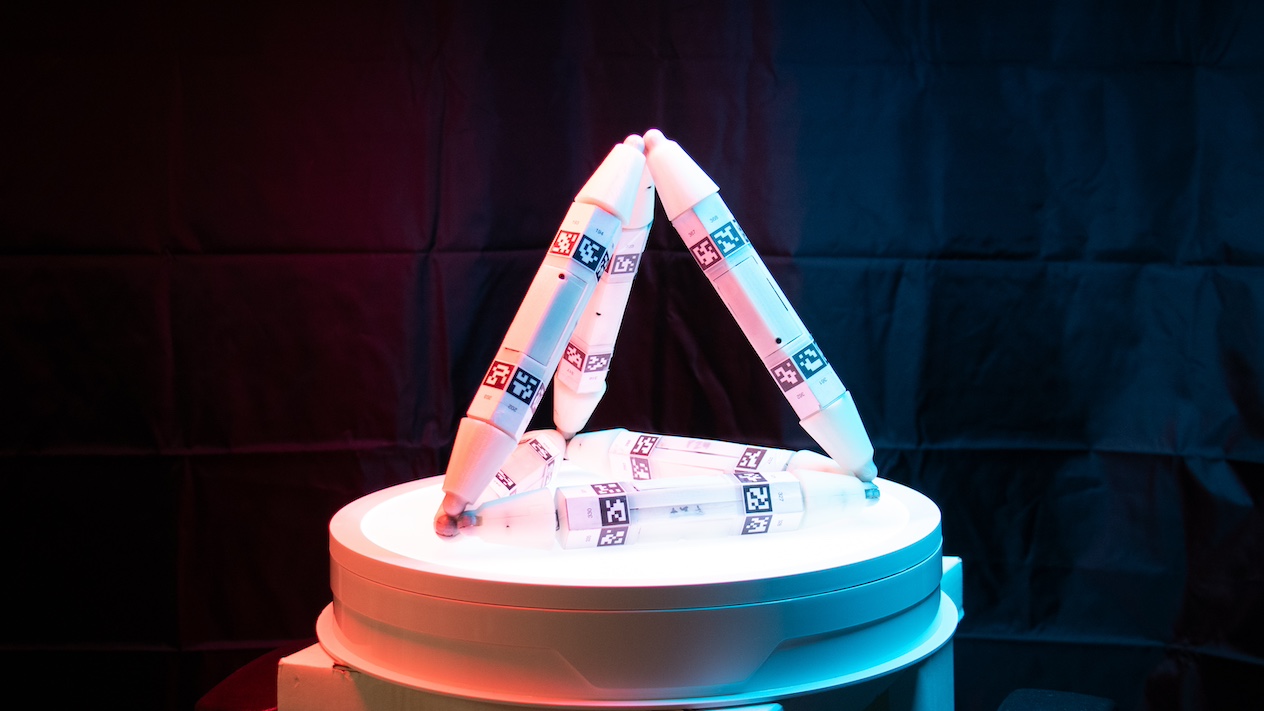
There is still a long list of things that separate robots and living beings, but a new study suggests that the list has become a little shorter. The development of robots that “grow”, “heal” and adapt their bodies to their environment, researchers from the University of Columbia have shown that robots can become greater and better by “consuming” other robots – a process that resembles metabolism in a living being.
This “robot metabolism”, described in an article published today in Scientific advances,, Allows a robot to integrate the material of other machines into its body, representing an important step towards the efficiency of more resilient and self -sufficient robots.
“Real autonomy means that robots must not only think for themselves, but also maintain themselves physically,” said Philippe Martin Wyder, study author and researcher at Columbia Engineering and the University of Washington, in a press release. “Just as organic life absorbs and integrates resources, these robots develop, adapt and repair with the help of environmental materials or other robots.”
Find out more: Humans and our alarming fear of robots
Brains and body of robots
Today’s robots already think a bit like living things. Indeed, as artificial intelligence (AI) regularly progresses the ability of robots to think and learn, the boundaries between robotics and increasingly vague biology. However, there are still biological functions that robots cannot reproduce.
While organic life forms are open systems, absorbing materials in their environment to develop and cure, robots are closed systems, limiting their ability to become truly autonomous.
“Robots spirits have advanced a giant in the past decade through automatic learning, but the robots are always monolithic, non -adaptive and non -specbles,” said Hod Lipson, another study author and professor at Columbia Engineering, in a press release. “Biological bodies, on the other hand, are all a question of adaptation – life forms can develop, cure and adapt. In large part, this capacity stems from the modular nature of biology which can use and reuse modules (amino acids) from other forms of life. ”
Find out more: Have the AI models obtaining the theory of the mind?
Simple robots for the “robot metabolism” complex
To bring the robots to metabolize – to make meals from the parts of other robots – the researchers designed the bond of the farm, an extensible and contractable robotic bar equipped with a magnetic connector at each end.
By developing and contracting, an individual farm link can crawl both in front and back on a surface. But by connecting to other lattice bonds to create complex structures (and by strategically expanding and contracting individual trellis links in these complex structures to move), a construction of these robots can crawl much more dynamically.
In a series of tests, researchers have shown that trellis connections could connect together, then adapt, almost as a living organism, consuming other farm connections. Starting with six independent links, they looked at the robots self -assembly in two forms with two dimensions – a triangle and a three -point star – then in a three -dimensional tetrahedron. In some tests, these structures have increased by engulfing new bonds of farms and incorporating them into their system. In others, they healed by repairing their connections and deleting and replacing the links of defective farms with newly consumed links.
According to researchers, firm links show that the best way to build solid and autonomous robots is to stick to simpler machines that can be organized in much more complicated assemblies – assemblies that can adapt as life can, by metabolizing resources in the world around them.
“While transmitting us more and more our lives to robots – driver -free cars with automated manufacturing, and even exploring defense and space – who will take care of these robots?” Lipson added in the press release. “We cannot count on humans to maintain these machines. Robots must finally learn to take care of themselves. ”
Find out more: How will we know when artificial intelligence will be sensitive?
Sources of articles
Our writers at Discovermagazine.com Use studies evaluated by high -quality peers and sources for our articles, and our publishers examine scientific precision and editorial standards. Review the sources used below for this article:
Sam Walters is a journalist covering archeology, paleontology, ecology and the evolution of Discover, as well as an assortment of other subjects. Before joining the Discover team as a deputy editor in 2022, Sam studied journalism at the Northwestern University in Evanston, Illinois.


