Webb Spots Cluster of Young Massive Stars in Lobster Nebula


Astronomers using the NASA / ESA / CSA James Webb space telescope took a nice new image of the Pismis 24 cluster, which resides in the heart of the lobster nebula nearby.
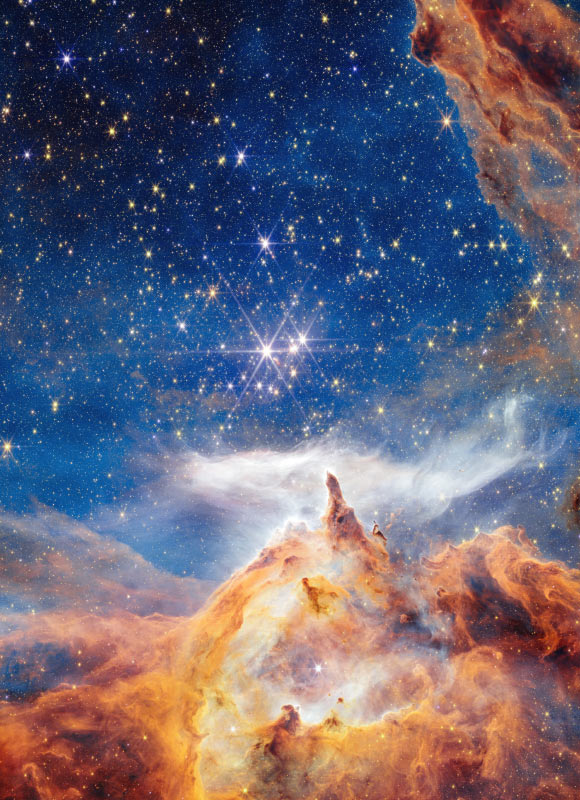
This webb image shows Pismis 24, a young group of stars some 5,500 light years in the Constellation of Scorpius. Image credit: NASA / ESA / CSA / STSCI / A. PAGAN, STSCI.
Pismis 24 is located around 5,500 light years in the Constellation of Scorpius.
Part of the lobster nebula, this star cluster houses some of the largest stars ever discovered.
“The house of a dynamic stellar nursery and one of the sites closest to the massive birth of stars, Pismis 24 provides rare information on large and massive stars,” webb astronomers said in a press release.
“This region is one of the best places to explore the properties of young hot stars and how they evolve.”
“At the heart of this sparkling group is the brilliant 24-1 piedis.”
“It is in the center of a tuft of stars above the shredded orange peaks, and the highest arrow points directly to it.”
“Pismis 24-1 appears as a unique gigantic star, and it was once considered the most massive known stars.”
“It is actually made up of at least two stars, although they cannot be resolved in the webb image.”
“At 74 and 66 solar masses, respectively, the two known stars are still among the most massive and brightest stars ever seen.”
This new image of the Nircam Instrument (Near Infrared Camera) from WebB reveals thousands of stars of jewelry of varying sizes and colors.
“The biggest and the brightest with the six -point diffraction tips are the most massive stars of the cluster,” said astronomers.
“Hundreds to thousands of small members of the cluster appear as whites, yellow and red, according to their stellar type and the amount of dust by consecrating them.”
“Webb also shows us tens of thousands of stars behind the cluster that are part of the Milky Way Galaxy.”
Super hot infant stars – sometimes the temperature of the sun – explode the burning and punishing radiation of winds that sculpt a cavity in the wall of the stars formation nebula.
This nebula extends far beyond Nircam’s field of vision.
Only small portions are visible at the bottom and at the top right of the image.
“Hot and ionized gas banks flow from the ridges of the nebula, and vaporous sails of gas and dust, illuminated by the light of the stars, float around its imposing peaks,” said the researchers.
“The dramatic arrows have moved away from the brilliant wall of gas, residing with incessant radiation and winds.”
“They are like fingers pointing to the hot stars that have carved them.”
“The ferocious forces shaping and compressing these arrows cause the formation of new stars.”
“The highest arrow extends over about 5.4 light years from its point at the bottom of the image.”
“More than 200 of our solar systems on Neptune orbit could integrate into the width of its tip, which is 0.14 light years.”
“In this image, the cyan color indicates hot or ionized gas hydrogen heated by young massive stars.”
“Dust molecules similar to smoke here on earth are represented in orange. Red means cooler and denser molecular hydrogen. The darker the red, the more dense the gas. Black designates the densest gas, which did not emit light. Vaporous white characteristics are dust and gas that diffuse stars. ”


