
Society
/
StudentNation
/
September 30, 2025
The annual list from U.S. News and World Report is helpful for affluent families and those with the resources to compete for a spot at elite universities. What about everyone else?
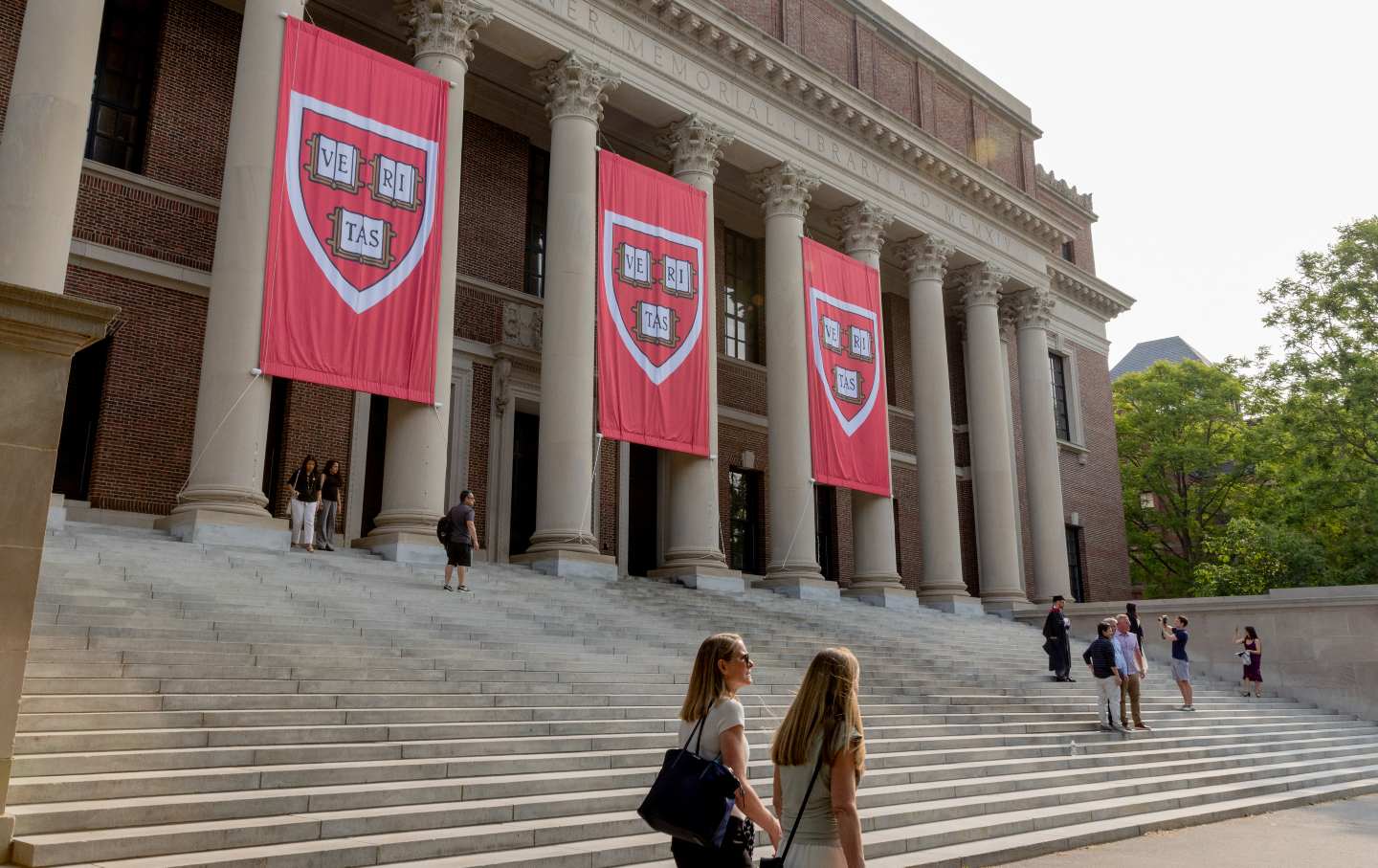
The Widener Library on the Harvard Campus in Cambridge, Massachusetts.
(Cassandra Klos / Getty)
The ostensible arbiter of college rankings—U.S. News and World Report—has released its annual list of the top institutions of higher education. The 2026 report is predictable, with minor changes, ranking elite Ivy League schools like Princeton and Harvard in their top five.
The U.S. News ranking isn’t a goblet of fire from which colleges are cryptically chosen. It claims to base its choices on 17 different categories, including retention rates, financial resources, and standardized test scores. Most universities send in their own data, but statistics from the US Department of Education are also taken into account. In the 19th century, it was initially the responsibility of the Bureau of Education—the Department’s predecessor—to publish annual reports ranking institutions of higher education. That practice ended in 1890.
In 1983, U.S. News published its first college ranking. For nearly 45 years, the list has shaped the perception of higher education as we know it, impacting application rates, enrollment rates, and marketing efforts by universities. For the past eight years, my school UCLA has been leveraging its “#1 public research university” rank placed upon it by U.S. News, publicizing it through banners on campus and online posts to boost applicant appeal (this year UCLA moved to number 2, falling short to UC Berkeley).
But while many rely on the ratings for guidance on where to apply, many others question whether creating such a hierarchy of educational institutions is helpful for the American public at all.
Current Issue
Paul Glastris, editor in chief of Washington Monthly, says the U.S. News rankings are based on values that are unhealthy for students and for society, giving a “hot nightclub idea of what a college is” and rewarding institutions primarily based on exclusivity, wealth, and prestige. He explained that the U.S. News rankings help compel other colleges to arrange themselves based on these factors in order to climb the list. “That would mean all the colleges are trying to be more selective, more expensive, and more brand-oriented,” Glastris said.
U.S. News aside, a majority of platforms use similar college rankings metrics, and have a comparable lineup of “top 10” schools. But many experts agree that such rankings are of primary relevance to those who come from affluent families and have the resources to compete for positions in elite universities. Harvard Medical School and Yale Law School have boycotted the U.S. News rankings, declining to give their data because of concerns about institutions’ placing metrics over educational mission.
Washington Monthly publishes its own rankings, which Glastris says sort institutions based on “upward mobility, research, and service.” According to its “Best Colleges for Your Tuition (and Tax) Dollars” List, Berea College in Kentucky is 28 spots above Harvard University. The list—which uses data provided by federal records—prioritizes institutions on factors like affordability, promotion of public service, and accessibility to non-wealthy students. With these metrics, Berea College (where a majority of students pay no tuition and graduate debt-free) outranks Harvard.
“Focusing on elite, selective universities—Harvard, Yale—makes selective elite universities the locus of energy, money, and attention,” Glastris said. “It takes away those resources from the colleges that 90 percent of students go to.”
Glastris emphasized how the rankings provided by U.S. News do not cater to the majority of college-going students in the United States, who may not have a top-tier SAT score or come from a wealthy background. The Washington Monthly list, in contrast, tries to rank colleges and universities by how much they help the average student, an outcome most Americans—students and taxpayers alike—should want from the higher education system.
The U.S. News report also lacks information about affordability, and how the degree one obtains there translates to future employment—factors for which Washington Monthly tries to account.
Since the 1960s, the cost of tuition at public, four-year institutions has nearly quadruped, and more and more people believe that the usefulness of a college degree is evaporating. “The U.S. News methodology encourages colleges to throw money at the problem and makes college more expensive,” said Glastris. Lining up institutions based on un-necessary metrics—which emphasize wealth and set quixotic expectations—fuels unnecessary competition rather than illuminating higher education’s true value for every student.
Don’t let JD Vance silence our independent journalism
On September 15, Vice President JD Vance attacked The Nation while hosting The Charlie Kirk Show.
In a clip seen millions of times, Vance singled out The Nation in a dog whistle to his far-right followers. Predictably, a torrent of abuse followed.
Throughout our 160 years of publishing fierce, independent journalism, we’ve operated with the belief that dissent is the highest form of patriotism. We’ve been criticized by both Democratic and Republican officeholders—and we’re pleased that the White House is reading The Nation. As long as Vance is free to criticize us and we are free to criticize him, the American experiment will continue as it should.
To correct the record on Vance’s false claims about the source of our funding: The Nation is proudly reader-supported by progressives like you who support independent journalism and won’t be intimidated by those in power.
Vance and Trump administration officials also laid out their plans for widespread repression against progressive groups. Instead of calling for national healing, the administration is using Kirk’s death as pretext for a concerted attack on Trump’s enemies on the left.
Now we know The Nation is front and center on their minds.
Your support today will make our critical work possible in the months and years ahead. If you believe in the First Amendment right to maintain a free and independent press, please donate today.
With gratitude,
Bhaskar Sunkara
President, The Nation
More from The Nation
This Hyde anniversary, Dr. Jamila Perritt reflects on the culture of fear and self-determination in the nation’s capital.
Dr. Jamila Perritt
Dr. Eric Cheyfitz, who has taught at Cornell for more than two decades, claims the university is attempting to silence him as part of a broader crackdown on pro-Palestinian activi…
StudentNation
/
Gabe Levin
We’re being told that all political violence is unacceptable. Why doesn’t the US-backed genocide of our people count?
Layla Saliba
As Trump deploys the National Guard to “make Memphis safe and restore public order,” the health risks from the city’s aging infrastructure, plumbing, and paint continue to be igno…
StudentNation
/
Ella Curlin
The late legend’s 1972 classic “The Candidate” was an urgent warning about how money-driven, TV-obsessed campaigns would devastate democracy.
John Nichols
From allowing segregation to gutting abortion rights, the court’s reactionary streak runs deep. A new collection shows why calls for reform are as old as the court itself.
Richard Kreitner


