West Antarctica’s history of rapid melting foretells sudden shifts in continent’s ‘catastrophic’ geology

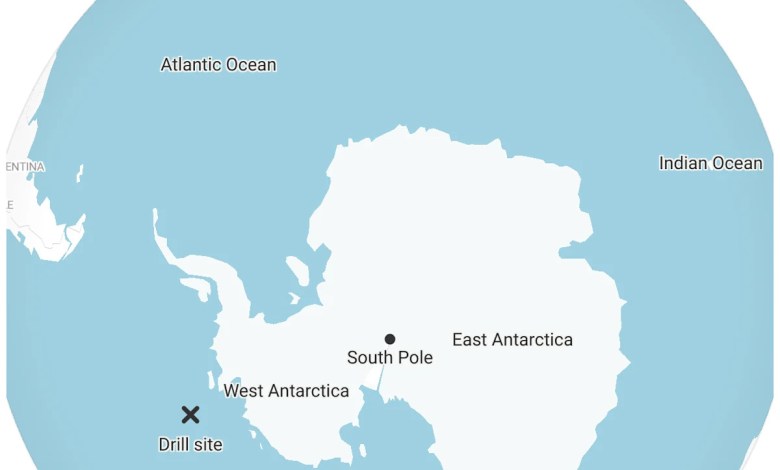
Because of its large, thick ice sheet, Antarctica appears to be a single, continuous landmass centered on the South Pole and spanning both hemispheres of the globe. The Western Hemisphere ice sheet sector is shaped like a hitchhiker’s thumb – an apt metaphor, because the West Antarctic ice sheet is on the move. Affected by warming oceans and Earth’s atmosphere, the ice sheet atop West Antarctica is melting, flowing outward, and decreasing in size, all at an astonishing rate.
Much of the debate over the melting of huge ice sheets in times of climate change focuses on its effects on populations. It makes sense: Millions of people will see their homes damaged or destroyed by rising sea levels and storm surges.
But what will happen to Antarctica itself as the ice caps melt?
In layers of sediment accumulated on the seafloor over millions of years, researchers like us discovered that when West Antarctica melted, terrestrial geological activity increased rapidly in the region. Evidence predicts what awaits us in the future.

A journey of discovery
As early as 30 million years ago, an ice sheet covered much of what we now call Antarctica. But during the Pliocene Epoch, which lasted from 5.3 million to 2.6 million years ago, the West Antarctic ice sheet retreated significantly. Rather than a continuous ice sheet, all that remained were tall ice sheets and glaciers on or near mountain peaks.
About 5 million years ago, conditions around Antarctica began to warm and the ice of West Antarctica shrank. About 3 million years ago, the entire Earth entered a warm climate phase, similar to what occurs today.
Glaciers are not stationary. These large masses of ice form on land and flow out to sea, moving over bedrock and scraping up the landscape materials they cover, and transporting this debris as the ice moves, almost like a conveyor belt. This process accelerates when the climate warms, as does birthing in the sea, which forms icebergs. Debris-laden icebergs can then carry these continental rocks out to sea, dropping them to the sea floor as the icebergs melt.
In early 2019, we participated in a major scientific voyage – International Ocean Discovery Program Expedition 379 – to the Amundsen Sea in the southern Pacific Ocean. Our expedition aimed to recover materials from the seabed to find out what happened in West Antarctica during its melting period so long ago.
Aboard the drillship JOIDES Resolution, workers lowered a drill nearly 13,000 feet (3,962 meters) to the sea floor, then drilled 2,605 feet (794 meters) into the ocean floor, directly offshore the most vulnerable part of the West Antarctic ice sheet.
The drill brought up long tubes called “cores,” containing layers of sediment deposited from 6 million years ago to the present. Our research focused on sections of sediment dating from the Pliocene epoch, when Antarctica was not entirely covered in ice.

An unexpected discovery
On board, one of us, Christine Siddoway, was surprised to discover a rare sandstone pebble in a disturbed section of the core. Since sandstone fragments were rare in the core, the origin of the pebble was of great interest. Tests showed the pebble came from mountains deep in Antarctica’s interior, about 1,300 kilometers from the drilling site.
For this to happen, the icebergs must have calved from glaciers flowing from inland mountains and then floated to the Pacific Ocean. The pebble provided evidence that a deep-water ocean passage – rather than today’s thick ice sheet – existed inside what is now Antarctica.
After the expedition, once the researchers returned to their home laboratories, this discovery was confirmed by analysis of silt, mud, rock fragments and microfossils also present in the sediment cores. The chemical and magnetic properties of the core material revealed a detailed timeline of ice sheet retreats and advances over many years.

A key sign came from the analyzes carried out by Keiji Horikawa. He tried to match the core’s thin layers of mud with the continent’s bedrock, to test the idea that icebergs had transported such material very long distances. Each layer of mud was deposited just after an episode of deglaciation, when the ice sheet retreated, creating a bed of pebbly clay carried by icebergs. By measuring the amounts of various elements, including strontium, neodymium and lead, he was able to link specific thin layers of mud in drill cores to chemical signatures in outcrops in the Ellsworth Mountains, 1,400 km away.
Horikawa discovered not a single specimen of this material, but up to five layers of mud deposited between 4.7 million and 3.3 million years ago. This suggests that the ice sheet melted and the ocean formed, then grew back, filling the interior, repeatedly, over short periods of thousands to tens of thousands of years.
Create a more complete picture
His teammate Ruthie Halberstadt combined this chemical and temporal evidence into computer models showing how an archipelago of craggy, ice-covered islands emerged as the ocean replaced the thick ice sheets that now fill Antarctica’s interior basins.
The most significant changes have occurred along the coast. Model simulations show a rapid increase in iceberg production and a dramatic retreat from the ice sheet edge toward the Ellsworth Mountains. The Amundsen Sea became clogged with icebergs coming from all directions. Rocks and pebbles embedded in glaciers floated out to sea within icebergs and fell to the seafloor as the icebergs melted.
Long-standing geological evidence from Antarctica and elsewhere around the world shows that as ice melts and flows, the land itself rises because the ice is no longer pressing down on it. This change can cause earthquakes, particularly in West Antarctica, which lies above particularly warm areas of the Earth’s mantle, which can rebound at high rates as the ice above them melts.
The release of pressure on the ground also increases volcanic activity, as is the case today in Iceland. The evidence in Antarctica comes from a layer of volcanic ash that Siddoway and Horikawa identified in cores, formed 3 million years ago.
Long-ago ice loss and upward movements in West Antarctica also triggered huge rock avalanches and landslides in fractured and damaged rocks, forming glacial valley walls and coastal cliffs. Undersea collapses displaced large quantities of sediment from the sea shelf. No longer held in place by the weight of glacier ice and ocean water, huge masses of rock broke away and surged into the water, producing tsunamis that triggered more coastal destruction.
The rapid onset of all these changes has made deglaciated West Antarctica a centerpiece of what is known as “catastrophic geology.”
The rapid increase in activity resembles what has happened elsewhere on the planet in the past. For example, at the end of the last ice age in the Northern Hemisphere, 15,000 to 18,000 years ago, the region between Utah and British Columbia was subject to flooding from the bursting of glacial meltwater lakes, land rebound, rock avalanches, and increased volcanic activity. On the coasts of Canada and in Alaska, such events continue to occur today.
Dynamic retreat of the ice sheet
Our team’s analysis of rock chemistry clearly shows that West Antarctica is not necessarily undergoing a gradual, massive change from an ice-covered to an ice-free state, but rather oscillates between very different states. Whenever the ice sheet disappeared in the past, it caused geological chaos.
The future implication for West Antarctica is that when its ice sheet collapses again, catastrophic events will return. This will happen repeatedly, as the ice sheet retreats and advances, opening and closing connections between different areas of the world’s oceans.
This dynamic future could lead to equally rapid responses in the biosphere, such as algae blooms around icebergs in the ocean, leading to an influx of marine species into newly opened sea lanes. Vast areas of land on the West Antarctic islands would then open up to the growth of mossy, coastal vegetation cover that would make Antarctica greener than its current glacial white.
Our past Amundsen Sea data and resulting predictions indicate that land changes in West Antarctica will not be slow, gradual, or imperceptible from a human perspective. Rather, what happened in the past is likely to happen again: rapid geological changes that are felt locally as apocalyptic events such as earthquakes, eruptions, landslides and tsunamis – with effects on a global scale.
This article is republished from The Conversation, an independent, nonprofit news organization that brings you trusted facts and analysis to help you make sense of our complex world. It was written by: Christine Siddoway, College of Colorado; Anna Ruth (Ruthie) Halberstadt, The University of Texas at Austinand Keiji Horikawa, University of Toyama
Learn more:
Christine Siddoway received funding from the U.S. Science Support Program for IODP and the National Science Foundation (grants 1939146 and 1917176, OPP Antarctic Earth Sciences) to support this research.
Anna Ruth Halberstadt received funding from the U.S. Scientific Support Program to participate in IODP Expedition 379.
Keiji Horikawa receives funding from JSPS KAKENHI grant (JP21H04924 and JP25H01181) to support this research.


