What are semiconductors and why is Trump planning 100% tariffs?


Technological journalists

 Getty images
President Donald Trump said that he was planning to introduce 100% prices on imports of semiconductors.
The tiny chips feed a range of different devices and are an integral part of modern technology and the world economy.
Although some semiconductor producers can be spared taxes, they can always have an impact on the technological industry and could increase the price of certain products.
What is a semiconductor and how are they used?
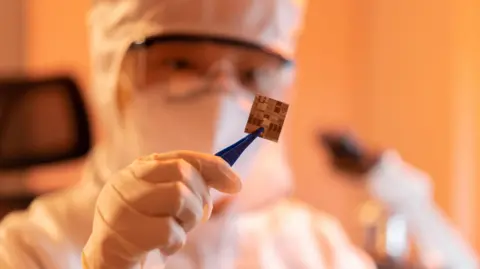
Semiconductors have enabled a multitude of modern devices – smartphones and laptops to video game consoles, pacemakers and solar panels.
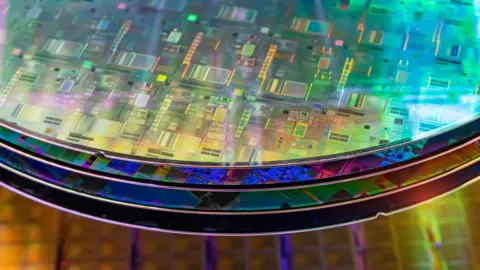
Sometimes called built -in micropuices or circuits, they are made from tiny fragments of raw materials, such as silicon.
Semiconductors, as its name suggests, can partially lead electricity – alternating between doing it and acting as insulation.
This allows them to be used as electronic switches, speaking the binary language of 0 and 1 which underlies the calculation.
 Getty images
What countries do semiconductors?
The United Kingdom, the United States, Europe and China have a stronger on Taiwan for semiconductors.
The Taiwan Semiconductor Manufacturing Company (TSMC) of the country provides more than half of the world supply.
Founded in 1987 as the first foundry in the world – dedicated to the production of semiconductors for manufacturers of devices – TSMC now manufactures them for technology giants like Nvidia, Apple and Microsoft.
It was also taken in the so-called “flea wars” between the United States and China. Each country has tried to slow down or cut the other’s access to essential components, materials and parts of supply chains while they run to develop the best technology.
Samsung Electronics in South Korea is the next largest supplier.
With SK Hynix, he established the country as one of the largest semiconductor centers in the world – in particular for the supply of memory chips.
Why does Trump want 100% prices on semiconductors?
One of President Trump’s main objectives of “reciprocal” prices during his second term was to encourage companies to manufacture more products in the United States.
In April, the White House exempted smartphones, computers and certain other electronic devices from prices, including 125% levies imposed on Chinese imports. The technological industry has sigh of relief.
But in early August, Trump reiterated the plans to impose prices on foreign semiconductors – saying that he would introduce a 100% tax on the tokens from abroad.
He did not offer more details on the prices, but said that companies could avoid them by investing in the United States.
The country already houses certain companies that design, manufacture and sell treatment chips, such as Intel and Texas Instruments.
But he wants to house more manufacturers, especially those that make the most advanced and requested products – many of which are based in Asia.
The president and the members of his administration also cited national security problems concerning the microchips produced or from elsewhere.
 Reuters
What impact could the prices have had?
In theory, Trump’s threat to impose 100% prices on imports of foreign manufacturing fleas would have an impact on a wide range of flea manufacturers and technological companies that depend on them for semiconductors-since most are based outside the United States.
The effect of this could be seen in the form of delays, while businesses rush to move manufacturing to the United States, or prices increase for some electronics – if manufacturers seek to transmit the cost of tariffs to consumers.
But Trump’s warning that companies that commit to manufacturing in the United States would not face the tax mean that the largest semiconductor companies could avoid Trump prices.
The president said that Apple, who is asking for his TSMC semiconductors, will escape the 100% prices following his additional $ 100 billion investment in American manufacturing.
This caused a 5% increase in TSMC’s action course on Thursday.
Meanwhile, South Korean officials said that Samsung and SK Hynix would not face 100% tariffs due to their investment in new American flea manufacturing factories.
How could the United States do more semiconductors?
The United States has spent colossal money in recent years to try to stimulate the manufacture of national technologies.
Certain semiconductor companies, such as TSMC, have already strengthened their American presence in response to legislation under the previous administration.
The American flea law has encouraged businesses to move flea manufacturing in the United States in exchange for funding awards.
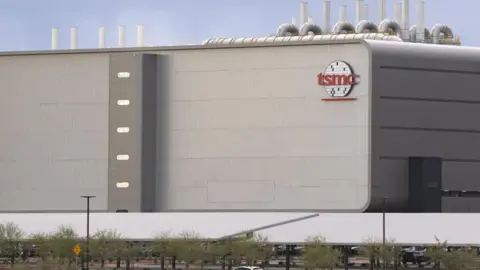
The US government has hired $ 6.6 billion (5 billion pounds Sterling) in TSMC awards after built an Arizona factory.
 Bloomberg via Getty Images
But production on the site has already been faced with delays due to a shortage of skilled workers – something that can present a wider challenge to increase the manufacture of American semiconductors.
TSMC would have resolved only his staff shortage by bringing thousands of Taiwan workers.


