What are wormholes? An astrophysicist explains these shortcuts through space-time

Curious Kids is a series aimed at children of all ages. If you have a question you’d like an expert to answer, send it to curiouskidsus@theconversation.com.
What are wormholes and do they exist? – Chinglembi D., 12 years old, Silchar, Assam, India
Imagine two cities located on opposite sides of a mountain. People in these towns would probably have to travel all the way around the mountain to visit each other. But if they wanted to get there faster, they could dig a tunnel directly through the mountain to create a shortcut. This is the idea behind a wormhole.
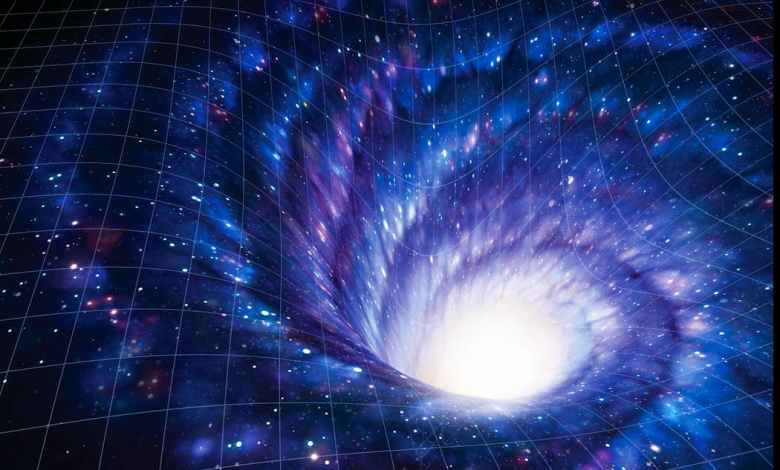
A wormhole is like a tunnel between two distant points in our universe that reduces the travel time from one point to the other. Instead of traveling for several million years from one galaxy to another, under the right conditions, one could theoretically use a wormhole to reduce the travel time to a few hours or minutes.
Because wormholes represent shortcuts through space-time, they could even act as time machines. You might emerge from one end of a wormhole sooner than when you entered the other end.
Even though scientists have no proof that wormholes actually exist in our world, they are good tools to help astrophysicists like me think about space and time. They can also answer age-old questions about what the universe looks like.
Fact or fiction?

Because of these interesting characteristics, many science fiction writers use wormholes in their novels and films. However, scientists were just as captivated by the idea of wormholes as writers.
Although researchers have never found a wormhole in our universe, scientists often see wormholes described in the solutions of important physical equations. More importantly, the solutions to the equations behind Einstein’s theory of space-time and general relativity include wormholes. This theory describes the shape of the universe and how stars, planets, and other objects move in it. Because Einstein’s theory has been tested repeatedly and proven correct each time, some scientists expect that wormholes exist somewhere in the universe.
But other scientists think that wormholes cannot exist because they would be too unstable.
The constant pull of gravity affects all objects in the universe, including Earth. Gravity would therefore also have an effect on wormholes. Scientists who are skeptical of wormholes believe that after a short time, the middle of the wormhole would collapse under its own gravity, unless a force was pushed outward from inside the wormhole to counteract that force. The most likely way to do this would be to use so-called “negative energies”, which would oppose gravity and stabilize the wormhole.
But according to scientists, negative energies can only be created in quantities far too small to counteract a wormhole’s own gravity. It is possible that the Big Bang created tiny wormholes with small amounts of negative energy at the beginning of the universe, and that over time these wormholes expanded as the universe expanded.
Just like black holes?
Although wormholes are interesting objects to consider, they are still not accepted by mainstream science. But that doesn’t mean they’re not real: Black holes, which we astrophysicists know are abundant in our universe, were not accepted when scientists first suggested their existence, in the 1910s.
Einstein first formulated his famous field equations in 1915, and German scientist Karl Schwarzschild found a way to mathematically describe black holes after just a year. However, this description was so unusual that the greatest scientists of that time refused to believe that black holes could actually exist in nature. It took 50 years for people to start taking black holes seriously – the term “black hole” wasn’t coined until 1967.
The same thing could happen with wormholes. It may take some time for scientists to reach a consensus on whether they exist or not. But if they find strong evidence for the existence of wormholes – which they could do by observing strange movements in the orbits of stars – this discovery will shape the way scientists see and understand the universe.
Hello curious children! Do you have a question you would like an expert to answer? Ask an adult to send your question to CuriousKidsUS@theconversation.com. Please tell us your name, age and the city where you live.
And since curiosity has no age limit – adults, let us know what you’re wondering too. We won’t be able to answer every question, but we will do our best.
This article is republished from The Conversation, an independent, nonprofit news organization that brings you trusted facts and analysis to help you make sense of our complex world. It was written by: Dejan Stojkovic, University at Buffalo
Learn more:
Dejan Stojkovic works at the State University of New York and the University at Buffalo. It receives funding from the National Science Foundation.


