
March 23, 2026
3 min read
 Add Us On GoogleAdd SciAm
What color is this dot? New illusion demonstrates weird vision quirk
An optical illusion with nine simple dots reveals a surprising amount about the eye and brain
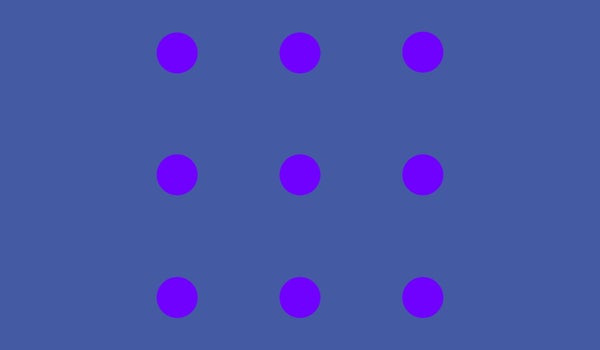
The “9 Purple Dots” illusion.
Hinnerk Schulz-Hildebrandt
Last August Hinnerk Schulz-Hildebrandt noticed something strange while he was looking at a flight map on his phone. As his eye traced the plane’s flight path, he noticed that the line looked purple, then blue, then purple again. The hue kept changing depending on where on the screen he looked; the line looked purple when he stared right at it but blue when he saw it with his peripheral vision.
Schulz-Hildebrandt, a biomedical optics engineer at Harvard Medical School, ran with his observation and developed an illusion that allows us all to see just how malleable our perception of color really is. The illusion, which was recently published in the journal Perception, contains nine purple dots against a blue background. When those of us with full color vision focus on one dot, it appears more purple while the rest seem to shift to blue.
Hinnerk Schulz-Hildebrandt
On supporting science journalism
If you’re enjoying this article, consider supporting our award-winning journalism by subscribing. By purchasing a subscription you are helping to ensure the future of impactful stories about the discoveries and ideas shaping our world today.
Why does this disorienting illusion work? Part of it comes down to the color-detecting cells, called cones, in our retinas. Different cones detect different wavelengths of light. There are relatively few of the blue-detecting ones in the center of our retina, called the fovea centralis, which is the part of the eye where light from the center of our field of vision hits. Having less blue perception there could trick our brain into seeing a dot as more purple when we look at it directly.
And there’s another anatomical quirk in our eyeballs that turns down our perception of blue specifically in the center of our vision. In front of the fovea is a protective layer of yellow pigments that acts like internal sunglasses, absorbing some blue and near-ultraviolet light before it even hits the cones in our retina. In turn, we don’t perceive as much blue in the center of our vision as we do in the periphery of it. “We don’t notice this usually because our brains have learned to ‘calibrate’ out the difference,” says Jenny Bosten, a visual neuroscientist at University of Sussex in England.
These blue-absorbing pigments can sometimes cause people to see a red dot called Maxwell’s spot in the center of their vision. Last year experimental psychologist Akiyoshi Kitaoka of Ritsumeikan University in Japan independently developed the Maxwell’s spot illusion, which is a very similar illusion to Schulz-Hildebrandt’s nine blue dots. It uses combinations of blue, green or red dots on a solid green or blue background to highlight the lack of blue perception in central vision.
The blue background in Schulz-Hildebrant’s nine-dot illusion likely makes the effect stronger, Bosten says. In a process called simultaneous contrast, our brain perceives colored objects in relation to the color of the background that they’re viewed against. When a gray circle is surrounded by a red background, we perceive the gray as “less red,” which makes it seem slightly green. Similarly, when a blue-purple dot has a blue background, we perceive it as more purple. When combined with the fact that a blue dot will look less blue when viewed in the center of our vision, these phenomena make for a striking illusion.
The illusion doesn’t reveal a new process, Bosten says, “but it is exploiting several processes we already know about to create a nice effect.”
It’s Time to Stand Up for Science
If you enjoyed this article, I’d like to ask for your support. Scientific American has served as an advocate for science and industry for 180 years, and right now may be the most critical moment in that two-century history.
I’ve been a Scientific American subscriber since I was 12 years old, and it helped shape the way I look at the world. SciAm always educates and delights me, and inspires a sense of awe for our vast, beautiful universe. I hope it does that for you, too.
If you subscribe to Scientific American, you help ensure that our coverage is centered on meaningful research and discovery; that we have the resources to report on the decisions that threaten labs across the U.S.; and that we support both budding and working scientists at a time when the value of science itself too often goes unrecognized.
In return, you get essential news, captivating podcasts, brilliant infographics, can’t-miss newsletters, must-watch videos, challenging games, and the science world’s best writing and reporting. You can even gift someone a subscription.
There has never been a more important time for us to stand up and show why science matters. I hope you’ll support us in that mission.


