What happened when humans and Neanderthals hooked up

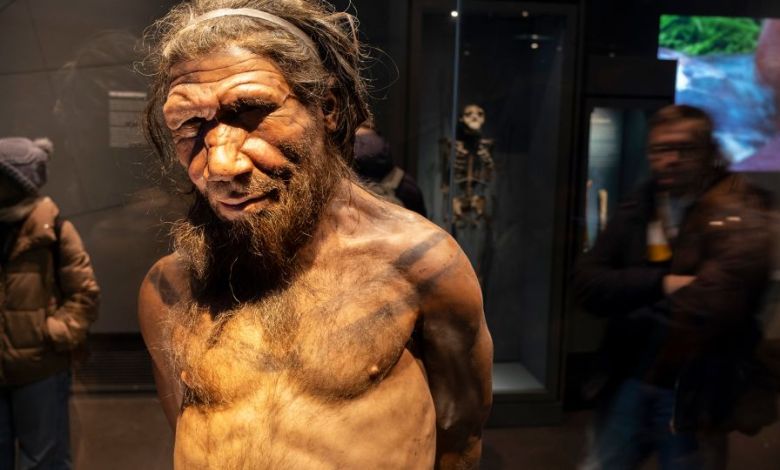
The discovery in 2010 that early humans and Neanderthals met and had babies was a scientific bombshell that electrified the field of human origins.
Now, geneticists at the University of Pennsylvania say they have a better understanding of the nature of these prehistoric relationships, suggesting that romantic trysts occurred primarily between Neanderthals and human women.
This intriguing discovery, published Thursday in the journal Science, could help explain why the Neanderthal ancestry present in humans today is unevenly distributed across the genome. However, it is far from clear why prehistoric pairings between our species, Homo sapiens, and Neanderthals – which died out around 40,000 years ago – largely followed this pattern.
“This is a fascinating and provocative hypothesis,” said Joshua Akey, a professor at the Lewis-Sigler Institute for Integrative Genomics at Princeton University, who was not involved in the research. “I find it extraordinary that we can use genome sequences to infer aspects of social dynamics and mating patterns that occurred tens or even hundreds of thousands of years ago.”
Researchers aren’t sure how often Neanderthals and members of our species encountered each other, but a study published in 2024 suggests that the two groups exchanged DNA several times over the past 250,000 years as they migrated across the globe. We also know that Neanderthals and Homo sapiens interbred with a third species: the Denisovans.
Most humans carry a small percentage of Neanderthal DNA, a genetic inheritance from these sexual interactions. In some cases, these genes can still influence human health. Neanderthal DNA has been shown to affect circadian rhythms, immune system function, and the way some people experience pain.
But mysteriously, the human X chromosome today appears to be what geneticists call an “archaic desert,” meaning it contains virtually no Neanderthal DNA. (Women have two X chromosomes, while men only have one plus a Y chromosome.)
“It’s not zero on the “And for ten years, we have had two families of explanations for what happened.”
Perhaps, the researchers speculated, the genes on the X chromosome did not transmit well between species, or the Neanderthal genetic variants of the The latest research, however, has ruled out these scenarios and suggested that a different dynamic is at work.
XRiddles
The new study, based on information from the genomes of 73 females and three samples of female Neanderthals, found that Neanderthal X chromosomes exhibited an opposite pattern to their Homo sapiens counterparts: They had a relative excess of human DNA far beyond what would be expected, even though human DNA conferred genetic advantages to Neanderthals.
The researchers identified modern human DNA in Neanderthal genomes by comparing it to current female genomes from human populations in Africa that had little or no Neanderthal DNA, making it easier to ensure that any overlap could be attributed to Homo sapiens DNA, rather than Neanderthal DNA.
Their analysis showed that excess human DNA on the Neanderthal X chromosome could be best explained by a strong sex bias in mating between the two groups, which resulted in low penetration of Neanderthal X chromosome DNA into the human gene pool. Specifically, research has suggested that when Neanderthals and humans interbred, mating was primarily between Neanderthals and women.
“It’s a story that involves who has the X chromosomes,” Platt said. “We didn’t get as many X chromosomes from these Neanderthals, and they had an excess of modern human ancestry on their X chromosomes,” he said.
Additionally, after episodes of interbreeding between the two groups, subsequent generations of Neanderthal men would have been more likely to mate with Neanderthal women with more modern human ancestry, the study found.

A human skull is displayed alongside a photo of a Neanderthal at the Toulouse Natural History Museum in France in October 2019. – Alain Pitton/NurPhoto/Getty Images
The simplest explanation for this phenomenon, according to the study, was “mate preference.” In other words, Neanderthal males, Homo sapiens females and Neanderthal females with greater human ancestry might have been “more attractive and more desirable as mates,” for some unknown reason, Platt said. Likewise, he noted, female Homo sapiens who encountered Neanderthals may have considered them more attractive sexual partners.
Sex-based migration patterns – meaning Neanderthals and Homo sapiens females were more likely to be in the right place at the right time to mix and have babies – could also have contributed, the study found, but were unlikely to explain this result on their own.
Lingering questions
Genomes contain a wealth of information that geneticists can use to mathematically model human migrations, encounters with other populations, and inheritance over thousands of millennia. However, modeling studies cannot capture the nuances of actual behavior, making it impossible at this time to paint a more complete picture of Neanderthal-human relationships.
“We all wish we could go back in time and figure this out,” said Sarah Tishkoff, study co-author and David and Lyn Silfen Professor of Genetics and Biology at the University of Pennsylvania. “You can do simulations and modeling under different scenarios and figure out which one is best, but that doesn’t rule out that multiple things could happen at the same time.”
Ryan McRae, a paleoanthropologist at the Smithsonian National Museum of Natural History, said the methods used in the study were sound and the “super interesting” results made sense. He stressed, however, that it would be very difficult to find archaeological evidence of how these couples happened.
“In an ideal world, we could find a Neanderthal site with a group of Neanderthal men and human women, but that is unlikely to ever happen,” he said.
“Perhaps human females flocked to Neanderthal groups naturally, or perhaps they were forced into it. Perhaps there was some form of trade going on. Endless stories are possible,” he added by email.
The results don’t necessarily mean that Neanderthals were constantly abandoning their own females for humans, but they do suggest that “if a female with human ancestry was available, no matter how many generations before the human ancestor, she became a more desirable mate,” McRae said.
“Even if we find first- or second-generation hybrid fossils, knowing which of their parents was which species would only tell us about that individual, not the entire population or demographic landscape,” he noted. “This is why these types of studies are so important; they can tell us about larger-scale impacts that individual fossils cannot.”
Princeton’s Akey said by email that the X chromosome had a “particularly complicated evolutionary history” and added that he was cautious about interpreting differences in Neanderthal ancestry between the
“Unraveling human history is complex,” Akey said, “and many different evolutionary forces and demographic processes can interact in ways that are difficult to untangle.”
Sign up for CNN’s Wonder Theory science newsletter. Explore the universe with information on fascinating discoveries, scientific advances and much more.
For more CNN news and newsletters, create an account at CNN.com


