What happens to ISIS detainees as Syria moves to take over SDF prisons

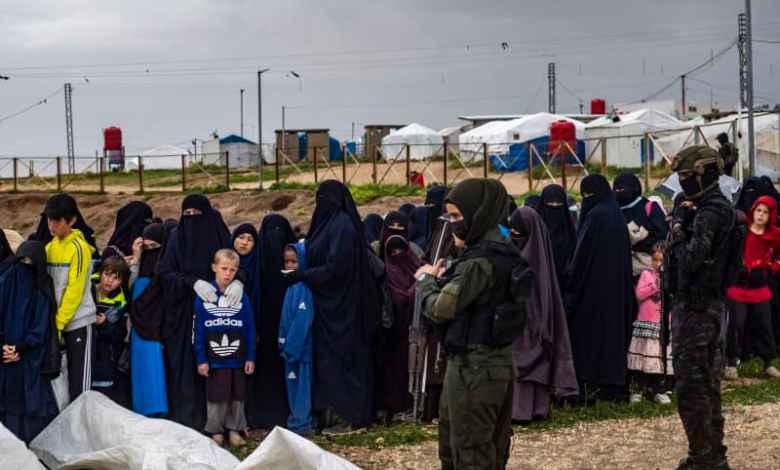
Amid the fighting, there are fears that IS detainees held in Syria could escape, amid a deal to hand them over to Damascus.
Thousands of suspected IS members are detained in Syria. They are held in around 20 different camps and prisons run by the US-backed Syrian Democratic Forces. These facilities were largely created following the defeat of ISIS between 2017 and 2019 in Syria. When the last major pockets of ISIS control were liberated by the SDF in 2019, thousands of ISIS member families found themselves in the hands of the SDF. After clashes between the SDF and the Syrian government last week, an agreement was signed which was supposed to mean that the administration of ISIS detainees in eastern Syria will be handed over to the Syrian government.
These ISIS members and their families, detained in eastern Syria, include thousands of people, mostly women and children who married ISIS members. Among them were also thousands of foreigners. This left the SDF facing a complex challenge. ISIS members could not be repatriated without the consent of the countries of origin. Many countries, such as the United Kingdom, did not want their citizens to return.
Stripped of citizenship
Some countries have stripped these people of their citizenship, leaving them in legal limbo. Foreign ISIS members entered Syria illegally during the Syrian civil war. As undocumented migrants supporting ISIS, they were not even officially in Syria.
After the SDF took control of some 50,000 people linked to ISIS, it was unclear what to do with them. The worst offenders, mostly men, were held in special prisons. Several were repatriated to other countries. Some women and children were also allowed to return to their countries, which sent people to collect them via Iraq. However, this left large numbers of people languishing in various facilities. ISIS women in the Al-Hol camp have formed their own society, replicating ISIS extremism in miniature. They killed dissident women and raised children to become extremists.
This means that when fighting broke out between the Syrian government and the SDF last week, concerns were raised about what might happen to ISIS prisoners. Videos from January 18 show some prisons taken over by the Syrian government. These are apparently women’s prisons where women and children were detained. While some social media accounts claimed that 3,000 ISIS members were allowed to leave prisons, the real figure is likely much lower, and it is unclear whether the people who fled prisons on January 17 and 18 were actually ISIS members.

A female fighter stands guard during a joint security operation by Syria’s Kurdish internal security police forces, also known as Asayesh, and the Kurdish-led Syrian Democratic Forces (SDF), at Camp Roj, where foreign relatives of people suspected of belonging to the Islamic State (IS) group are detained. (credit: DELIL SOULEIMAN/AFP via Getty Images)
What will happen next to the detained ISIS members?
What matters now is what will happen to ISIS detainees. Devorah Margolin, a Blumenstein-Rosenbloom senior fellow at the Washington Institute for Near East Policy, wrote a thread on X discussing the camps. She notes that six years after the defeat of ISIS, “many of these populations remain detained and are being held in approximately 27 centers, including 25 detention centers (including two youth reintegration centers) and two detention camps (Al-Hol and Roj) in northeastern Syria, and run by several different actors, including the SDF and affiliated security forces such as the Internal Security Forces, as well as by the civilian wing, the DAANES. » DAANES is the civilian authority that manages eastern Syria, essentially the civilian branch of the FDS. It is largely a Kurdish organization.
Margolin goes on to note that “there are today approximately 25 detention centers (including two youth rehabilitation centers – Houri and Orkesh) under the umbrella of “IS in detention” which detain approximately 9,000 mostly adult men, but also 1,000 adolescents and young men initially detained as minors, as well as 100 women. This population includes “5,000 Syrians, 3,000 Iraqis, and 2,000 third-country nationals (TCN). Gathering concrete information on these individuals remains extremely difficult – and sometimes unreliable – for many reasons, including security concerns, as well as the fact that they are led by non-state actors, the SDF and DAANES.”
Al-Hol camp hosts 25,000 people
She adds that the population of Al-Hol camp is now estimated at around 25,000 people. Another large camp, called Roj, has around 2,400 people. “Today, the majority of those detained at Al-Hol are Syrians, followed by Iraqis (only about 13,000 remain today) and fewer than 10,000 third-country nationals. Iraqis were once the largest group detained at Al-Hol, but the Iraqi government has repatriated more than 20,000 people from the camp, including more than 11 000 in 2025 alone.”
Now, according to Kurdish media Rudaw, Baghdad is ready to welcome the rest of the Iraqis. It comes as Iraq also deploys forces along the Syrian border, fearing the fighting could spill over. “We are preparing to return all Iraqi families remaining in al-Hol camp to Iraq as soon as possible,” an Iraqi source told Rudaw. “Iraqi Interior Minister and Acting Minister of Migration and Displaced Persons Abdul-Amir al-Shammari is overseeing the process and is expected to visit the Jadaa camp in Nineveh province on Monday.”
Ahmed Sheikhmous, who oversees the internally displaced persons (IDP) and refugee camps in Rojava, told Rudaw that due to the attacks by Hay’at Tahrir al-Sham [HTS] activists [who are a now major part of the Syrian interim government]”Iraqi data indicates that “fewer than 100 Iraqi families remain in al-Hol camp,” the article states. “Preparations are beginning and it is expected that the repatriation of all these families will begin early next month,” Ali Jahangir, spokesperson for the Iraqi Ministry of Migration and Displacement, told Rudaw on Monday.
Large numbers of foreigners still remain in camps and prisons
As Iraqis return home, most of the people in the camps will be Syrians. However, a large number of foreigners, estimated in the thousands, are still in the various camps and prisons. Some foreign ISIS members, particularly women, have children in these facilities. It seems that children grow up without papers if they are the children of foreigners. This seems to mean that there could be hundreds, if not thousands, of stateless children.
One of the best-known cases is that of Shamima Begum, a British woman who traveled to Iraq to support ISIS when she was a fifteen-year-old. A BBC report two weeks ago said Britain’s Home Secretary would “vigorously defend” the decision to strip Shamima Begum of her British citizenship. “The European Court of Human Rights (ECtHR) has called for an investigation, but a government source said the decision had already been upheld by the British courts,” noted the BBC. Begum is now 26 years old. While her case is well known, there are many other women. Some of them have children. As the countries refuse to take them back, it is not clear what Syria will do with them.


