What is the ‘acid rain’ in the wake of U.S. bombings in Iran?


March 10, 2026
4 min reading
 Add us on GoogleAdd SciAm
What is “acid rain” following the American bombings in Iran?
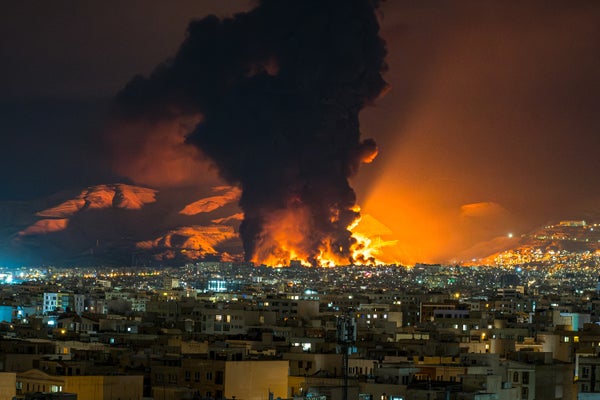
Iranian residents reported headaches, difficulty breathing and rain contaminated by oil that fell on buildings and cars after the bombing of oil depots.
Sasan/Middle East Images/AFP via Getty Images
The following essay is reproduced with permission from  The Conversation, an online publication covering the latest research.
Reports of black rain falling on parts of Iran in the hours following US-Israeli airstrikes on oil depots over the weekend, with some media outlets referring to it as “acid rain”.
Iranian residents reported headaches, difficulty breathing and oil-contaminated rain that landed on buildings and cars. The Iranian Red Crescent Society warned that rainfall following the strikes could be “very dangerous and acidic.”
On supporting science journalism
If you enjoy this article, please consider supporting our award-winning journalism by subscription. By purchasing a subscription, you are helping to ensure the future of impactful stories about the discoveries and ideas shaping our world today.
As an atmospheric chemist and chemical engineer who studies air pollution, these reports are very concerning and indicate much more than just acid rain.
These rains would contain acids but also probably a host of other pollutants harmful to humans and the environment in the short and long term. It could be even worse than the term “acid rain” suggests.
More broadly, the thick clouds of toxic smoke above densely populated areas of Iran also pose a major problem for anyone currently breathing this air.
What could this “acid rain” be?
One of the main ways that air pollutants are removed from the atmosphere is through rain. When significant levels of pollutants are present in the air, they will be collected by falling water droplets and “rain” out of the atmosphere.
That’s why we’re getting these reports of black rain falling from the sky after the oil depots were attacked – proof of how contaminated the local air must be.
To me, this black rain indicates that toxic pollutants such as hydrocarbons, ultrafine particles known as PM2.5, and carcinogenic compounds called polycyclic aromatic hydrocarbons (PAHs) have found their way into the rain.
On top of that, there would be a mixture of other unknown chemicals, likely including heavy metals and inorganic compounds from the building materials and anything else caught up in the initial explosions and subsequent fires.
Smoke from bombed oil depots is also believed to contain sulfur dioxide and nitrogen dioxide, precursors to the formation of sulfuric acid and nitric acid in the air. This acid is then found in water droplets and is responsible for what we traditionally call acid rain.
The acid rain we’ve heard so much about in recent decades was primarily caused by sulfur dioxide produced by burning fossil fuels. Sulfur is naturally present in crude oil, but is now largely removed at the refining stage.
Aside from rain, it is worth remembering that all smoke is toxic; if you can feel it, it may be at levels that harm you.
The level of black smoke observed over densely populated areas of Iran is therefore extremely worrying and can lead to chronic short- and long-term health problems.
What are the potential health risks?
In the short term, people exposed to this black smoke in Iran may experience headaches or difficulty breathing, especially if they have asthma or lung disease.
Vulnerable populations – such as the elderly, young children and people with disabilities – are at greater risk. Exposure to toxic air pollution during pregnancy can also lead to reduced birth weight.
In the longer term, exposure to compounds present in the air and in this black rain potentially increases the risk of cancer. When ultrafine particles (PM2.5) are inhaled, they can enter your bloodstream. This has been associated with a range of health impacts, including cancers, neurological disorders (such as cognitive impairment), and various cardiovascular diseases.
Once these plumes of heavily polluted air blow their pollutants into natural waterways, they can also begin to affect aquatic life, as well as sources of drinking water.
Another problem is that this black rain deposits these compounds on buildings, roads and surfaces, meaning they can return to the air when disturbed by high winds.
A legacy of war
The environmental impact of conflicts around the world is receiving increasing attention. Part of this phenomenon emerged as a result of past wars in Iraq and Kuwait, where there was large-scale deconstruction of oil wells and the use of burn pits.
We now know there are long-term health impacts on returning service members, including Australians. It can therefore be assumed that local populations are also deeply affected.
In the short term, people exposed to this smoke and black rain in Iran should try to wear masks or face coverings, take shelter, stay indoors, close doors and windows, and try to keep the air out. It is also important to clean hard surfaces when possible, especially indoors, to reduce exposure to deposited pollutants.
On the ground, of course, this can be very difficult to achieve in the chaos of war.
This article was originally published on The conversation. Read the original article.
It’s time to defend science
If you enjoyed this article, I would like to ask for your support. Scientific American has been defending science and industry for 180 years, and we are currently experiencing perhaps the most critical moment in these two centuries of history.
I was a Scientific American subscriber since the age of 12, and it helped shape the way I see the world. SciAm always educates and delights me, and inspires a sense of respect for our vast and magnificent universe. I hope this is the case for you too.
If you subscribe to Scientific Americanyou help ensure our coverage centers on meaningful research and discoveries; that we have the resources to account for decisions that threaten laboratories across the United States; and that we support budding and working scientists at a time when the value of science itself too often goes unrecognized.
In exchange, you receive essential information, captivating podcasts, brilliant infographics, newsletters not to be missed, unmissable videos, stimulating games and the best writings and reports from the scientific world. You can even offer a subscription to someone.
There has never been a more important time for us to stand up and show why science matters. I hope you will support us in this mission.


