What the hell is an M5 super core?


Summary created by Smart Answers AI
In summary:
- Macworld takes a look at new terminology for Apple’s M5 chips, including “super cores” branding and “Fusion Architecture” for the M5 Pro and Max processors.
- The M5 Pro and Max feature six “super cores” and twelve new “performance cores,” but the super cores appear to be rebranded performance cores from previous M5 chips.
- This marketing strategy raises questions about transparency, as Apple appears to be renaming existing features while the new “performance cores” are likely efficiency-enhanced cores.
I am two things by nature: fascinated by new processor technologies and wary of marketing BS. So Apple has triggered all kinds of reactions from me with its new branding move.
In case you missed it, the announcement of the M5 Pro and M5 Max came with some new buzzwords. One of them is “Fusion Architecture,” which is Apple’s trademark for a chip that has multiple silicon dies on a high-speed interconnect. They are not the first to do this, but they are using new packaging technology. AMD has been doing this sort of thing for years, but it’s new for Apple.
What really got me was the other new buzzword, “super hearts.” Oh, the M5 Pro and Max no longer have “performance and efficiency” cores. They have “super performance and super cores”.
What exactly is a super core? Is it a core with a massive L2 cache? Much more than the usual execution units? Support for some special instruction set extensions?
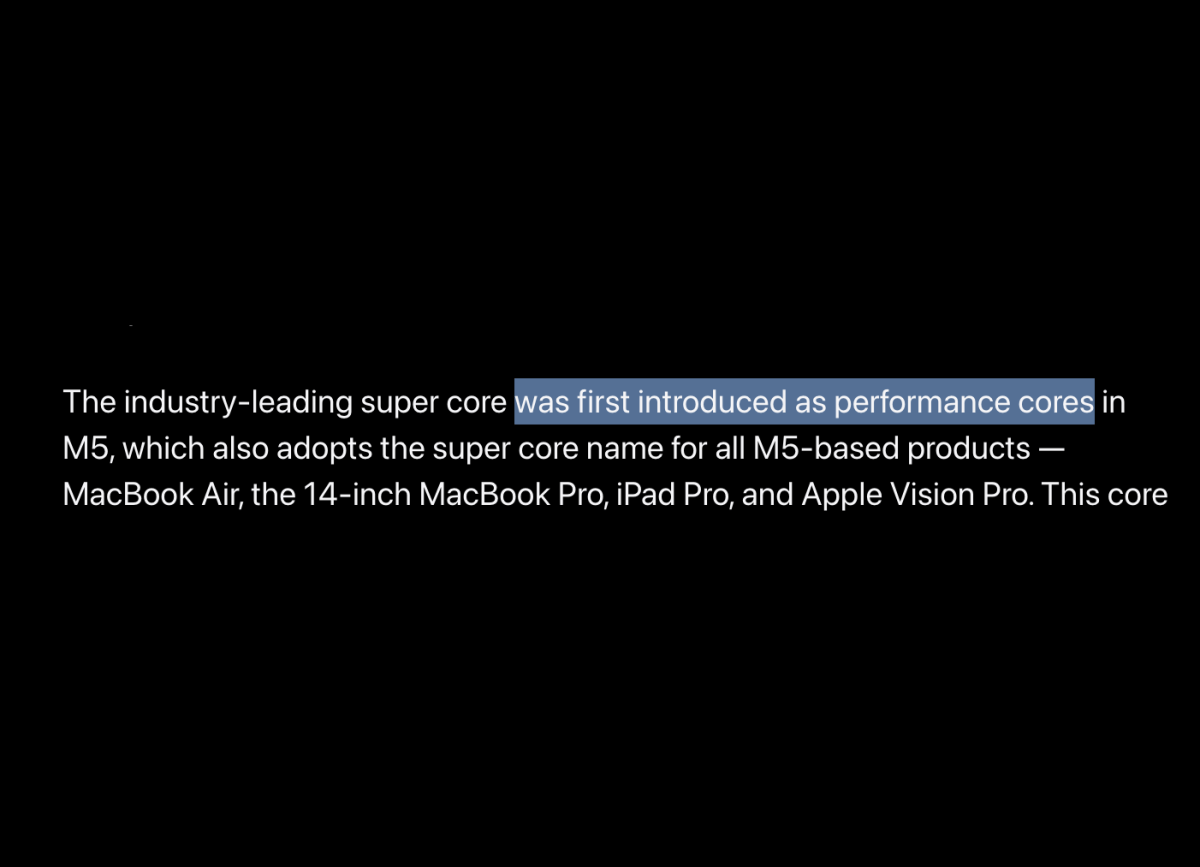
No, it turns out they’re just the same performance cores they already shipped. Apple openly states that it has renamed the performance cores of its M5 products, including the iPad Pro, MacBook Pro and Vision Pro M5, which have been shipping for months, to “super cores”.
Apple
(As I write this, Apple has yet to update the technical specifications pages for the iPad Pro or Vision Pro, but it has on the standard M5 MacBook Pro page, so those updates are likely coming.)
So the M5’s performance cores are now super cores, but according to Apple, they’re the same thing with a different name. I guess Apple wasn’t respected enough to have some of the highest single-threaded benchmark performance on the market.
The M5 Pro and M5 Max each have six of these super cores, significantly fewer than the M4 Pro’s 10 performance cores and the M4 Max’s 12 performance cores. Additionally, the M5 Pro and Max chips also have 12 “performance cores,” which are presumably not has just renamed the efficiency cores. According to Apple’s press release, this is a completely new development. Even in the MacBook Pro M5 spec sheet, Apple makes a distinction between efficiency cores (on the M5) and performance cores (on the M5 Pro/Max).
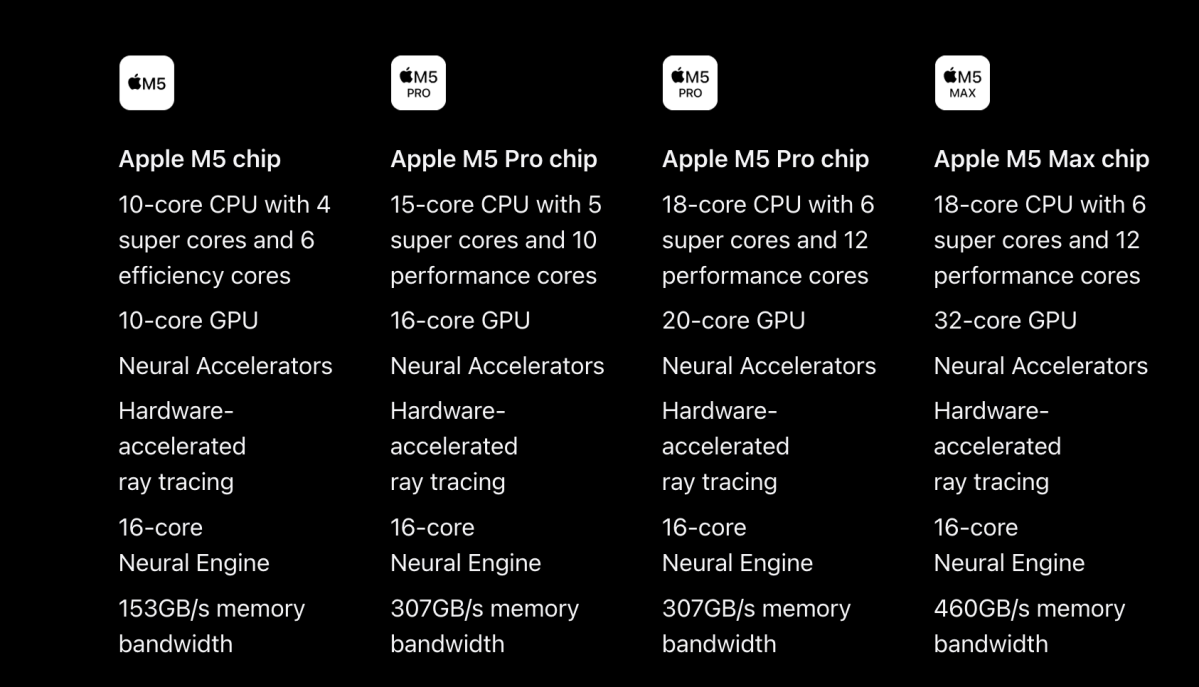
We can clearly see that the M5 has super cores and efficiency cores, while the M5 Pro and Max have super cores and performance cores.
Apple
So if these new performance cores aren’t the old efficiency cores with a new name, and they aren’t the old performance cores (which became super cores), then what are they?
Apple only says that they are “optimized to deliver more power-efficient multithreaded performance for professional workloads”, which seems to me to be simply a new efficiency core design, and Apple is so proud of it that they have started calling them “performance cores”.
It doesn’t help that much of the marketing around these MacBook Pros is geared toward comparisons to the M1 generation. It’s been 4.5 years, of course that’s much faster.
None of this is to say that fleas are bad or slow. I expect that when we review them, we’ll see a surprisingly big improvement over the M4 generation, just like we did when we reviewed the M5 MacBook Pro. So why play word games while marketing the tokens?
Will “super cores” be available on other Apple products? You can bet on it. Don’t be surprised when the A20 shows up with two “super cores” and four “performance cores.” Why stop there? Maybe in a few years we can have ultra cores?


