What we know about US seizure of oil tanker off Venezuela


An American helicopter flies low over a foggy blue sea as it approaches a huge ship. He hovers as camouflaged soldiers holding rifles descend ropes to the deck of the ship.
The video, released by the American government, shows the latest in a series of escalations in the pressure campaign led by Washington on the government of Nicolas Maduro: the seizure of an oil tanker.
The United States says the tanker is used to transport sanctioned oil from Venezuela and Iran in an “illicit oil transportation network supporting foreign terrorist organizations.”
Venezuelan Foreign Minister Yvan Gil called the seizure “international piracy” and says US President Donald Trump wants Venezuela’s energy resources.
Here’s what we know.
The operation
“We just seized an oil tanker on the coast of Venezuela — a big tanker, very big, the biggest ever seized in fact,” Trump told reporters at the White House on Wednesday.
Footage of the operation was shared by Attorney General Pam Bondi on social media. Bondi said a seizure warrant for the tanker was executed by the U.S. Coast Guard, FBI, Homeland Security Investigations and the Department of Defense.
The exact location of the tanker at the time of the seizure is unclear, but a senior military official told the BBC’s US partner CBS News that the ship had just left a port in Venezuela.
The 45-second video shows a U.S. team walking on the deck of the ship with their weapons drawn. No ship’s crew is visible.
The seizure involved two helicopters, 10 Marines and 10 U.S. Coast Guard personnel, as well as special operations forces, a source familiar with the operation told CBS.
The boarding of the ship involved an elite Coast Guard group called the Maritime Security and Response Team, the source said.
This team is trained in counterterrorism and high-risk law enforcement boarding procedures – like the fast-rope boarding from a helicopter seen in the video. It was created after the September 11 attacks, as part of a national security overhaul.
The Coast Guard led the operation with support from the Navy, officials told CBS.

 Planet Labs PBC
The tanker
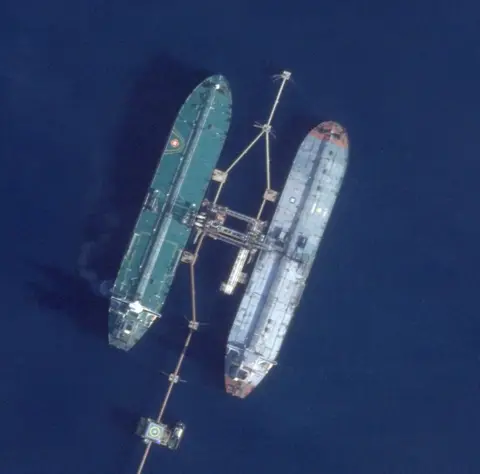
Marine risk firm Vanguard Tech identified the vessel as the Skipper and said it believed the vessel had been “spoofing” its location – or broadcasting a false location – for a long time.
The ship has sailed under other names, including Toyo and Adisa, since it was built 20 years ago. The Skipper measures 333 m (1,092 ft) in length and 60 m in width and is classified as a very large crude carrier (VLCC).
Vanguard Tech said the ship “is believed to be part of the Dark Fleet and has been sanctioned by the United States for carrying Venezuelan oil exports.” The Dark Fleet refers to ships used to smuggle sanctioned goods.
It is believed to have left the oil port of José on Dec. 4 or 5, with about 1.8 million barrels of heavy crude oil on board, of which about 200,000 barrels were transferred to another vessel before the seizure, Reuters reported, citing an analysis by TankerTrackers.com and Venezuela’s national oil company PDVSA.
The U.S. Treasury Department sanctioned the captain in 2022, CBS reported, for his alleged involvement in oil smuggling that generated revenue for the Hezbollah group in Lebanon and the Islamic Revolutionary Guard Corps’ Quds Force in Iran.
BBC Verify located the tanker on MarineTraffic, showing that the vessel was sailing under the Guyanese flag when its position was last updated two days before the seizure. A statement from Guyana’s Department of Maritime Administration on Wednesday evening, however, said the skipper was “falsely flying the Guyanese flag as he is not registered in Guyana”.
MarineTraffic shows it last occurred near Iran in mid-September before arriving off the coast of Guyana in late October and making few movements since then. This data may be partial or incorrect due to identity theft.
Oil seized
Asked by reporters what the United States would do with the oil carried by the tanker, Trump responded: “We’ll keep it, I guess…I guess we’ll keep the oil.”
Global crude oil prices are trading at around $61 (£46) a barrel, meaning the reserve on board the skipper could be worth more than $95 million – if it actually contains 1.6 million barrels after 200,000 are removed. The BBC has not verified how much oil is on board the ship.
Bondi, the top U.S. prosecutor, said of the seized vessel: “For several years, the tanker was sanctioned by the United States due to its involvement in an illicit oil transportation network supporting foreign terrorist organizations. »
Maduro has accused the United States of using its ongoing military buildup in the Caribbean and its “war on drugs” to try to remove him and get its hands on Venezuelan oil – something the United States denies.
Venezuela has the largest known reserves of crude oil in the world. But analysts have pointed out the complexities. Oil is considered “heavy” and very viscous, meaning its extraction requires specific equipment and knowledge.
Venezuela’s aging infrastructure and heavy sanctions imposed by the United States have also hampered the country’s efforts to monetize its vast resources.
The broader US pressure campaign
The Trump administration has focused for much of the last year on combating the influx of drugs — particularly fentanyl and cocaine — into the United States.
As part of this effort, Trump designated two Venezuelan criminal groups – Tren de Aragua and Cartel de los Soles – as foreign terrorist organizations and alleged that the latter was led by Maduro himself.
Without providing evidence, Trump also accused Maduro of “emptying his prisons and insane asylums” and “forcing” his inmates to emigrate to the United States. Stopping immigration is another White House priority.
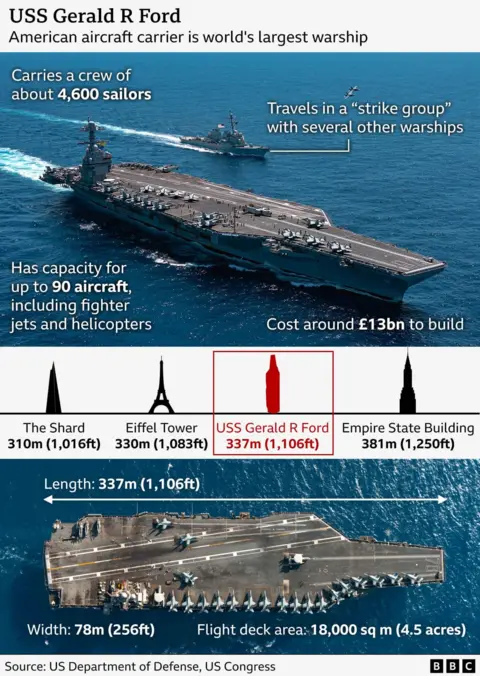
As part of the pressure campaign, the United States deployed 15,000 troops and a range of aircraft carriers, guided-missile destroyers and amphibious assault ships to the Caribbean. Among them is the world’s largest warship, the USS Gerald Ford, from which helicopters took off as part of the tanker’s seizure.
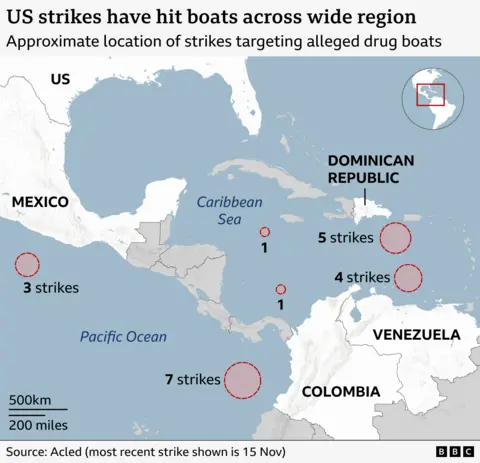
Since the beginning of September, US forces have carried out more than 20 strikes in international waters against boats suspected of transporting drugs. More than 80 people were killed.
The Trump administration says it is involved in a non-international armed conflict with suspected drug traffickers, whom it accuses of waging an irregular war against the United States.
The United States also labeled those on board “narcoterrorists,” but legal experts say the strikes are illegal because that designation “did not transform them into legal military targets.”