When I Go, I’m Going Green


Our annual family holidays on CAPE COD included all the familiar summer pleasures: climbing dunes, walking beaches, spotting seals, eating oysters, reading books that we intended to go to the whole year.
And a little shopping. My little child wanted a few small toys. My daughter has full of thousand -room puzzles in the provincial game store. I bought a pair of earrings and a few pocket books.
And a grave.
It is near a group of oaks, in a cemetery in Wellfleet, Massachusetts, where certain tombstones in the era of the mossy civil war are so altered that you can no longer decipher who is under them. The city allows non-residents to join the inhabitants there, and it welcomes green burials.
Regular summer visitors as often share the fantasy of acquiring real estate on the CAP. Admittedly, probably consider a place to use while they are still alive, a reverie that remains beyond my means.
The purchase of a conspiracy of the cemetery where I can have a green burial, on the other hand, was surprisingly affordable and will allow my body, once more used, to decompose as quickly and as naturally as possible, with a minimum of environmental damage. Bonus: If my descendants never care to visit, my grave will be in a beloved place, where my daughter has come almost every summer of her life.
“Do you see a lot of interest in green burials?” I asked the friendly commissioner of the city cemetery who showed me.
“I don’t think we had a traditional burial in two years,” he said. “Everything is green.”
No one can count how many Americans now choose green or natural burials, but Lee Webster, former president of the Green Burial Council, follows the growing number of cemeteries in the United States that allow them.
The first, Ramsey Creek Preserve, began its operations in Westminster, South Carolina, in 1998. In 2016, the webster list included 150 cemeteries; Now, it has 497. Most, like that of Wellfleet, are hybrids welcoming both conventional and green burials.
Although consumer survey carried out by the National Funeral Directors Association revealed that less than 10% of respondents would prefer a green burial (against 43% promoting cremation and 24% opting for conventional burial), more than 60% would be interested in exploring green and natural alternatives.
“It has to do with baby boomers who arrive at maturity and want to practice what they have preached,” said Webster. “They are looking for environmental consistency. They seek authenticity and simplicity. ”
She added: “If you feed your babies and recycle the cardboard in the roll of toilet paper, you will like it.” (I raise my hand.)
In addition to their environmental concerns, many participants in the survey attributed their interest in green burial at its lower cost. The median funeral price with burial in 2023 was around $ 10,000, including a safe, but not counting the land or a monument, according to the NFDA.
Although the defenders of green burials, like Webster, denounce the toxic emissions of cremation and dependence on fossil fuels, the method now represents almost two thirds of bodily provisions in the United States, reports the association. One of the reasons is its median cost of $ 6,300, without burial or monument.
These figures vary considerably depending on the location. I live in Brooklyn, where real estate is expensive even for the dead, and where the green green cemetery – a national jewel and a historic monument – invoice from $ 21,000 to $ 30,000 for a plot. Burial in its new green section is a good deal at $ 15,000.
However, about 40 miles outside Nashville, Tennessee, a green burial to the conservation of Larkspur costs $ 4,000, including the tomb and almost everything else, unless the family wants one, a flat and engraved native stone.
Larkspur is one of the 15 funeral fields of conservation in the country operating in partnership with Land Trusts – La Nature Conservancy, in this case – to preserve the space. “This is what prevents forests from becoming subdivisions,” said John Christian Phifer, founder of Larkspur.
He listed the common elements of green burials: “No chemical embalming, no steel coffin, no concrete safe. Everything that happens in the soil is compostable or biodegradable. ” A small industry has evolved to produce craft woven coffins, linen shrouds and other ecological funeral articles.
Green funerals often feel different too. Mourning people in Larkspur tend to travel the path to the burial place with jeans and hiking boots, not black costumes.
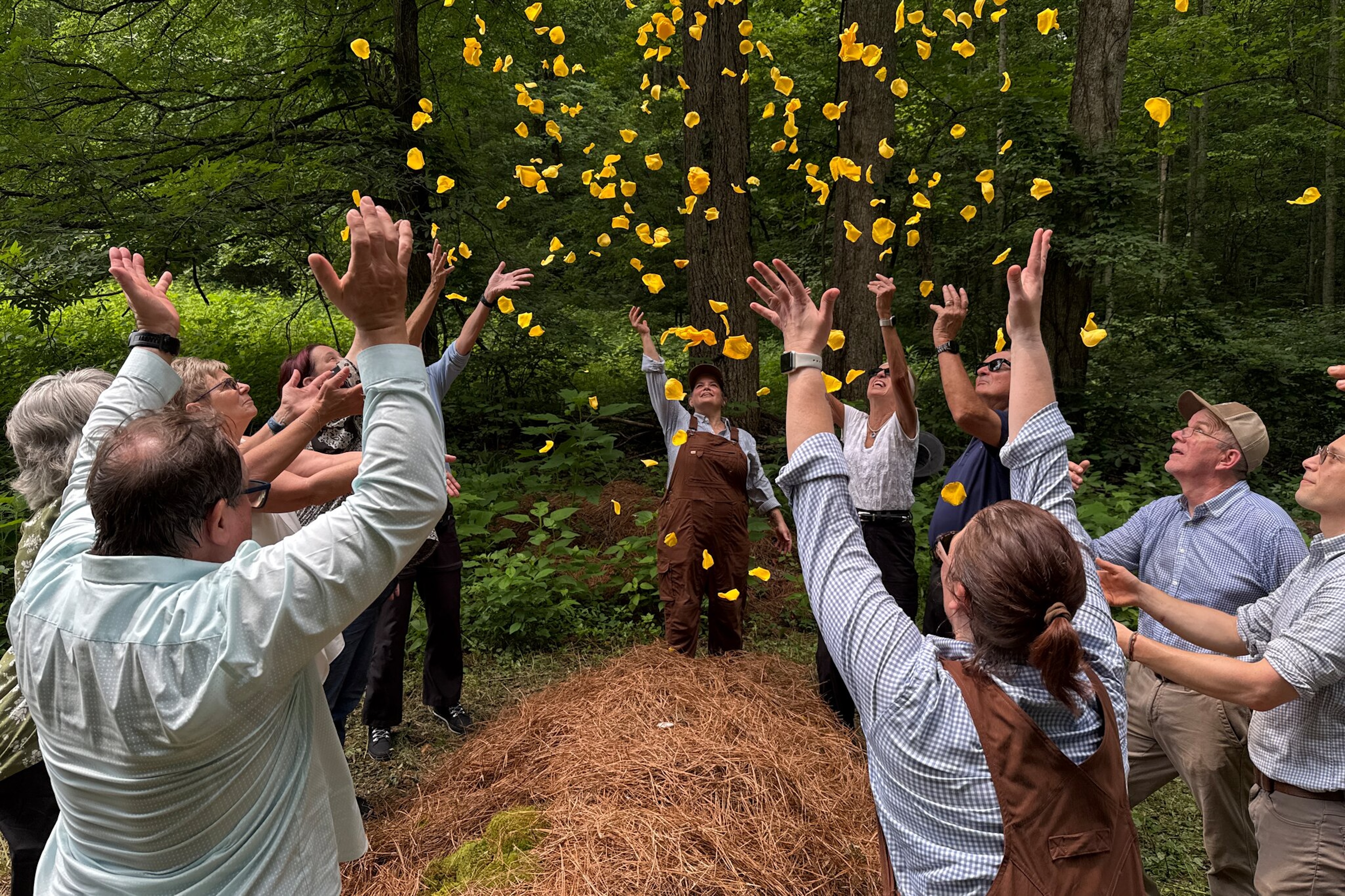
“Instead of observing, they are actively participating,” said Phifer. “We invite them to help lower the body in the grave with strings, put a handful or shovels of earth in the grave”, and to mount the ground, the pine branches and the flowers at the top thereafter. Then they could do toast in the parade with champagne or share a picnic.
When Larkspur began to operate in 2018, Phifer as the only employee, 17 bodies were buried on his 161 acres. Last year, an eight personnel treated 80 burials and the cemetery acquired more goods.
Other alternatives to conventional burial have also emerged. The company Earth Funeral has installations in Nevada, in the state of Washington, and, soon, Maryland, for the so-called human composting. In this process, a body is heated with vegetable material for 30 to 45 days in a high -tech drum, where everything ultimately turns into a Yard Cube de Terre.
It is 300 pounds, more than most families can use, so local conservances receive the rest. Cost: $ 5,000 at $ 6,000.
Alkaline hydrolysis, which is legal in almost half of all states, dissolves the bodies using chemicals and water, leaving sprayed bone fragments which can be dispersed or buried and an effluent which must be eliminated.
On the environmental level, when you include standard cremation, “there are ramifications for the three processes that we can avoid by simply putting a body in the soil” and leaving microbes and mushrooms do the rest, said Webster.
The area of the cemetery near the main population centers is however limited and more and more expensive. “I don’t think there is a perfect option, but we can do much better than traditional methods,” said Tom Harries, founder of Earth Funeral. The debates on comparative greenery will certainly continue.
But Green Burial made sense to Lynne McFarland and her husband, Newell Anderson, who heard of Larkspur in their episcopal church in Nashville. “The idea of going back to earth seemed good to me,” said McFarland.
His mother, Ruby Fielden, 94, was one of the first people buried in Larkspur in 2018, in an open meadow that attracts butterflies.
Last spring, Anderson, who had Alzheimer’s disease, died at the age of 90 and was buried a few meters from Fielden, in a biodegradable willow. A dozen family members read prayers and poems, shared stories and sung “Amazing Grace”.
Then they picked up shovels and filled the grave. That was exactly what her outdoor husband, a Boy Scout leader, said, said McFarland, 80, who plans to be buried there too.
I do not know if my survivors will undertake so much physical work. But my daughter and my son -in -law, although probably decades of their own end -of -life decisions, loved the idea of green burial in a place that we all cherish. The prices in what I consider now as my cemetery were low enough – $ 4,235, to be precise – that I could buy a plot to adapt to myself and seven descendants, if I never have a lot.
I hope this plan, in addition to minimizing the impact of my death on a fragile landscape, also reduced the family burden to make precipitated arrangements. At 76, I don’t know how my future will take place. But I know where it will end.
New age is produced thanks to a partnership with the New York Times.