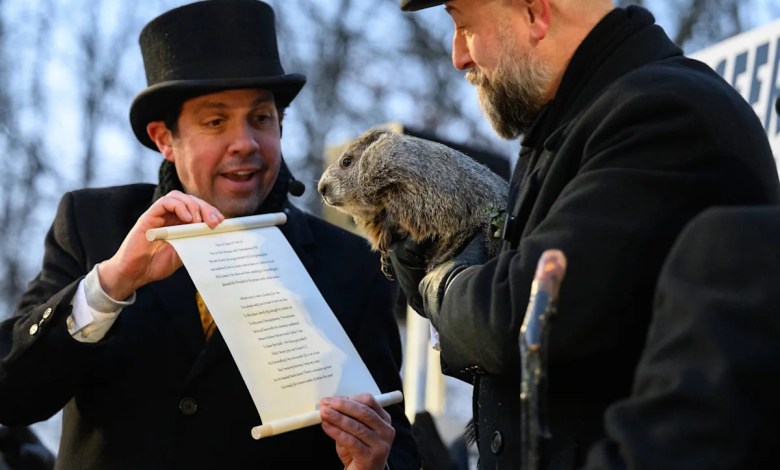
As the winter chill begins to fade, it is once again time for the nation to turn its eyes to Punxsutawney Phil for weather predictions for the next six weeks.
Although people may question the groundhog’s accuracy, this year, many are hoping that Phil does not see his shadow for the sixth consecutive year. Much of the country, including Tennessee, is still recovering from the snow and ice storms that struck on Jan. 24 and continues to feel the impacts of the cold weather.
Here is what to know about the history of Groundhog Day.
When is Groundhog Day?
Groundhog Day takes place on Feb. 2 every year. This year, it will be on a Monday.
What time does Punxsutawney Phil make his call?
Punxsutawney Phil usually makes his weather call early in the morning. It typically happens after 7 a.m.
How accurate is Punxsutawney Phil?
According to the Groundhog Club’s archives, Punxsutawney Phil has now seen his shadow 108 times, or 84% of the 129 times he has predicted the weather. From 1903 until 1933, he observed his shadow every year, making 31 his longest run.
In his more than 135 years of experience, he has an overall accuracy rating of just 35%, according to NOAA.
When did Groundhog Day start?
The tradition goes back centuries.
Around the fifth century, the European Celts believed that animals possessed supernatural powers on special days that fell halfway between the Winter Solstice and Spring Equinox, according to the National Weather Service.
Folklore from Germany and France indicated that when marmots and bears came out of their winter dens too early, they were frightened by their shadow and retreated back inside for four to six weeks. This was adopted by the Romans as Hedgehog Day, and when Christianity came into being, the formerly pagan observance also came to be called Candlemas.
The earliest known American reference to Groundhog Day can be found at the Historical Society of Berks County in Reading, Pennsylvania, where it was made on Feb. 4, 1841, in Morgantown, Berks County storekeeper James Morris’ diary:
“Last Tuesday, the 2nd, was Candlemas Day, the day on which, according to the Germans, the Groundhog peeps out of his winter quarters and if he sees his shadow he pops back for another six weeks nap, but if the day be cloudy he remains out, as the weather is to be moderate.”

Groundhog handler AJ Dereume holds Punxsutawney Phil after he saw his shadow predicting six more weeks of winter during the 139th annual Groundhog Day festivities on Friday, Feb. 2, 2025 in Punxsutawney, Pennsylvania.
In the U.S., the tradition derives from a Scottish poem, which reads:
“As the light grows longer, the cold grows stronger. If Candlemas be fair and bright, winter will have another flight. If Candlemas be cold and snow, winter will be gone and not come again. A farmer should on Candlemas day have half his corn and half his hay. On Candlemas day, if thorns hang a drop, you can be sure of a good pea crop.”
Why is Groundhog Day celebrated on Feb. 2?
In the Northern Hemisphere, in western countries, the official first day of Spring is about six weeks after Groundhog Day, on March 20 or 21.
Before the adoption of the Gregorian calendar about 1,000 years ago, when the date of the equinox drifted in the Julian calendar, the spring equinox fell on March 16. This was exactly six weeks after Feb. 2.
USA TODAY contributed to this report.
Jordan Green covers trending news for The Commercial Appeal and Tennessee. She can be reached at jordan.green@commercialappeal.com.
This article originally appeared on Memphis Commercial Appeal: When is Groundhog Day? How accurate is Punxsutawney Phil?


:max_bytes(150000):strip_icc()/HDC-GettyImages-1251707235-0fbf7e5cdd8349508f3229dd7dad785b.jpg?w=390&resize=390,220&ssl=1 "We Asked a Dietitian Which High-Fiber Foods They Always Keep On Hand—These Are the Top 12")
