Where could alien life exist in our solar system?


Who did not look in heaven and wondered if there was life there, somewhere, looking at us? Is it possible that there is an extraterrestrial life closer to us – within the limits of our solar system?
The short answer is yes, there are several places that researchers are looking for signs of life in our solar systemAnd there are clues that life could hide in unexpected places.
Is there life on Mars?
Although there do not seem to be “Small green men“Living in Mars, it is possible that there has been microbial life in the past. March is currently a freezing desert, but thanks to Mars Rovers who studied the rocks of the planet, we know that a long time ago, There was liquid water – An important condition for life.
“The Rover Curiosity was built to seek habitable environments, the genre that could have supported microbial life on Mars in the past, if life appeared on the red planet,” said Amy WilliamsProfessor of geology at the University of Florida and member of the teams in science of curiosity and perseverance of NASA. “The payload of curiosity has been selected to accomplish this task by looking for the conditions whose life we know on earth – liquid water, a source of carbon and chemical energy to feed a metabolism“She told Live Science.
In addition to studying the Martian environment, the Rover Perseverance made it possible to recover promising rock samples on earth for advanced analysis. The return mission of the Mars sample is currently being developed by NASA and ESA to go to Mars, collect the sampling nuclei and bring them back to earth. (Donald Trump administration proposed Cut funding from NASA To pay this mission, however.)
“At least one of the nuclei collected has qualities that correspond to the definition of a possible indicator of ancient microbial life,” said Williams about a particularly interesting rock sample. “Turning samples on earth with the Mars sample Sample Return Architecture would allow us to answer some of the deepest questions of humanity, especially if we are alone in the universe.”
In relation: How would we give instructions on the extraterrestrials towards the earth?
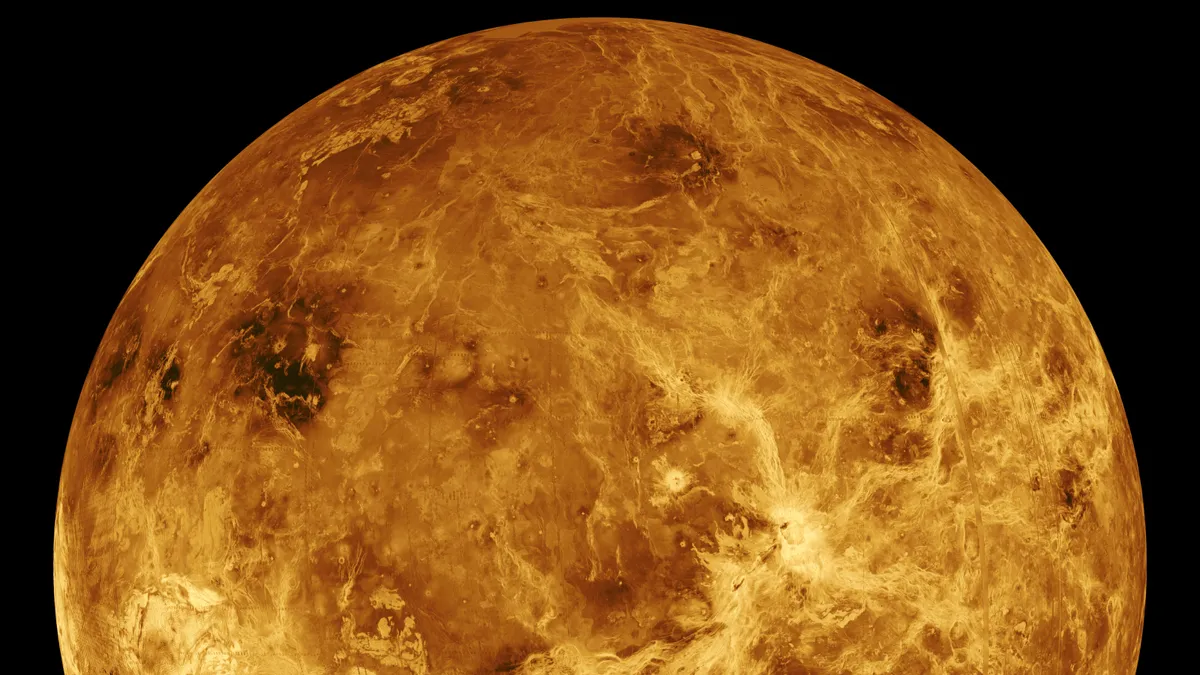
Could there be life in Venus?
Even if it is commonly called the “twin” of the earth, Venus is probably not the first place that anyone could seek life in the solar system. Its surface temperature is Hot enough to melt the leadAnd the average surface pressure is more than 90 times that of the earth. It is wrapped in thick and dense clouds which are mainly Made from sulfuric acidA highly corrosive substance that mixes with water to form acid rain on earth, damaging flora, fauna and soil.
Despite these hostile conditions, the microbial lifespan of the extremophiles could survive in the atmosphere of Venus, where temperatures and pressures are not so extreme; Perhaps life could find ways to protect itself from the destructive nature of sulfuric acid. To find out, the MIT sets up the Morning star missionsWho will go to the atmosphere of Venus in the ultimate goal of collecting a sample of the clouds on the planet and making it on earth for a better analysis.
“Microbial life could exist in the clouds of Venus, despite their composition of concentrated sulfuric acid”, ” Sara SeagerA professor at the MIT and the director of the Morning Star missions, told Live Science. “If we find convincing signs of life on Venus, this would upset our understanding of habitability and prove that life can exist in non -water solvents, opening the range of worlds where life is possible.”
When you are looking for life, scientists often focus on the search for liquid water because it is a requirement for life on earth. Finding life on Venus would break this limitation – which means that extraterrestrial life could be much stranger than we thought and there could be many more places to search for it.
In 2020, a possible detection of sparkling phosphine in the clouds of Venus became the center of a controversy on the signs of life in Venus. Phosphine gas was an unexpected discovery because the best known chemical processes that produce it come from living organisms or from extreme pressures on gas giants. However, the signal was small and the criticisms said it could have been Data noise. The Morning Star Missions to Venus will give us much more information on the chemistry of the planet and possibly confirm if there is floating phosphine in the clouds.

Is there life on the moons of Saturn and Jupiter?
Further in the solar system, there is Several moons In orbit around Saturn and Jupiter who could potentially accommodate life, especially Enceladus and Europa.
The moon of Saturn Enlade has a global underground ocean hides under a thick icy shell. The moon constantly spits giant salt water plumes in space which give scientists a rare opportunity to directly sample the interior of a celestial body other than the earth. The Cassini mission carried out several Enladus flies from 2005 to 2017, collecting images and even direct samples of the plumes which are still analyzed. A 2023 paper in nature announced that scientists had detected phosphates on Enlade – which means that scientists have now detected all basic chemical ingredients for life in the ocean of the Moon.
Several missions to study Astrobiology on Enceladus, with the aim of taking more samples from the plumes, were in preparation by ESA and NASA teams, although they are still far from going to the launch ramp.
Like Enladus, Jupiter’s moon Europa is an icy world with a global underground ocean and plumes of water that burst out of its surface. Massive of Jupiter gravitational traction on the moon provides energy and movement that supplies active geological activityAnd is considered the main reason why the ocean is hot enough to be liquid. The interactions between the salty ocean and the rocky interior could possibly accommodate a life similar to the life found around hydrothermal vents on earth.
Jupiter Icy Moons Explorer of ESA (Juice) Launched on April 14, 2023 with an expected arrival in Jupiter in July 2031, where he studied Jupiter and three of his moons: Europa, Callisto and Ganymede. Clipper Europa de la Nasa Mission launched on October 14, 2024 to reach Jupiter in 2030 and lead Europa flies to study if living conditions are present.
Titan, another of Saturn moons, is an extremely unique place in the solar system. He has A methane cycle Like the water cycle of the earth and a thick atmosphere of nitrogen and methane. The Cassini mission carried out more than 50 Flybys of Titan from 2004 to 2017 and launched the Huygens survey which landed on the surface of the Moon in 2005. These two missions collected data indicating the Titan atmosphere could probably Create complex molecules which are constituent elements for life. NASA sets up a octocopter the size of a car To fly on Titan and take samples from different landing sites.
Where could life in the solar system be?
There are a lot of other places that we could find life in the solar system, including dwarf planets like Ceres. Ceres is supposed to have a lot liquid water under an icy and rocky crust, thanks to the images taken by NASA dawn mission who visited it in 2015.
The more we explore the solar system, the more places we find that have conditions that could support life. If there is life there, it is probably not advanced enough to contact us, so we will have to be the first to say hello.


