
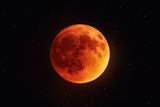
On March 3, 2026, the only total lunar eclipse visible from Earth in 2026 will take place. Visible from North America, some Pacific islands, Australia, and parts of East Asia, the eclipse will be the last chance to see the lunar event before the New Year 2029. The eclipse is also called a blood moon, as the moon can turn a deep crimson during the event.
This eclipse will be visible during the morning hours of March 3, 2026. The totality will last nearly an hour, from 6:04 to 7:02 a.m. EST, according to NASA. On the Eastern seaboard of the U.S., the blood moon will set during totality, but will be in the sky for the whole hour on the Pacific coast.
Read More: Establishing a Moon Time Zone Could Benefit Future Missions to Mars
What Is A Total Lunar Eclipse?
This rare lunar event occurs when the sun, Earth, and moon line up perfectly, with our planet sandwiched between the sun and the moon.
A blood moon is always full, but full moons are only rarely blood moons. That’s because the moon’s orbit is on a slight tilt compared to Earth’s orbit around the sun. Only when the moon sits in the “umbra,” a dark shadow region cast by Earth blocking the sun’s light, is a blood moon possible.
What Happens During An Eclipse?
At the start of the eclipse, the moon will enter a second, less intense shadow cast by Earth called the penumbra. This is a very subtle effect and may only be seen as a slight darkening of the moon’s surface. But as the moon enters the umbra, a much darker, curved shadow will start to move across the moon’s surface.
When the moon enters the middle of the umbra, it will reach totality. Here, the moon is still visible, but the only light reaching it has been warped by traveling through Earth’s atmosphere. After the moon leaves totality, it will slowly move out of Earth’s shadow.
Why Is The Moon Red During A Total Lunar Eclipse?
Our planet’s atmosphere scatters blue light, but allows red and orange light to pass through more easily. This is why sunsets are red; when the sun is at the horizon, its light has to pass through more atmosphere to reach us.
As the sun’s light has to pass through a lot of Earth’s atmosphere during a total lunar eclipse, all the blue light is scattered by the time it reaches the face of the moon. This casts the moon in an orange haze, producing the blood moon. If the atmosphere is especially dusty, for example, because of a volcanic eruption, the normally orange blood moon may appear dark red, or even reddish-black.
Tips For Watching The Total Lunar Eclipse
Remember that, unlike a solar eclipse, which should not be viewed directly, a total lunar eclipse can be observed with the naked eye, so feel free to peer at our moon as it undergoes its rapid color shift.
Since totality will last about an hour, it’s best to find a comfortable spot outside — perhaps by setting up a chair or blanket. It may also be cold, so make sure to dress appropriately.
Read More: The Moon Is Moving Farther From Earth Each Year, and Tides Are the Reason
Article Sources
Our writers at Discovermagazine.com use peer-reviewed studies and high-quality sources for our articles, and our editors review for scientific accuracy and editorial standards. Review the sources used below for this article:


