Who are three Dodger stars who need to heat up at the plate?

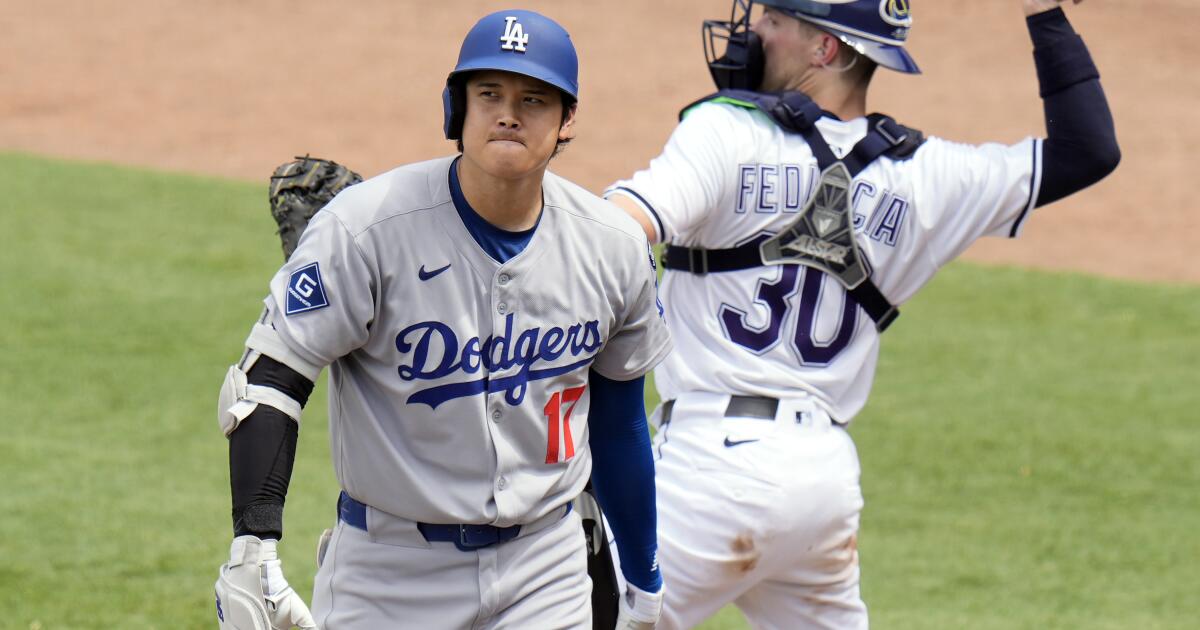
The Dodgers direct the majors as a percentage of the base of the base and the leak as an infraction this year. They are second in the National League in a score and third on average in the team stick.
They have the best players in the League by hitting (Will Smith Bat .324 and Freddie Freeman Battant .306) and OPS (Shohei Ohtani at .982 and Smith at .963).
They think they have several players who will get MVP votes at the end of the season, including the rating favorite for the price in Ohtani.
And yet, while the club enters the section of the season, their alignment could be the greatest question point for their attempted defense of the World Series championship last year. Since the beginning of July, they have scored the third most important points of the majors, have the second average of the lowest team strikers and the lowest fourth OPS.
They remained relatively silent on the deadline for trade, hoping that a certain number of superstars in difficulty make it possible to pass the last two months of the campaign. But at this point, only Freeman (who endured a two -month crisis Before warming up during their recent trip to nine games) showed tangible signs of a renewal at the end of the season.
“If you look at him on the offensive side, with regard to our guys, they will be the first to tell you that they have to work better and more regularly,” said manager Dave Roberts last weekend, after public services Alex Call has become the only addition of the team’s deadline. “This is something on which we all count … Now it’s all up to all of us and do our job.”
Although this is true for most programming strikers, up to Andy Pages and (even before his last ankle injury push) Tommy Edman, there are three players of stars in particular that the Dodgers were waiting to come back in shape.
Here is an overview of the problems that afflict each of them:
Mookie Betts
First 15 games:. 304 Average, .554 Strike percentage, .954 ops
Last 87 games: .222 Average, .327 Strike percentage, 0.616 ops
When asked on Sunday for the umpteenth time this season if he knew what was wrong with the swing of Mookie Betts, Roberts failed to answer.
“Honestly, no,” said Roberts. “I know that he and the struck coaches worked with diligence, in a coherent, intentionally. I think the first thing, the simplest thing, is to say that it is a mechanical thing. So I suppose that is there. But I also believe that there is a mental part, which beats it a little.”
When Betts was presented with the same question later Sunday afternoon, after spending a sequence without strike from a season to 17 bates and looking at his average striker at 0.233, he was left in search of a divine intervention.
“I did everything I can do,” he said. “It is to God at this stage.”
Betts’ difficulties are not for a lack of effort. He spends hours in the stick cage before (and sometimes after) almost all matches. He has tried mechanical adjustments and mental signals and fundamental exercises which, in the past, would bring it back on the right track.
Its approach has largely remained solid, as it ranks in the highest 20% of the bigiles in prosecution rate, assistance rate and percentage of withdrawals, according to data from scholarly baseball statcast.
And although his bat speed is in the 11th centile of MLB strikers (and going down near two MPH of his season of 39 Homer in 2023), it is also almost the same thing as last year, when he was still a 0.289 striker with 19 circuits (in just 116 games) and a .863 ops (which only dragged Shohei Ohtani the team).
“I really don’t know what else to do,” he said. “I have no answers.”
Perhaps the most confusing metric: Betts is in the 99th centile in “square” rate, a metric which effectively determines when a ball is struck from the ideal point of the bat.
But, even when Betts establishes solid contact, it simply does not generate as much power as usual – ranking among the lower third of the league strikers in the average output speed and the hard percentage; And look at flies of flies that used to leave the courtyard on the warning track, if they arrive so far.
Although he was the victim of an unluckiness (his average stick of .252 expected is almost 20 points higher than his real brand), he has had no choice but to “return to the drawing board” repeatedly this year – grating gradually on his confidence because the answers do not manage to appear continuously.
“I do not know anyone in the world who would have confidence in the section that happens [for me]”He said.” It fears when you don’t do things. “
Betts can be a striated striker. And the Hope of the Dodgers is that, at one point in the past two months, it will find something that unlocks more pop in its bat, and goes to the type of radiator which can make it an effective producer at the top of the programming.
Until this happens, however, the questions will persist. On the question of whether his stop game is to be blamed for his offensive decline (a multiple theory of rival assessors has recently indicated in recent times as a reason for his difficulties). On the question of whether age simply catches up with the 33 -year -old veteran who will soon be 33 years old. And to find out if he will never be the same striker as he was once, in the midst of a crisis of a season, almost no one has seen coming.
Shohei Ohtani
The first 70 games (before resuming pitching):. 297 average, 1.034 ops, withdrawal rate of 24%
Last 40 games (since the recovery of pitching): .230 average, .886 ops, withdrawal rate of 31%
The easy demarcation line for Ohtani this year was before and after his return to pitch in mid-June, with an offensive production, even if his business checked the mound.
Ohtani has always been a relatively productive striker since then, continuing to strike circuits at a pace of the league (he is tied with Kyle Schwarber for the head of the NL with 38 over the year).
But it has become much easier in the past two months, it has also embodied and above all by its climbing withdrawal rate.
An overly aggressive approach would be an easy explanation here. And there have been times, Roberts noted, the hitter seems to enter a “swing mode” which prevents him from dismissing bad throws.
But overall this season, Ohtani is in fact less often swayed than last year, chasing throws at an almost identical pace and continues to make more walks than almost anyone in the majors (his 71 free passes are seventh plus this season).
Ohtani’s problem was an increase in swing-and-miss, the reigning MVP coming empty on more than a third of its hacks.
It could simply be a by-product of the additional physical workload that he has provided since his recovery in two directions. But he insisted that such problems remain repairable, citing a lack of balance and consistency in its swing mechanisms.
Like Betts, Ohtani can also be subject to more extreme highs and bass during a year. Last season, for example, he only reached. 235 with a .886 OPS in August, before turning in September and hitting .393 with a 1,225 Ops.
Dodgers could use another tear at the end of the season like this again. That he can do it while accelerating while a launcher is looming as one of the biggest questions that the dodgers are faced with the last period this year.
Teoscar Hernández
33 First games (strain before Roin): .315 average, nine circuits, .933 ops, 18% withdrawal pace
57 Last games (post-legal voltage): .211 average, seven home runs, 0.619 ops, 28% withdrawal
Hernández’s mid-season deposit may be the easiest to explain any recently collapsed Dodgers striker.
Before undergoing groin / adductor tension in early May, he was at a rhythm of stars (and potentially even MVP) after re-signed with the dodgers during the offseason.
Since then, however, the 32 -year -old man simply did not look like the same thing – both on the plate, where he was unable to drive the ball as he usually does, and in the field, where his range was clearly limited.
To this end, a lack of ball that he removed last month did not help things either.
There have been recent signs that Hernández is in good health again. His percentage of slugging has started to back off for a week off for the stars break. He had harder contact, especially in the center and the opposite field.
“At first [after my injury] It was a bit hard, “said Hernández after hitting circuits in consecutive games in Fenway Park last week.” First, I had my groin, then I gave my foot fault. Could not put a lot of weight [on it] For about two weeks. Thank God, there was a break in there. I obtained these four days of leave, going through it and obtaining treatment, based. And finally feeling like me again.
But, this still has not resulted in a total reversal of fortunes, Hernández finishing the road trip of five for 25 with nine sticks to the stick and only one additional blow.
Last year, Hernández’s ability to be a racing producer behind the Dodgers star trio was crucial for their regular seasonal season and in playoffs. Recently, however, it was more subject to withdrawal and less opportunistic on the plate, contributing to a series of recent frustrating defeats marked by chances wasted in leverage.
“He is about and he does not try to kicks,” said Roberts. “He creaks.”
Like the other Dodgers stars, the team will need him to get out of it completely and to revise once again to the expectations that the club had for him and the alignment as a whole.


:max_bytes(150000):strip_icc()/Health-GettyImages-1840883649-93d16ec7754b4bd6ad89dbfd234e1d5c.jpg?w=390&resize=390,220&ssl=1 "The Best Time To Drink Hibiscus Tea To Naturally Reduce Your Blood Pressure")