NASA astronaut, two Russian cosmonauts return to Earth from space station


A NASA astronaut and two cosmonaut crewmates attached to their Soyuz ferry Monday evening, detached from the International Space Station and plunged toward a target landing in the frigid steppe of Kazakhstan early Tuesday to conclude a eight month mission.
With Soyuz Commander Sergey Ryzhikov strapped into the descent module’s central seat, flanked on his left by cosmonaut Alexey Zubritsky and on his right by NASA’s Jonny Kim, the Soyuz MS-27/73S spacecraft detached from the laboratory at 8:41 p.m. ET.
After flying a safe distance to a specific point in space, the Soyuz braking rockets fired for four minutes and 42 seconds starting at 11:09 p.m., slowing the craft’s speed of 27,100 mph to about 286 mph, just enough to drop the other side of orbit into Earth’s lower atmosphere.
NASA 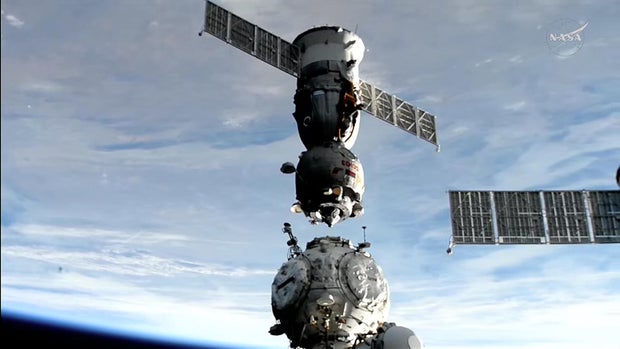
Enduring re-entry temperatures of around 2,500 degrees Fahrenheit — and decelerating rapidly in the process — the Soyuz descent module, suspended beneath a large orange and white parachute, landed at 12:03 a.m. EST Tuesday (05:03 UTC, 10:03 a.m. local time in Kazakhstan) and rolled over onto its side.
Braving freezing weather, Russian recovery teams and NASA support personnel quickly reached the charred spacecraft, opening the Soyuz hatch, extracting the crew and performing the first medical checks as the trio began to readjust to gravity.
NASA 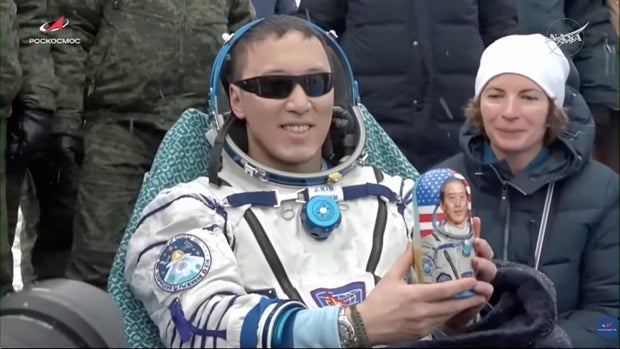
Resting briefly in a nearby recliner, as is tradition for returning Soyuz crew members, Kim appeared healthy and in good spirits, smiling in thanks after Russian recovery teams presented him with a nested matryoshka doll with its face painted on the outermost hull.
After more detailed medical checks inside a heated inflatable tent, the crew was to be flown by helicopter to the town of Dzhezkazgan where Kim planned to board a NASA plane for the long flight back to the Johnson Space Center in Houston. Ryzhikov and Zubritsky will travel to Star City near Moscow for debriefings and reunions with family members.
NASA 
Left aboard the space station were NASA Crew 11 aviators Zena Cardman and Mike Fincke, Japanese astronaut Kimiya Yui and cosmonaut Oleg Platonov.
Also on board: Soyuz MS-28/74S commander Sergey Kud-Sverchkov, flight engineer Sergei Mikaev and NASA astronaut Christopher Williams. They arrived at the space station on November 27 to replace Ryzhikov, Zubritsky and Kim.
At a change of command ceremony Sunday, Kim said what he would remember most about his eight months in space was “the bond we shared together.”
“I firmly believe that the greatest quality of an astronaut, and of a human, is not technical competence, nor loyalty, nor any of the myriad other things we like to attribute to astronauts. It is love,” he said. “We’ve always given each other grace and had so much love for each other and everyone who supports us. I think that’s what makes space exploration possible.”
During their time aboard the space station, Kim and his crewmates traveled 104 million miles in 3,920 orbits. Kim focused on research and maintenance in the U.S. segment of the station while Ryzhikov and Zubritsky conducted two spacewalks.
NASA 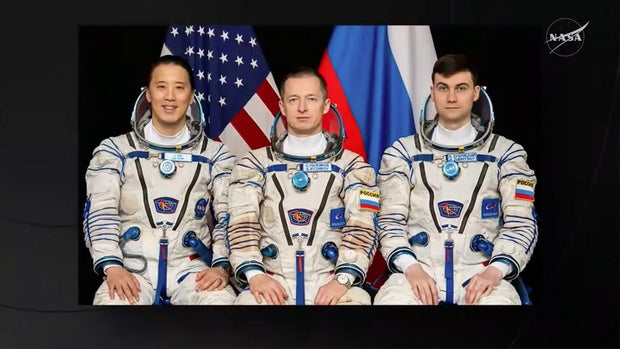
The son of South Korean immigrants and father of three, Kim has an impressive resume, even by astronaut standards. He is a former Navy SEAL, combat veteran, and graduate of Harvard Medical School.
In a pre-launch interview, Kim said he experienced “terrible times” in combat and ended up “really exhausted. I was very exhausted from combat, from war and from loss. … I needed a way to continue to serve, and it seemed logical that medicine would be that vehicle.”
Already a SEAL Team combat medic, Kim was accepted by Harvard Medical School. Along the way, “I probably went a little too far in making sure that previous successes didn’t prepare me for the future.”
“I made sure that the people I worked with at the hospital didn’t know that I was previously a SEAL, because I wanted my patients, I wanted my colleagues to think of me as a reliable, competent, good doctor. Not because I was a SEAL, but because that’s what I was.”


