Why blizzards, heat waves, tornados and floods are all hitting the U.S. this week


March 16, 2026
3 min reading
 Add us on GoogleAdd SciAm
What’s this wild weather this week?
From blizzard conditions in the Midwest to a heat wave in the Western United States to flooding in Hawaii, March brought wild weather to the country.
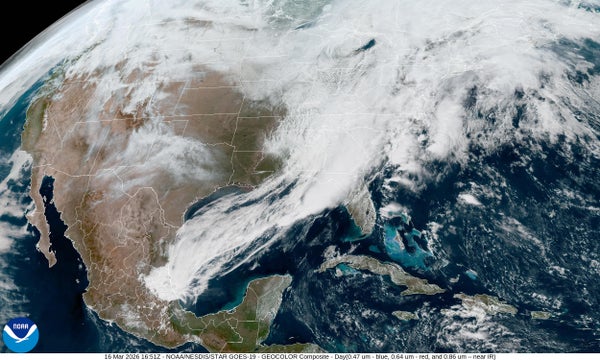
On Monday, a low pressure system brought snow to the Midwest and stormy conditions to the eastern United States.
Torrential rains caused flash flooding in Hawaii. Parts of the upper Midwest are covered in more than two feet of snow, and flakes are still falling. Hail, high winds and tornadoes threaten the eastern United States. And the west will experience record heat. Why does everything seem to be happening right now?
The short answer: It’s March. Early spring is a transitional time of year, weather-wise. Cold air from the north persists even as warm, humid air rises from the south, leading to collisions over the contiguous United States that create ideal conditions for unsettled weather and breathtaking snowstorms. “March and April are the times of year when we see these air mass clashes,” says Brian Hurley, a meteorologist with the National Weather Service (NWS) Weather Prediction Center.
Let’s look at the details a little more, starting with snow in the Midwest. A storm, or low pressure system, developed over the region, with cold air coming from Canada meeting moist air coming from the Gulf of Mexico. That means the storm “has a lot of moisture to work with,” Hurley says, so snowfall totals are high. The snow is also very wet compared to what usually falls in the area in January or February. That’s pretty normal for March and April snows there, Hurley said. But because this storm is quite strong, it brings blizzard conditions and snowfall of up to three to four inches per hour in some locations. Some locations could see record snowfall for this time of year.
On supporting science journalism
If you enjoy this article, please consider supporting our award-winning journalism by subscription. By purchasing a subscription, you are helping to ensure the future of impactful stories about the discoveries and ideas shaping our world today.
Next, the low pressure system is associated with a feature that in meteorology is called QLCS, or quasi-linear convective system. Basically, this means a long wavy line of thunderstorms, which can be seen moving down from the low pressure area in the shape of a classic comma on weather maps. Waves occur when “winds blow faster” in front of the mainline, Hurley explains, an arrangement that resembles a taut arc. The wind occurs due to large pressure differences, and in this case it could reach gusts of up to 60 to 70 miles per hour in parts of the Mid-Atlantic on Monday. Abundant moisture creates an unstable atmosphere that will cause thunderstorms to develop and, combined with strong winds, could create tornadoes.
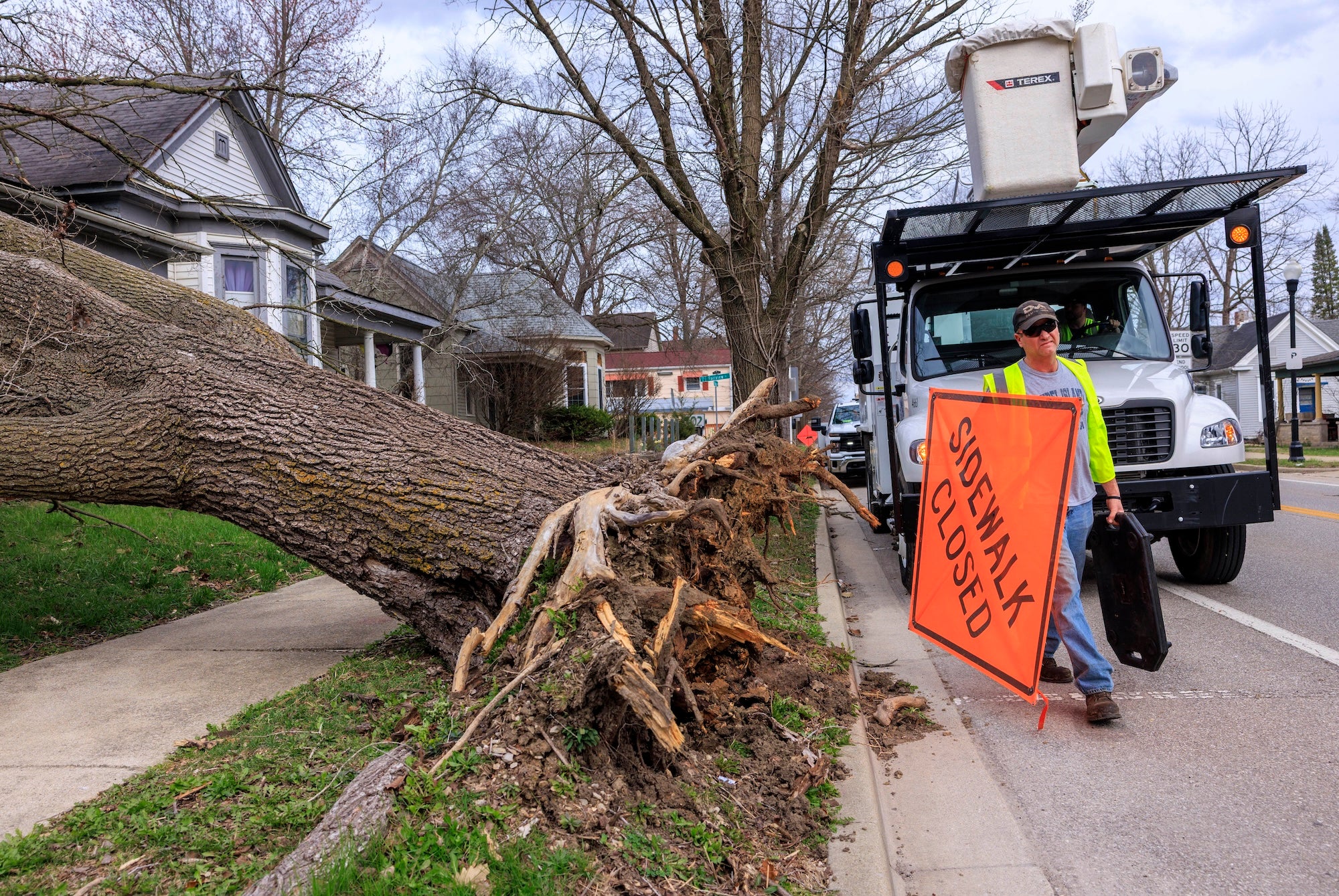
A city worker closes a sidewalk after high winds toppled a tree onto a home March 15, 2026 in Bloomington, Indiana.
Jérémy Hogan/Getty Images
Now let’s move west. Upstream of a low pressure area, you will find an anticyclonic area, which is exactly the one that should stabilize and strengthen over the South-West this week. This will lead to a major heat wave that is expected to send temperatures well above 100 degrees Fahrenheit (38 degrees Celsius) in some locations. This also happens in summer and is often called a heat dome: temperatures won’t be as high as if it were, say, July “but they are very warm compared to what they were.” [they] It should be,” Hurley says. The heat wave could set all-time March records, unusually early in the month.
Moving west and even further upstream, on the other side of the high pressure system is another area of low pressure. This one, called the “Kona Low,” brings southerly winds “which bring a lot of deep moisture to the islands,” said Thomas Vaughan, a meteorologist at the NWS office in Honolulu. The Hawaiian Islands typically see a few of these systems per year, he said, but this one was intense. Several locations recorded rainfall totals of 15 inches or more over five days, leading to flash flooding and mudslides. These rains “well exceeded normal precipitation values for the entire month of March,” Vaughan explains. Further rain is expected this week, but not to the same extent, he adds.
It’s time to defend science
If you enjoyed this article, I would like to ask for your support. Scientific American has been defending science and industry for 180 years, and we are currently experiencing perhaps the most critical moment in these two centuries of history.
I was a Scientific American subscriber since the age of 12, and it helped shape the way I see the world. SciAm always educates and delights me, and inspires a sense of respect for our vast and beautiful universe. I hope this is the case for you too.
If you subscribe to Scientific Americanyou help ensure our coverage centers on meaningful research and discoveries; that we have the resources to account for decisions that threaten laboratories across the United States; and that we support budding and working scientists at a time when the value of science itself too often goes unrecognized.
In exchange, you receive essential information, captivating podcasts, brilliant infographics, newsletters not to be missed, unmissable videos, stimulating games and the best writings and reports from the scientific world. You can even offer a subscription to someone.
There has never been a more important time for us to stand up and show why science matters. I hope you will support us in this mission.


