Why Congress rarely pushes back when presidents deploy military force : NPR

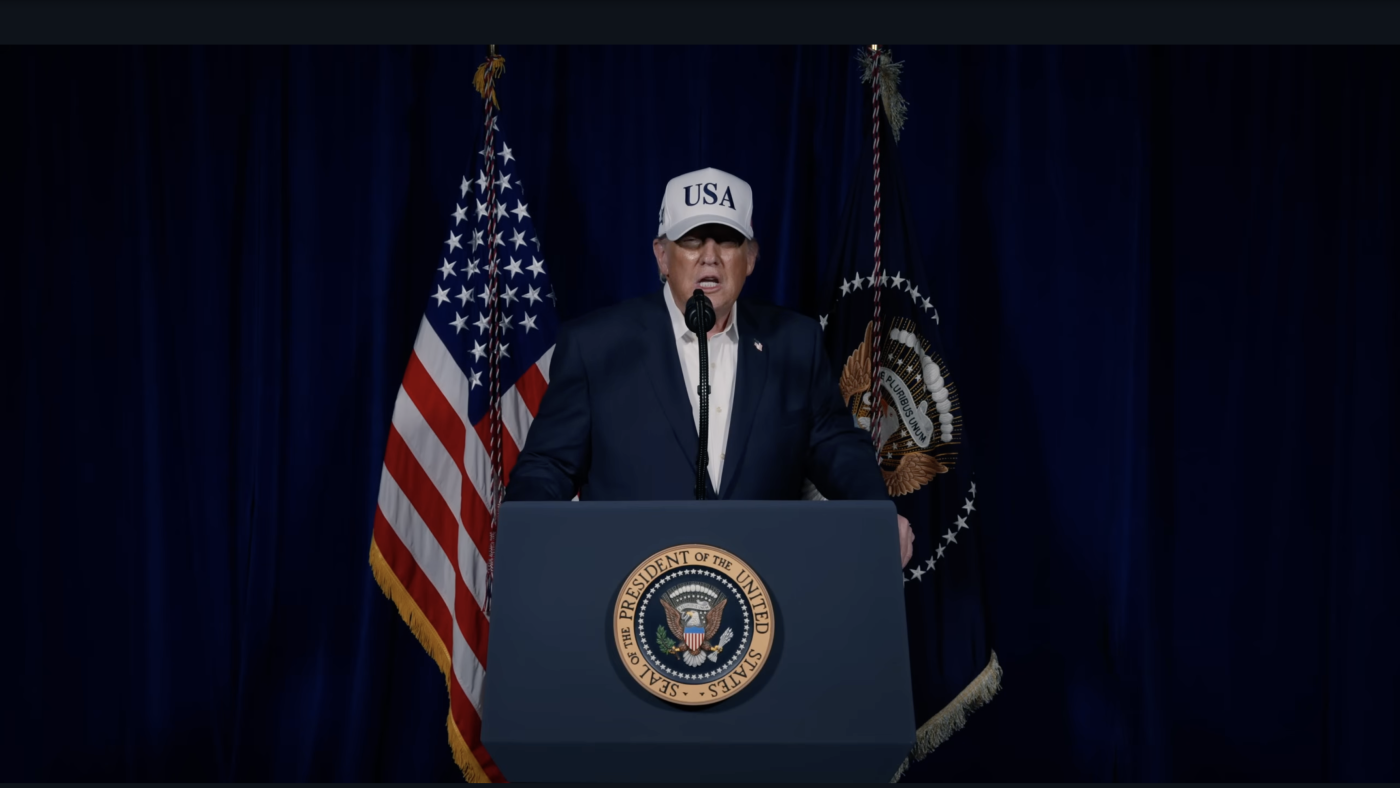

On February 28, the White House released a video of President Trump discussing the strikes against Iran.
The White House/NPR screenshot
hide caption
toggle caption
The White House/NPR screenshot
The Constitution gives Congress alone the power to declare war, but modern presidents have claimed broad authority to use military force.
Congress has done little to respond, including last week when lawmakers voted against a resolution to end President Trump’s military action against Iran.

Democrats have clashed with Republicans and the administration over the legality of the strikes.
“We should not be at war without debate and a vote,” said Sen. Tim Kaine, D-Va. “That’s what the creators wanted.”
“We have exceeded the law and its requirements,” Secretary of State Marco Rubio told reporters after briefing lawmakers last week. “This is an action by the president to address a real threat.”
The Constitution says the president is commander in chief. It also asserts that the power to declare war rests with Congress. But in practice, establishing this delimitation has proven complicated and controversial.
To understand how this happened, it is helpful to trace the evolution of the war powers debate, dating back to the earliest days of the republic.
How tensions between Congress and the president have evolved
Matthew Waxman, a Columbia University law professor and war powers expert who served in several positions in George W. Bush’s administration, says this separation of powers between the executive and legislative branches in this space didn’t create much tension at first.
“There just wasn’t a lot of standing strength,” says Waxman. “The president should address Congress to fund military forces to conduct military campaigns abroad.”

On December 8, 1941, President Franklin D. Roosevelt addressed a joint session of Congress in Washington, D.C., following the Japanese attack on Pearl Harbor, Hawaii.
PA/
hide caption
toggle caption
PA/
And that’s what presidents did, all the way back to President Franklin D. Roosevelt during World War II, the last time a president asked Congress for a formal declaration of war.
The United States emerged from that war as a global superpower – a superpower with nuclear weapons.

“So these are fundamental changes in the nature of war, the role of the United States in the world, and the relationship between Congress and the president,” says Oona Hathaway, a law professor at Yale University who has advised the State Department on international law under several administrations.
This changing relationship was tested in 1950 when President Harry Truman deployed troops without approval after communist North Korea invaded South Korea.

President Harry Truman speaks to a film crew at the White House on November 30, 1950. Truman warned that U.N. forces would not retreat in Korea and that the atomic bomb would be used if necessary to deal with the military situation in the Korean War.
Henry Griffin/AP
hide caption
toggle caption
Henry Griffin/AP
“It ended up being a grueling three-year war,” Waxman says. “This truly constitutes a culmination of presidential unilateralism.”
So in 1964, President Lyndon B. Johnson asked Congress to authorize growing involvement in Vietnam after American ships were attacked in the Gulf of Tonkin.

On August 10, 1964, President Lyndon B. Johnson speaks at the White House as congressional leaders stand at his office for a signing ceremony of the Congressional Resolution, also known as the Gulf of Tonkin Resolution, supporting his strong stance against aggression in Southeast Asia. Historians view the resolution as the crucial catalyst for the United States’ deep involvement in the Vietnam War.
John Rous/AP
hide caption
toggle caption
John Rous/AP
But President Richard Nixon’s secret bombing operation in Cambodia beginning in 1969 triggered congressional hearings and the 1973 War Powers Resolution.
“What Congress was really trying to do was get back in the game, assert its constitutional role,” Hathaway says.
What is War Powers Resolution?
The War Powers Resolution requires that Congress be consulted first “in every possible case.” The law also requires the president to notify Congress within 48 hours of the introduction of U.S. forces into hostilities. This further gives Congress a tool to end U.S. involvement by passing a resolution ending military action, subject to presidential veto.
The same law requires the president to step down within 60 days absent authorization from Congress.
What can make things murky, Hathaway says, is that Congress refusing to order a withdrawal is not the same as authorizing the use of force.

“This is sometimes misinterpreted as a 60-day blank check to the president,” Hathaway says.
Presidents largely complied with the requirement to inform lawmakers and went to Congress to authorize the wars in Iraq and Afghanistan. And it is understood that the Constitution gives presidents the power to act quickly in emergencies.
But presidents have also pushed the limits of their power to act in certain circumstances, interpreting words like “hostilities” and “imminent threat” to fit their goals.

President Barack Obama arrives with Secretary of State Hillary Clinton to deliver a statement on Libya at the White House on February 23, 2011.
Pablo Martínez Monsivais/AP
hide caption
toggle caption
Pablo Martínez Monsivais/AP
Without Congress, strikes were ordered by President Bill Clinton in Kosovo, President Barack Obama in Libya, President Donald Trump in Syria and President Joe Biden in Yemen.
Why presidents have expanded their power
But Waxman and Hathaway say Trump is now taking a big constitutional leap.
“Starting a war in the Middle East, now involving more than a dozen countries, is war in the constitutional sense,” Hathaway says. “The nature, scale and duration of this conflict are extraordinary.”
Hathaway argues that Trump could have asked Congress for authorization to use force in anticipation of possible intervention, without sacrificing the president’s ability to act quickly when the time came to act. She also says these actions raise not only constitutional questions, but also respect for international law.
Hathaway and Waxman note that the courts have mostly avoided weighing in on war powers debates, leaving Congress to oversee its own authority.
“James Madison, in the Federalist Papers, describes checks and balances as a way to control ambition,” says Waxman. “We’ve seen presidents generally assert their prerogatives and Congress be quite passive and acquiescent. Often, it’s best for members of Congress to sit back and then either support the president or criticize him depending on how these things are going.”
And for now at least, that’s the position of most Republicans and some Democrats in Congress, but that calculus could change if this conflict drags on and the sacrifices it requires increase.


