Amid global tensions, Italy hosts a relatively peaceful Olympics

MILAN — The world is experiencing more conflict and unrest than at any time since the fall of the Berlin Wall almost forty years ago.
There are hot wars in Ukraine and Gaza, cold wars on the Korean Peninsula and the Taiwan Strait, and incipient wars in Iran and parts of Africa. The global peace index is at its lowest level ever.
But four days after the start of the Milan-Cortina Winter Games, harmony reigns in the villages and Olympic sites of northern Italy,
“We are only one [few] days of competition, so fingers crossed,” said Andrea Varnier, general director of the Milan-Cortina Games. “This is sport. It’s athletes from all over the world coming together and you have to focus on that and try to leave the other issues elsewhere.
“This is why we are holding the Games.”
Maybe. But the Olympics have long been a platform for politics and protest, from Nazi propaganda in 1936 to the black-gloved fists of John Carlos and Tommie Smith in 1968 to the Munich massacre four years later.
More than 135 countries, including the United States, have boycotted at least one Olympic Games due to political differences. The level of calm that has fallen on the Italian Olympic sites therefore attracts attention.
“The geopolitical situation in the run-up to these Games is perhaps more tense than I can remember,” said a British adviser to the Milan-Cortina Olympic organizing committee, who was not authorized to speak publicly. “People just came, I think, almost to break away from macro-geopolitics, just to get away from everything and enjoy everyone coming together without all of that.”
That’s not to say the Olympics are devoid of drama.
Back in the United States, President Trump used social media to criticize some of Team USA’s top athletes, who used press conferences to denounce federal immigration raids in Minnesota, the treatment of immigrants and anti-LGBTQ policies adopted by the Trump administration.
On Sunday, Trump called freestyle skier Hunter Hess a “loser” after Hess said that carrying the flag “doesn’t mean I represent everything that’s going on in America.”
On Monday, Chloe Kim, a two-time Olympic snowboarding champion whose parents are from South Korea, and snowboarder Bea Kim responded to Trump.

American snowboarder Chloe Kim speaks during a press conference at the Milan-Cortina Olympic Games on Monday.
(Hannah Peters/Getty Images)
“My parents are immigrants from Korea, this one really hits close to home,” said Torrance native Chloe Kim. “I’m really proud to represent the United States. The United States has given my family and I so many opportunities, but I also think we have the right to express our opinions about what’s going on.”
Bea Kim, a teenager from Palos Verdes, also comes from a family of Korean immigrants.
“There are a lot of different opinions in the United States right now. Obviously, we’re very divided,” she said. “Personally, I am very proud to represent the United States. That being said, diversity is what makes us a very strong country and what makes it so special.”
Over the past two weeks, large protests in Milan have addressed everything from the cost and environmental impact of the Games to the inclusion of U.S. immigration agents in the U.S. team’s security detail. On Saturday, one of those protests turned violent when around 100 hooded demonstrators left a peaceful march and clashed with police, who responded by shooting them with tear gas and a water cannon. Six people were arrested.
And the country’s transport ministry said it had opened a terrorist investigation into the synchronized sabotage of railway lines in northern Italy on the first day of the Games last weekend.
All of this took place outside of the competition venues and Olympic villages. So, although it is still early, the generally calm and relaxed atmosphere of the Milan-Cortina Games contrasts sharply with that of other recent Olympic Games.
Two years ago, the Paris Summer Games opened amid threats of political sabotage from Russia, fears of Islamist terrorist plots and fallout from the war between Israel and Hamas. As a result, more than 75,000 police, soldiers and private security personnel were mobilized for the opening ceremony, and camouflaged soldiers carrying assault rifles became a common sight outside the venue.
In 2012, more than 18,000 troops deployed around London’s Olympic venues, marking the largest peacetime operation in Britain’s modern history.
“We don’t want to create a militarized type environment,” Varnier said. “As the Games approached, we did not perceive this tension.”
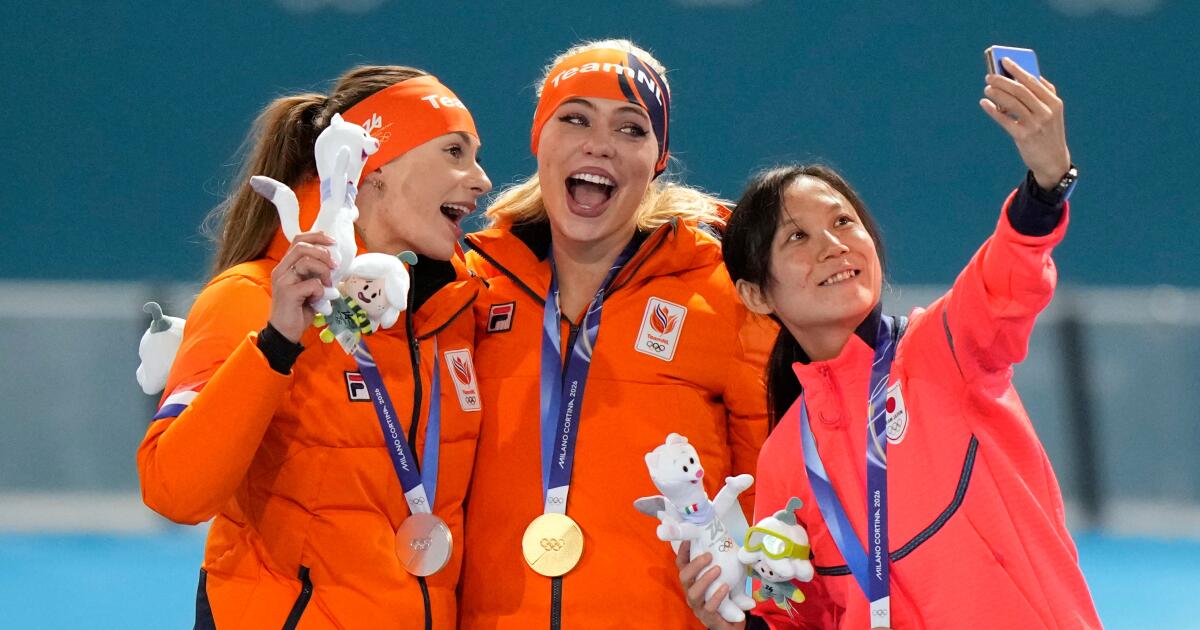
The theme of the opening ceremony was armoniaor harmony, and many credit Kirsty Coventry, the president of the International Olympic Committee presiding over its first Games, with helping to create this change in tone. The first woman and first African to lead the IOC, the five-time Olympic swimmer worked to bring the Games back to the competitors by shielding them from political divisions and emphasizing unity and respect.

Swiss skiers Tanguy Nef, left, and Franjo von Allmen, celebrate after winning Olympic gold in the men’s combined alpine team on Monday.
(Rebecca Blackwell/Associated Press)
And most athletes have adopted it.
Their village of Cortina d’Ampezzo has a fitness center, recreation area, lounge, dining room, prayer room and massage rooms, all designed to foster interaction and cultural exchange among the 1,400 residents from more than six dozen countries who will spend the Games there.
“It’s been so nice,” said Czech curler Vit Chabicovsky. “We met at the Olympic Village before the competition and everyone was saying hello to us. Everyone congratulated us for arriving here after the Olympic qualification.
“Throughout the event it was a little more tense, you can imagine, because we’re competing. But yeah, I think the curling community is so friendly and it’s been just amazing.”
“We live together, we train together, we eat together,” added American curler Cory Thiesse. “It’s such a fun environment, surrounded by so many other athletes.”

American curlers Korey Dropkin, left, and Cory Thiesse celebrate after beating Italy on Monday to reach the gold medal match in mixed curling.
(Robert Gauthier/Los Angeles Times)
The sprawling Milan Village, home to nearly 1,500 athletes from 42 countries, has similar common areas where athletes are encouraged to mingle.
“It’s pretty cool. I’ve never seen anything like this,” said American hockey player Auston Matthews. “That’s what the Olympics are all about. These are the best athletes from around the world.”
There are other factors that also contributed to the peaceful atmosphere. This depends in part on which countries participate and which do not.
Ukraine is here, for example, but Russia is not. Israel sent nine athletes, including a bobsleigh team nicknamed “Shul Runnings”, while there are no Palestinian participants. And the only Koreans here are from the southern half of the peninsula.
However, 13 Russians are competing in Italy as neutral individual athletes, a title used to describe Russians and Belarusians allowed to compete despite their countries being banned from the Games following the invasion of Ukraine in 2022. This has not gone down well with everyone.
“Personally, I’m against it,” said Vadym Kolesnik, an American ice dancer born in Ukraine. “It’s a terrorist country. They kill Ukrainians every day and until the end of the war, I think they have no place.”
Emilea Zingas, Kolesnik’s companion and friend, tried to adapt these comments to the spirit of the Milan-Cortina Games.
“We really don’t want to have conflict with anyone,” she said. “We’re representing the United States in the Olympics, and that’s really special. We’re not focused on any type of political situation.”
Another factor is the size of these Olympics. There are fewer countries and athletes at the Winter Games: 2,871 from 91 countries in Milan-Cortina, compared to 10,714 from 204 nations in Paris in 2024.
“Limited delegations and less media attention,” Varnier said. “I think that’s a factor.”

An overview of the sliding venue in Cortina d’Ampezzo, Italy, for the Milan-Cortina 2026 Olympic Games.
(Robert Gauthier/Los Angeles Times)
Then there is the fact that the national teams are spread across six residential complexes. As the delegations at each site are smaller, athletes from different countries necessarily cross paths more often.
Additionally, while the four main competition hubs – Cortina d’Ampezzo, Valtellina, Val di Fiemme and Milan – are spread over an area roughly equivalent to the size of New Jersey, the villages and venues are relatively small, especially when compared to London or Paris. This makes these Games much easier to manage.
“Milano-Cortina has lived up to expectations very well,” said the British advisor to the local organizing committee, who has worked on the last 14 Olympic Games, summer and winter. “They didn’t design this as something huge that’s going to change the world. …
“[But there is] every opportunity for it to have an impact. People are realizing that we are all part of a global village, that we can come together, and that sport is a great way to do that.
Times staff writers Thuc Nhi Nguyen and Sam Farmer contributed to this story.