Why Democrats aren’t talking about climate change much anymore


Nearly a year after the 2024 election, Democrats are still trying to figure out what went wrong. Amid this soul-searching, a new piece of advice emerged: “Don’t say climate change.”
That’s according to a recent poll from the Searchlight Institute, a new Democratic think tank. Americans have said they view climate change as a problem, but it is rarely one of their top concerns: Voters in conflict states are more concerned about affordability and health care. But when asked what issue they think the Democratic Party prioritizes, climate change comes out on top.
This discrepancy could explain, at least in part, why Democrats are often presented as out of touch with reality. “Advocates and elected officials need to understand that their messages are actively weakened by a focus on ‘climate’ rather than affordability and low energy prices, and that voters are looking for immediate relief in the face of rising costs rather than solutions to abstract problems,” Searchlight’s post about the poll said.
The results did not surprise Rep. Sean Casten, an Illinois Democrat and longtime climate advocate who champions the idea that clean energy can lower electric bills. Casten recently unveiled a bill called the Cheap Energy Agenda, alongside Rep. Mike Levin, a California Democrat.
“There’s no obvious electoral benefit to being really smart about energy and climate policy,” Casten said. But he still talks about climate change. “Polls don’t tell you what you’re talking about,” he said. “That tells you how you talk about it.”
Advocacy groups are also on board, with the League of Conservation Voters, Climate Power and others launching an ad blitz this summer accusing Republicans of raising energy costs.
Over the past decade, activists and organizations have pushed Democratic politicians to take climate change seriously. The youth-led Sunrise Movement became a force in climate policy in 2018, when activists stormed into House Speaker Nancy Pelosi’s office to demand a Green New Deal. They ultimately managed to help elevate climate change into the party platform. Democrats even passed the nation’s most ambitious climate legislation, the Inflation Reduction Act, in 2022 to accelerate the adoption of clean energy through tax credits and incentives — a high-profile effort dismantled by Republicans this year.
Searchlight’s pragmatic approach to tracking polls has been interpreted by some Democrats as a willingness to abandon what they believe. Tré Easton, vice president of public policy at Searchlight, sees things differently. “This is not about Democrats simply abandoning their long-held political beliefs and values,” he said. “We have to recalibrate the way they make these speeches to voters. Because clearly, I think the results of the 2024 elections would demonstrate that something is not working.”
In fact, it appears that climate change had already begun to fade from the national debate, long before the Searchlight poll was released. Media coverage of the topic has declined by about half since 2023, according to Anthony Leiserowitz, director of the Yale Program on Climate Change Communication. His group’s poll found that compared to previous years, Americans say they hear less about climate change in the news, on social media and from people they know. They also don’t seek out as much information on their own: there has been a sharp decline in Google News searches for “climate change” since 2023.
Google News search interest on “climate change”, percentage change from January 2023
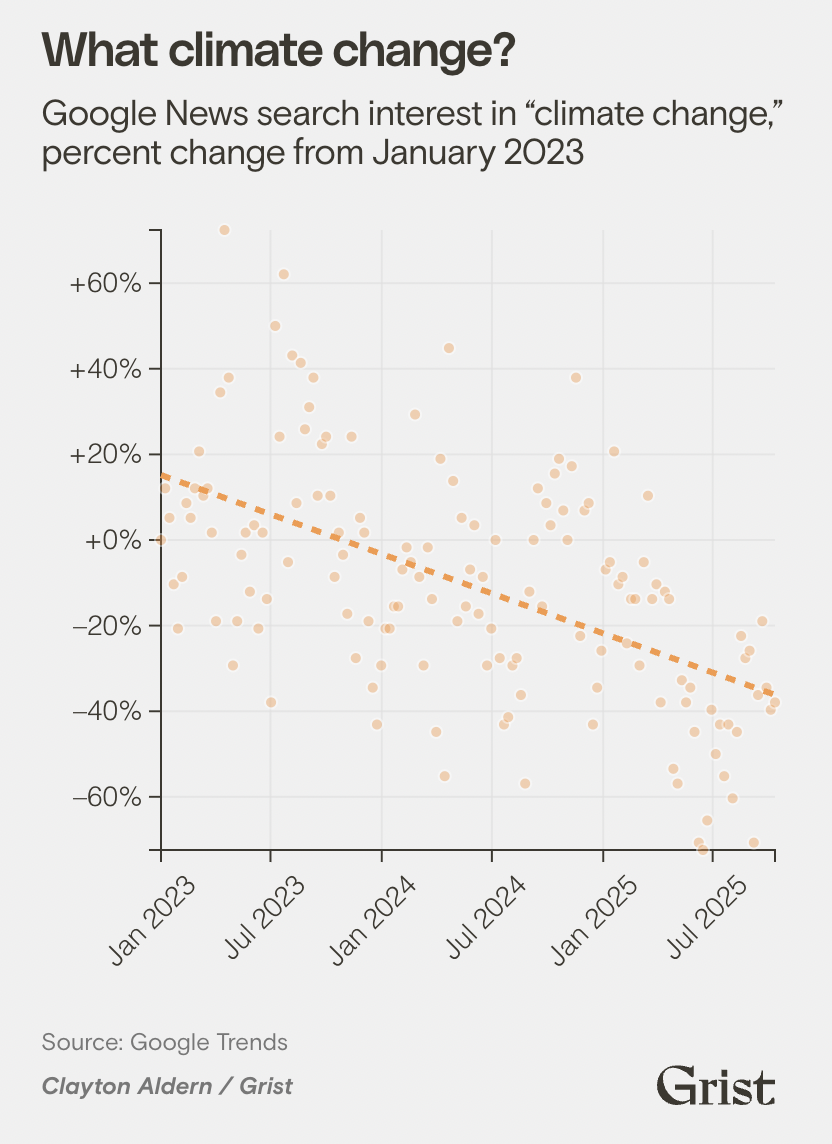
“The point is, we’re talking about things that we collectively consider important,” Leiserowitz said. “Most people will then conclude that if no one is talking about climate change, it can’t be that important.” It’s out of sight, out of mind.
Leiserowitz argues that the 2024 election was not a referendum on climate change. Most Americans still worry about global warming, according to the latest Yale Program poll. “They haven’t changed their views and concerns about climate change at all,” Leiserowitz said. “What has The elite’s discourse on this subject has changed.
It’s not just Democratic politicians who are talking less about climate change. The progressive left is also turning its attention to other pressing concerns. The Sunrise Movement, for example, shifted its focus from climate change to fighting for the rights to free speech and protest under President Donald Trump, training its members in nonviolent resistance tactics. Progressive activists are opposing the administration’s crackdown on immigration, protesting outside ICE facilities and deploying the National Guard in cities like Chicago, Portland and Washington, DC. Over the weekend, about 7 million people participated in the “No Kings” protests against the Trump administration, according to organizers.
“At least for us — and I don’t know how many others think exactly the same way — but it’s like the terrain of authoritarianism, the terrain of fascism, is the thing that we’re trying to solve, so that we can actually fight for whatever it is that we’re trying to fight for,” said Aru Shiney-Ajay, executive director of Sunrise. Still, she says, it’s important not to lose sight of their signature.
“No one wants to give up on the issue of climate change,” Shiney-Ajay said. “I think everyone is pretty clear-eyed that we have to constantly remind people that we’re doing this because we’re young people fighting for a livable future.”
Leiserowitz said Searchlight’s advice (“How to Talk About Climate Change: Don’t Do It”) fails to distinguish between climate advocates and Democrats running for office in swing states. It may make sense for a politician in a tight race to tailor his message to the polls, but climate organizations have other goals than getting Democrats elected, he said. “If your goal is to get global societal action on climate change, it’s crazy not to talk about it. »
Searchlight and others dispute the notion that Democrats to have talking about climate change to get political action, arguing that it’s easier to pass legislation on an issue that hasn’t been drawn into a polarizing national debate. “A lot of very important action on climate change has been done, for example, in what’s called a ‘secret’ or ‘low-key’ Congress, behind the scenes,” said Josh Freed, senior vice president for climate and energy at the think tank Third Way. He cited growing bipartisan support for nuclear energy legislation as an example. Last year, members of Congress from both parties overwhelmingly supported the ADVANCE Act, signed into law by President Joe Biden, aimed at accelerating the development of new reactors.
There is growing recognition that the way politicians talk about climate change, full of jargon and abstract language, is also part of the problem. “The path to victory is to talk about prices,” Sen. Brian Schatz, a Hawaii Democrat who has been a vocal advocate for climate action, said at a recent New York Times event. “You could talk about the planetary emergency, mitigation and adaptation, and you could add environmental justice rhetoric, and by the time you’re done talking, people think you don’t care about them.”
Even though the “cheap energy” argument is trendy, not everyone is convinced it resonates with voters. “Voters can tell when affordability is an afterthought, and that doesn’t neutralize the toxicity of the term ‘climate,'” the Searchlight post says.
“We phrased it in a particularly provocative way to start the conversation,” Easton said. But he thinks Democrats still have a chance to talk about the subject. “If you have an issue as big as climate change, but it becomes polarized, you have to think creatively about how you approach it from a policy perspective. »


