Why did the Russian mega earthquake not cause more tsunami damage?


BBC News Climate and Science

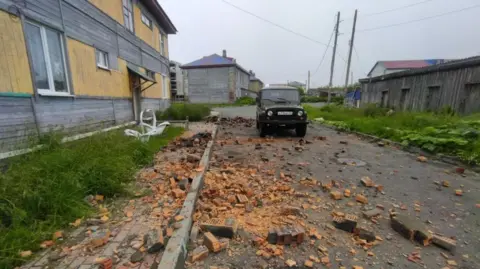 Images S. Lakamov / Anadolu / Getty
He was one of the strongest earthquakes ever recorded – but so far has not brought the catastrophic tsunami that many feared.
When the 8.8 coarse earthquake hit the east of Russia at 11:25 am Wednesday (00:25 BST), it raised concerns for coastal populations across the Pacific.
Millions of people have been evacuated because spirits rejected in the devastating tsunami the day after Christmas 2004 in the Indian Ocean and Japan 2011, both launched by similar earthquakes.
But today’s tsunami was much less serious, even if it caused damage.
So, what caused the earthquake and tsunami-and why was it not as bad as the fearing initially?
What causes a mega earthquake?
The Kamchatka peninsula is distant but lies in the “Pacific Ring of Fire” – so called due to the high number of earthquakes and volcanoes that occur here.
The upper layers of the earth are divided into sections – tectonic plates – which move all to each other.
The “Pacific Ring of Fire” is an arc of these plates which extends around the Pacific. Eighty percent of the earthquakes in the world occur along the ring, according to the British Geological Survey.
Just off the coasts of the peninsula, the Pacific plaque moves to the northwest at around 8 cm (3 inches) per year – only about double the growth rate of your nails, but quickly according to tectonic standards.
There, he comes into contact with another smaller plate – called Okhotsk microplate.
The Pacific plaque is oceanic, which means that it has dense rocks and wants to flow under the cheapest microplaque.
While the Pacific plaque sinks towards the center of the earth, it warms up and begins to melt, disappearing effectively.
But this process is not always smooth. Often the plates can get stuck while they moved against each other and the primordial plate is dragged downwards.
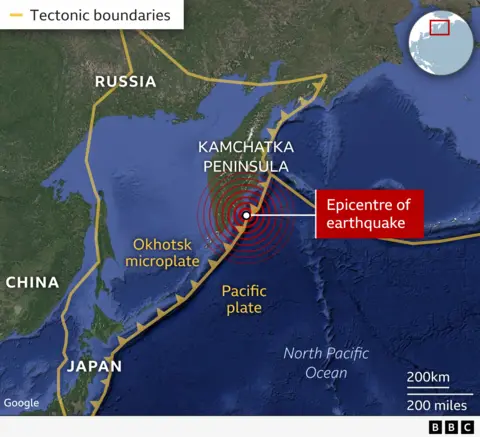
This friction can accumulate more than thousands of years, but can then suddenly be released in a few minutes.
This is known as a megathrust earthquake.
“When we generally think of earthquakes, we imagine an epicenter like a small point on a map. However, for such large earthquakes, the fault will have broken up for several hundred kilometers,” said Dr. Stephen Hicks, a speaker in environmental seismology at College University in London.
“It is this large quantity of slipping and zone of the fault which generates such a high scale of the earthquake.”
The greatest earthquakes recorded in history, including the three strongest in Chile, Alaska and Sumatra, were all megathrust earthquakes.
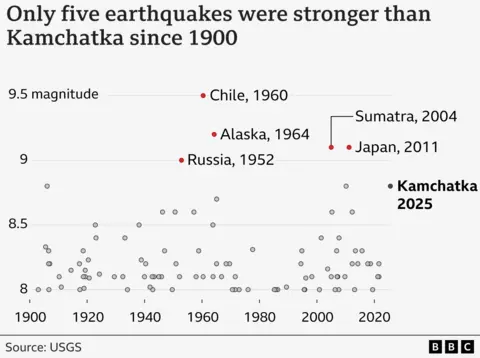
And the Kamchatka peninsula is subject to strong earthquakes.
In fact, another high magnitude earthquake of 9.0 struck less than 30 km (19mi) compared to the earthquake today in 1952, according to the US Geological Survey.
Why was it not as bad as the previous tsunamis?
This sudden movement can move the water over the plates, which can then go to the coast as tsunami.
In the deep ocean, tsunami can travel to more than 500 MPH (800 km / h), about as fast as a passenger plane.
Here, the distance between the waves is very long and the waves are not very high – rarely more than a meter.
But as a tsunami enters shallow waters near the earth, it slows down, often to around 20-30 mph.
The distance between the waves is shortened and the waves grow in height, which can effectively create a wall of water near the coast.
But it is in no way guaranteed that a very strong earthquake will lead to a particularly large tsunami reaching far inside the land.
Today’s earthquake has brought tsunami waves of 4m (13 feet) in some parts of eastern Russia, according to the authorities.
But they do not approach the waves of tens of meters high of 2004 boxing in the Indian Ocean and Japan 2011.
“The height of the tsunami wave is also affected by the local forms of the seabed near the coast and the [shape] On the ground where it arrives, “said Professor Lisa McNeill, tectonic professor at the University of Southampton.
“These factors, as well as the duration of the coast, affect the severity of the impact,” she added.
The first reports of the US Geological Survey said that the earthquake was centered with a fairly narrow depth, about 20.7 km (12.9 miles) below the surface of the earth.
This can lead to a greater movement of the seabed, and therefore a larger wave of tsunami, but it is difficult to say so shortly after the event.
“One possibility is that tsunami models may have taken a conservative estimate of the depth of the earthquake,” said Dr. Hicks to BBC News.
“You could potentially move this earthquake 20 kilometers more, and this would in fact reduce the amplitude of tsunami waves quite considerably.”
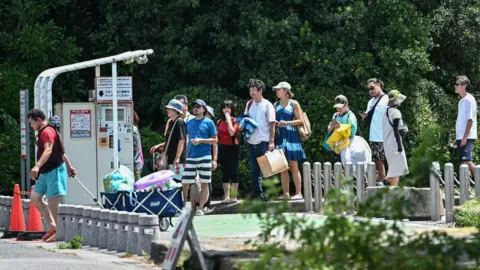 Philip Fong / AFP / Getty Images
Better early alert systems
Another important element is the development of early alert systems.
Due to the strong occurrence of earthquakes in the Pacific region, many countries have tsunami centers. They send warnings via public announcements for the populations to be evacuated.
No system of this type was in place when the Tsunami the day after Christmas 2004 has occurred – leaving many people without time to evacuate.
More than 230,000 people died in 14 countries of the Indian Ocean.
Early alert systems are important due to the limited capacity of scientists to predict when an earthquake occurs.
The US Geological Survey recorded an earthquake measuring 7.4 in the same region ten days earlier.
It may have been a precious – an early release of energy – but he is not a predictor of the exact moment of a future earthquake, said Professor McNeill.
“Although we can use how fast the plates move, GPS to measure current movements and when previous earthquakes occurred, we can only use this information to make the probability of earthquake probability,” she said.
The geophysical survey of the Russian Academy of Sciences (GS RAS) will continue to monitor the region because it provides that the aftershocks could continue for next month.


