Why Dodgers treat title pressure as routine while chasing a dynasty

TORONTO— They didn’t run out of the dugout. They did not attack each other with piles of dogs near the mound.
When the Dodgers won the National League pennant last week, their on-field celebration was little different than normal. What for others would be a moment of frenzied accomplishment, they seemed to regard as routine.
“The celebration wasn’t even there,” said veteran infielder Miguel Rojas, “because everyone is absorbed in winning a World Series.”
“This,” he added, “is the only celebration we really want to have.”
This has been the Dodgers’ philosophy all year long. They knew they were on the precipice of history, trying to become MLB’s first repeat champion in a quarter-century. They knew they were playing for a larger legacy, trying to cement a modern dynasty with the franchise’s third title in the last six seasons. But they rarely expressed it. They tried to keep these historical issues in perspective.
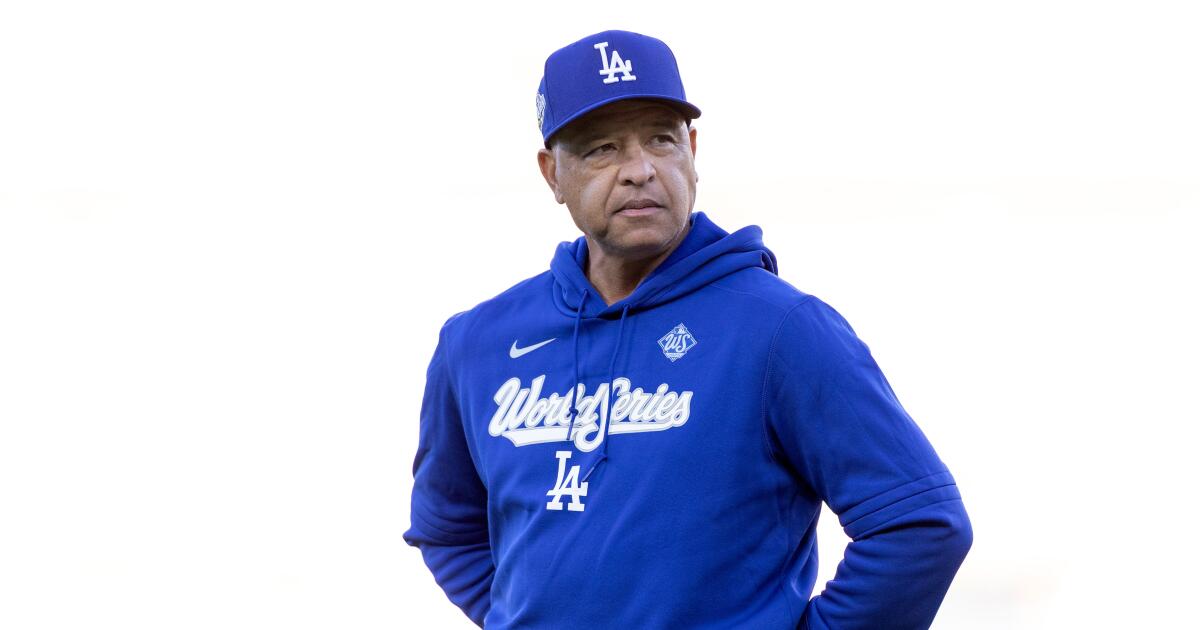
“The legacy, the dynasty talk, a lot of it is for other people who don’t play,” manager Dave Roberts said. “Let them have these debates.”
“Very few people get the chance to do something as big as this organization has the chance to do,” added reliever Blake Treinen. “But it’s not like we have a huge team and we say, ‘This is what we do. This is all we worry about.’ It’s just in our DNA.
Treinen is one of six players who, if the Dodgers win this year’s World Series against the Toronto Blue Jays, will have contributed to the three recent titles (Will Smith, Max Muncy, Kiké Hernández, Mookie Betts and Clayton Kershaw are the others).
This week, during the team’s six-day break between the end of the NLCS last Friday and the opening of the World Series this Friday, Treinen sat at his locker at Dodger Stadium, took a moment to reflect on the season, then had a somewhat surprising revelation.

“It doesn’t even feel like the season is almost over,” he thought. “I feel like it’s just getting started.”
This helps explain why the Dodgers have never been crushed by the pressure of chasing a dynasty this year. How they followed a disappointing regular season with a dominant 9-1 playoff march to the Fall Classic.
Being here, Treinen said, “feels a little natural.”
“When you’re a Dodger,” he noted, “it’s just part of what you expect.”
At least that’s been the case in recent years, when the club began to assemble star talent in a way that the rest of the sport simply couldn’t match.
Betts became the first big-name outside addition when the Dodgers acquired him in a trade with the Boston Red Sox in 2020 — back when the team was still trying to break a three-decade title drought. At this point, they had already built a juggernaut made up largely of local talent. They had reached the World Series twice in the previous three years. And they hoped that an MVP-winning superstar of his caliber could help them reach the top.
Betts did just that, playing a key role on that 2020 championship team.
And in the years that followed, he felt the organization’s urgency to do more, as Freddie Freeman, Shohei Ohtani, Yoshinobu Yamamoto, Roki Sasaki, Tyler Glasnow and Blake Snell also came through the door.
“Go get guys [like that]“I mean, it kind of lets you know where the team is,” Betts said. “You can kind of look up and know that the window you’re in is really important and you really need to win now.”
To do that, though, Betts noted a certain mindset that has enveloped the clubhouse, the understanding that “you’ve got to take it one day at a time, you’ve just got to win one at a time.”
“Eventually you look up at the end of that window and you mind your business,” Betts said. “But if you don’t take it one day at a time, there’s no way you’ll get to where you want to get.”
That was key to the Dodgers’ second recent championship last year, when they navigated an arduous postseason path that included two early playoff games against the San Diego Padres and a patchwork pitching plan that threatened to implode at any moment.
That was needed again this summer, as the club reeled off a 93-win campaign (the lowest in a full season since 2018) that was marred by repeated injuries and squad-wide underperformance (including from Betts himself during a first-half hitting slump).
“For us, it’s about being in the moment and taking care of business,” Roberts said. “Then at the end of the season you can look back.”

That’s not to say the Dodgers — who are trying to join the Yankees, Athletics, Red Sox, Cardinals and Giants as the sixth MLB franchise to win three titles in six years — didn’t recognize the opportunity before them this year.
On the first day of spring training, Roberts focused his message to the club on the historic significance this season would hold. In passing conversations during the year, players would sometimes reminisce, “Let’s win another one, let’s win another one,” Treinen recalled. Muncy said the team’s internal belief was that “we need to repeat this year,” because “that’s how good we felt.” »
And at the lowest moments of the club’s second half, Rojas said this week, the team’s group text chat occasionally included messages like: “We had a really good opportunity to do something really big. Not just for us, but for the city, and for the organization, for baseball.”
“I think that’s one of the things that kept us going and motivated us,” Rojas added. “It’s something we really want to accomplish.”
Of course, mileage varies with such a mentality.
Kershaw, the most prominent face of this era of Dodgers baseball, responded to a dynasty-related question Thursday by professing, “I don’t care about any of that,” choosing instead to focus on how far the organization has come during his 18-year career.
“It’s really impressive to be on one end,” he said, thinking back to a time when playoff appearances were sporadic and money was tight under former owner Frank McCourt, “and to see where it is now,” as playoff trips have become an annual event and the club’s current group of Guggenheim owners has established payroll records.
“It’s come a very long way,” he added. “It’s built to last.”
Muncy offered a similar perspective, arguing that the team’s success over the past 13 years (including 12 division titles, five pennants and five 100-win campaigns to go along with 13 consecutive playoff appearances) “has to count for something” in any talk of the team’s legacy.
“The culture that we’ve created, to me, is everything,” Muncy said. “I feel like that alone is its own dynasty.”
Still, Muncy acknowledged that a true dynasty label would likely require a third title.
“They always say that in other sports you have to win three titles to form a dynasty,” he said. “I don’t know if that’s true. But we have the chance to do it.”
Freeman reiterated that despite all the “sustained wins the Dodgers have had for so long,” winning a title this week would push them over the threshold.
“Yes, I guess you could call it, if we do, a modern-day dynasty,” he said.
That doesn’t mean the Dodgers will change their mindset this week. As they have done all year, they are taking advantage of this historic opportunity without focusing on the reward that awaits them.
“The goal is to win as many as possible while this group is together,” Treinen said. “So, pinch yourself and consider yourself lucky that an organization put you on the list to do this.” »


:max_bytes(150000):strip_icc()/Health-GettyImages-1401621131-6e12a43bfe494c599761f6e68a47a257.jpg?w=390&resize=390,220&ssl=1 "This Diet Can Help Lower Your Cortisol Levels—Improving Your Weight, Sleep, and Energy")
