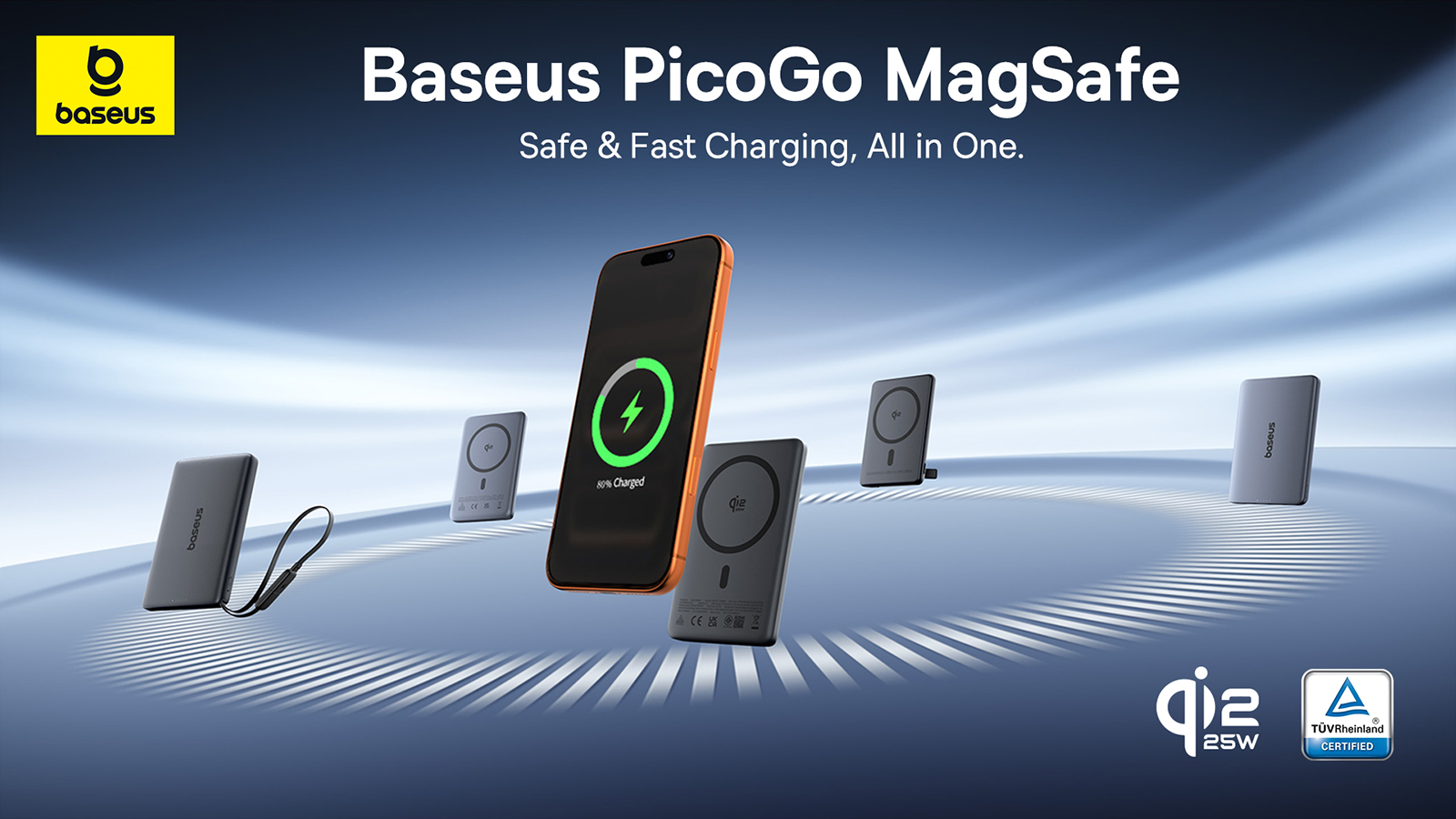
Every new generation of wireless charging promises the same thing: more speed, less friction, fewer cables. And almost every generation runs into the same wall—heat. Push wireless charging faster, and temperatures climb. Throttle it too aggressively, and speed gains vanish. The arrival of Qi2.2 technology, with its headline 25W magnetic wireless charging, puts that trade-off front and center.
Baseus
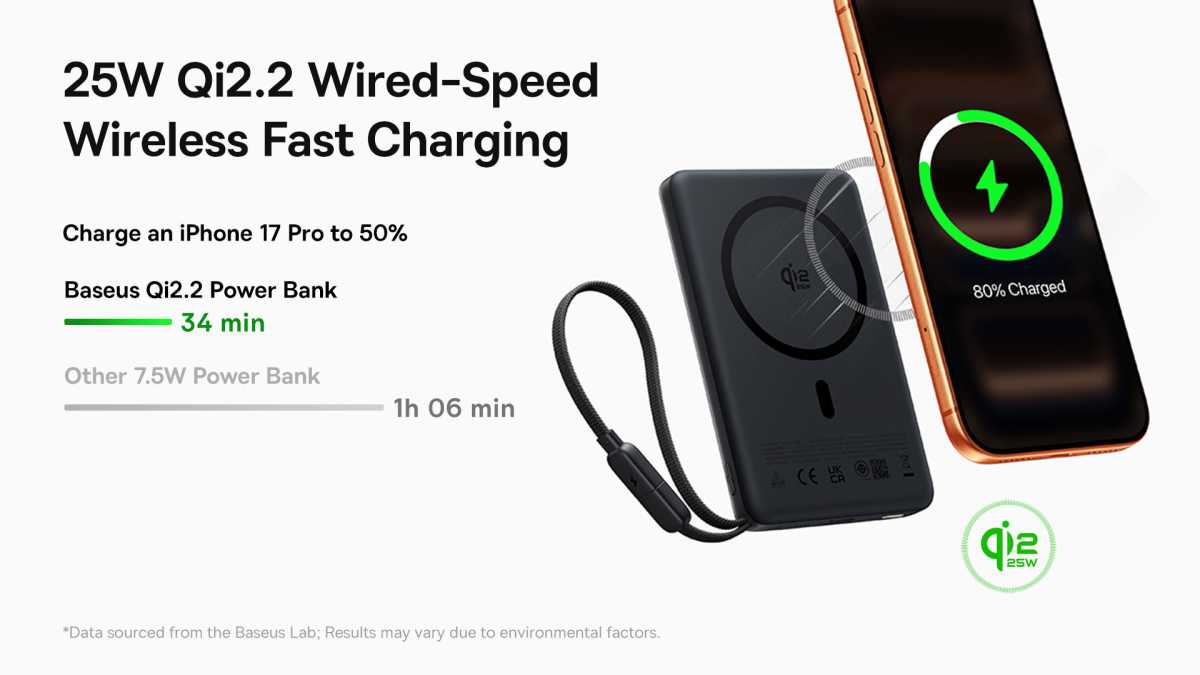
25W: The fastest possible wireless charging
The Baseus PicoGo AM52 magnetic wireless power bank is compelling not just because it supports Qi2.2 25W wireless charging, but because it demonstrates how the standard can be implemented properly, balancing speed, heat, and real-world usability in a way most power banks still struggle to achieve. With this level of innovation, the magnetic wireless power bank at last becomes the must-have accessory for every iPhone user.
At a spec level, Qi2.2’s jump from 15W (Qi2 and MagSafe) to 25W is transformative. Wireless charging finally approaches wired performance, removing the psychological and practical gap that made cables feel “necessary” for quick top-ups. The PicoGo AM52 embraces that promise fully and joins already ground-breaking Baseus PicoGo power banks such as the 5K AM41 Ultra Slim and 10K AM41 Ultra Slim and 5K AM31 Ultra Mini magnetic power banks.
Its officially certified 25W Qi2.2 output can power an iPhone 17 Pro to around 45% in just 30 minutes—territory that was previously exclusive to cables. Crucially, this speed isn’t theoretical or situational. The integrated 16×N52 magnetic ring ensures precise alignment and consistent energy transfer, eliminating the micro-misalignment losses that often generate excess heat and erratic charging curves.
Baseus
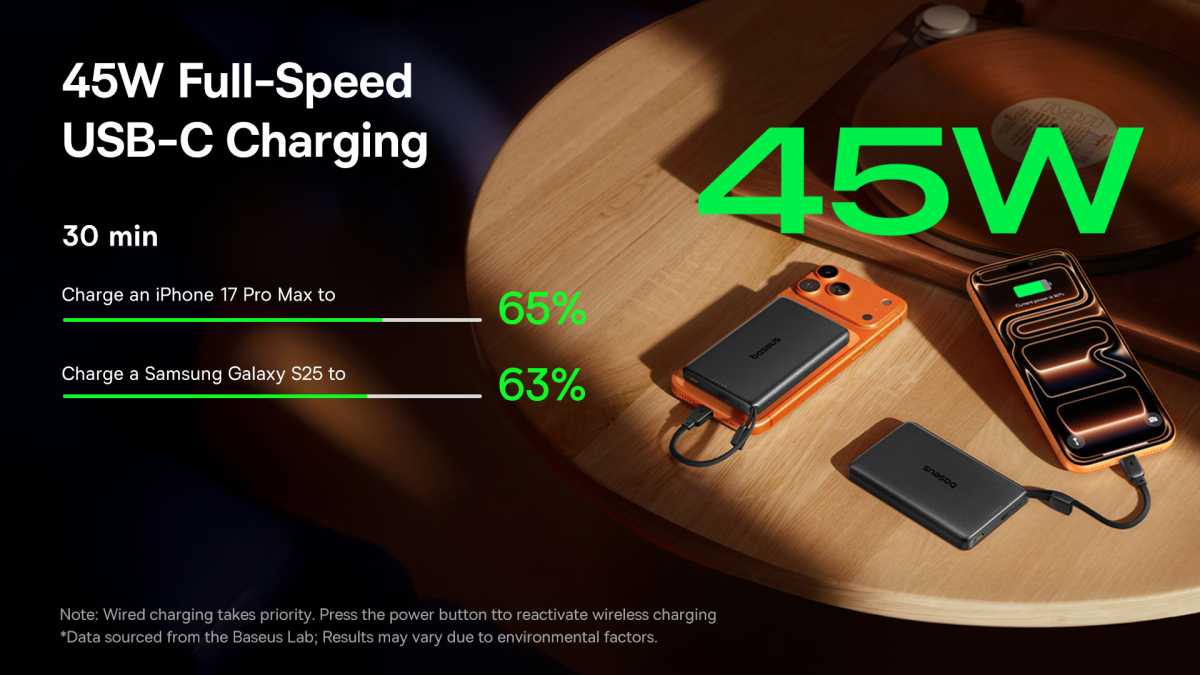
If you use the USB-C output you can achieve even faster 45W wired charging. It is available in two models: one with a clever built-in USB-C cable, and one without. 45W wired charging can be achieved using either the USB-C port or the built-in USB-C cable.
Cool: Making fast wireless charging possible
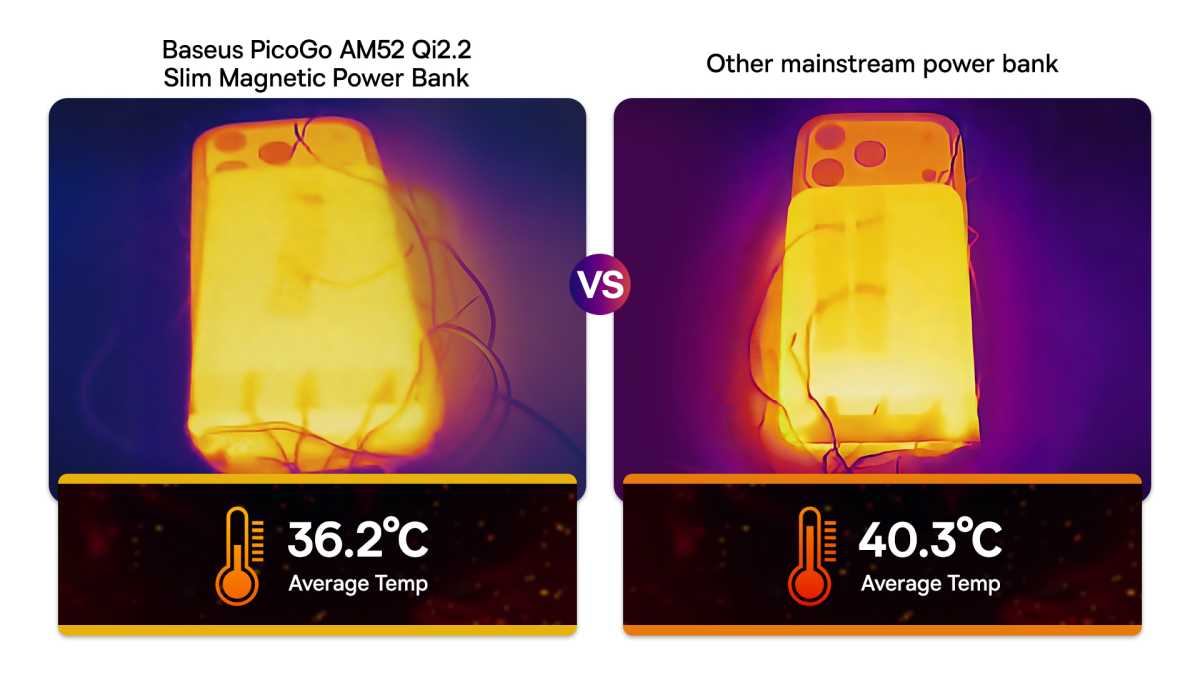
But raw wattage alone doesn’t solve the speed-versus-heat dilemma. In fact, it usually makes it worse. Where Baseus stands out is in how deliberately the AM52 is engineered around thermal control. Instead of relying on a single mitigation tactic, it uses a triple-loop cooling system: a graphene heat-conduction layer to spread heat quickly, an aluminum alloy body to dissipate it efficiently, and real-time temperature monitoring to adjust output dynamically. The result is tangible. The AM52 operates at around 102°F, compared to an industry norm closer to 118°F. That difference isn’t just a lab stat—it directly affects charging stability, battery health, and user comfort when the power bank is attached to a phone in your hand or pocket.
Baseus
This thermal discipline enables something that defines good Qi2.2 design: sustained performance. Many fast wireless chargers spike early, then throttle sharply once heat builds. The AM52’s cooler operating envelope allows it to maintain higher output for longer, delivering faster real-world charges rather than short-lived bursts. That’s the difference between “supports Qi2.2” and “actually benefits from Qi2.2.”
16mm thin: The slimmest-ever wireless 10K power bank
Equally important is how Baseus integrates this technology into a form factor that respects everyday use. At just 16mm thick and under 7 ounces, the PicoGo AM52 is slimmer and lighter than even lower-wattage competitors. Ergonomic curved edges, a soft silicone contact surface, and a durable aluminum alloy shell make it comfortable to hold while charging—no small detail when magnetic power banks are designed to stay attached during use. The aluminum body isn’t just premium; it’s functional, doubling as a key thermal pathway.
At a spec level, Qi2.2’s jump from 15W (Qi2 and MagSafe) to 25W is transformative. Wireless charging finally approaches wired performance, removing the psychological and practical gap that made cables feel “necessary” for quick top-ups. The PicoGo AM52 embraces that promise fully and joins already ground-breaking Baseus PicoGo power banks such as the 5K and 10K AM41 Ultra Slim and 5K AM31 Ultra Mini magnetic power banks.
The AM52 also recognizes that wireless shouldn’t replace wired—it should coexist with it intelligently. Alongside 25W wireless output, it offers 45W USB-C fast charging and 30W self-recharging, fully topping up its 10,000mAh capacity in about 1.5 hours. The option of a model with an integrated USB-C cable further reinforces the product’s minimalist, travel-friendly philosophy. You carry less, charge faster, and adapt to whatever device or scenario you’re in.
In the broader context of Qi2.2, the Baseus PicoGo AM52 feels like a reference design. It shows that faster wireless charging doesn’t have to mean hotter, bulkier, or more compromised hardware. By treating thermal management, magnet alignment, materials, and ergonomics as equal priorities—not afterthoughts—Baseus demonstrates how the new standard can deliver on its promise. Qi2.2 isn’t just about 25W. Done right, as the AM52 proves, it’s about making wireless charging finally feel effortless, fast, and safe enough to trust everywhere you go.
Baseus PicoGo AM52: The next generation of mobile charging