Why You Shouldn’t Use a Mechanical Keyboard


Summary
-
Mechanical keyboards offer tactile feedback, satisfactory sound and personalization options.
-
Reasons that people may not like mechanical keyboards include noise, high keys, arrangements and costs.
-
If you do not like traditional mechanical keyboards, consider alternatives such as silent switches, low profile options or electro-capacitive keyboards.
The mechanical keyboards have acquired a passionate suite of an increasing audience for their tactile feedback, its satisfactory sound and its unique drawings. But if you are not in media threshing, it’s perfectly correct, and you are not bad to feel this way.
Why some people are obsessed with mechanical keyboards
There are many reasons why mechanical keyboards have become so popular in recent years. The most apparent is that mechanical keyboards simply feel more pleasant to type.
Whether it is a smooth, touching linear switch with a satisfactory bump when you press it, or a clicky that harmonizes with your typing speed, the tactile feedback that comes with each touch is simply fantastic. I tried really cheap and horrible mechanical keyboards, and they always felt better than an average membrane keyboard that you would find in an office or a school.

The second factor is sound. Whether it is a deep and satisfactory mouth, a strong clack or a marbled or creamy intermediate noise when it is the lowest, each personalized keyboard has its own unique tone.
Standard mechanical keyboards also have separate sounds, which you can personalize considerably by exchanging switches and keys or making advanced mods to literally adjust the sound of the keyboard to your taste.
Speaking of mods and personalization, it is another enormous advantage of mechanical keyboards. If it is a hot model, you can replace keyboard switches with any compatible model on the market. This allows you to experience different switches that can provide a very different striking experience, even without changing anything else.

For example, you can go from light linear switches to heavy tactiles, and it will instantly transform it into a brand new keyboard.
But it doesn’t stop there. Even if a mechanical keyboard is not hot, you can always replace its keys to update the appearance, the sensation and even the sound. There are thousands of different Keycap sets on the market with prices ranging from ~ $ 15 for affordable (but decent) PBT keys to sophisticated craftsmen that can cost more than $ 100.
For players, there is a significant performance gain to consider. The current trend among the game keyboards is the Hall effect switch, which have an extremely low input latency, adjustable activation points for lightning reaction times and other games focused on play such as Rapid Trigger and Snap Tap.
By the way, it lasts even longer than traditional mechanical switches – which can themselves survive the membrane keyboards.
Why are they not for everyone
Very well, you have heard enough about my rambling how much the mechanical keyboards are, so let’s see why not everyone is a fan. Interestingly, many of the reasons why people do not like them are the same reasons as enthusiasts love them.
I spoke to several people who tried the mechanical keyboards and did not love them, and one of the main reasons is noise. Many associate mechanical keyboards with sadly famous blue switches Cherry MX Clucky or with an older buckling spring that is found in the M model – and it is a fair assessment. These keyboards are undeniably strong; The noise is overwhelming for anyone nearby.

Another major reason why people are discouraged by mechanical keyboards is the high keys, especially for those used to standard desktop keyboards, laptop keyboards or low profile models with scissors, such as the Pop Logitech icon keys.
My wife tried all of my keyboards, and the touched highs are the only coherent complaint she had (even with the XDA flat keys). Honestly, this is a fair point – most of the mechanical keyboards have quite large touches that can feel more physically trying to type, especially for light dactylographers.
The variety of provisions in which the mechanical keyboards can also be confusing. There are Tenkeyless models, 75%, 60%, and more. Some occupy a lot of office space, which can be a problem if you have a smaller workspace.
Another major factor. When you read how much people spend on their keyboards, it is easy to feel like the entrance barrier is extremely high. Worse, what happens if you spend more than $ 100 on a mechanical keyboard that everyone seems to love, and that you end up not loving it at all? Then you need to spend a lot of money and efforts to modify it so that it is at least usable.
Even the software supplied with many mechanical keyboards can be confusing, especially for hall models. What do all these parameters do? And why is it not just a simple plug-and-play experience like most non-mechanical advice?
All this can be overwhelming for occasional typing. This is why it is easier to take the path of the slightest resistance by narrowing the options to some popular non -mechanical models and choosing one that looks good. Most membrane keyboards feel similar to the seizure, so as long as it is reasonably well constructed, it will be familiar.

A few last things to try before abandoning mechanical keyboards
It is very good if the mechanical keyboards are not your thing, but before giving up entirely, consider some alternatives that could change their mind.
If sound is a problem, here is good news – unlike clicked switches from the past, modern mechanical keyboards can be equipped with relatively calm switches that produce a deep mouth much quieter than the older models. And if you need absolute silence, silent mechanical switches exist – and as a person who has a whole, I can confirm that they are damn silent.
If you don’t like stretch keys or think they slow down, think of a low profile mechanical keyboard. These keep most of the feeling of satisfactory mechanical typing, but have thinner touches and a shorter movement distance, which makes them more familiar. Together, these features can create an ultra-fast typing experience with a large part of the satisfaction of a traditional mechanical keyboard.
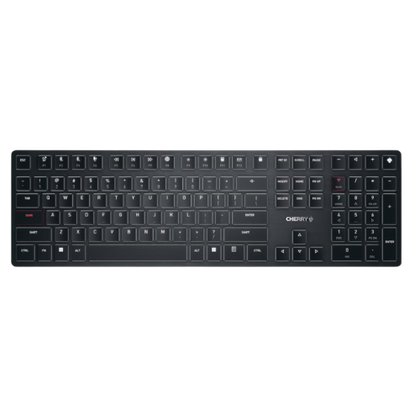
- Brand
-
Cherry
- Wireless
-
2.4 GHz radio
- Backlight
-
White with red accents
- Media checks
-
Volume, brightness
- Battery
-
Li-ion
- Cushion
-
Yes
Cherry’s KW X Ultra-Loc wireless keyboard offers a robust and durable strike experience, you work in the office, whether you are traveling with your laptop or you enjoy AAA games.
If you are discouraged by the feeling of the mechanical switches themselves rather than by the keys or the sound, you may be trying to try an electro-capacitive keyboard (Topre). These combine a rubber dome with a spring and a piston to create a perfect hybrid between mechanical and membrane switches.
The result is a soft and cushioned bump when you press the key, accompanied by a deep and deaf mouth. A good to try is the Niz Micro 84, although it is quite expensive.
If this does not suit you either, then at least do a favor and get a keyboard that uses a scissor style switch like the aforementioned pop icon touches. The scissors are essentially membranes but offer a much more coherent and satisfactory striking feeling thanks to the scissor mechanism under each key.


.jpg.png?w=390&resize=390,220&ssl=1 "Your Weekly Horoscope: August 31 to September 6, 2025")
