With ICE Using Medicaid Data, Hospitals and States Are in a Bind Over Warning Immigrant Patients


The Trump administration’s decision to give deportation officials access to Medicaid data puts hospitals and states in a bind as they weigh whether to alert immigrant patients that their personal information, including their home addresses, could be used in efforts to remove them from the country.
Warning patients could dissuade them from enrolling in a program called Emergency Medicaid, through which the government reimburses hospitals for the cost of emergency treatment for immigrants who are not eligible for standard Medicaid coverage.
But if hospitals don’t disclose that patient information is shared with federal law enforcement, they may not know that their health coverage puts them at risk of being located by Immigration and Customs Enforcement.
“If hospitals tell people that their Medicaid emergency information will be shared with ICE, it is predictable that many immigrants would simply stop receiving emergency medical care,” said Leonardo Cuello, a research professor at the Center for Children and Families at Georgetown University. “Half of Medicaid emergency cases involve the delivery of U.S. citizen babies. Do we want these mothers to avoid the hospital when they give birth?”
For more than a decade, hospitals and states have assured patients that their personal information, including their home address and immigration status, will not be shared with immigration enforcement officials when they apply for federal health coverage. A 2013 ICE policy memo ensured that the agency would not use information from health coverage applications for enforcement activities.
But that changed last year, after President Donald Trump returned to the White House and ordered one of the most aggressive immigration crackdowns in recent history. His administration began funneling data from various government agencies to the Department of Homeland Security, including tax information filed with the IRS.
The Centers for Medicare & Medicaid Services, part of the Department of Health and Human Services, agreed last spring to give ICE officials direct access to a Medicaid database that includes enrollees’ addresses and citizenship status.
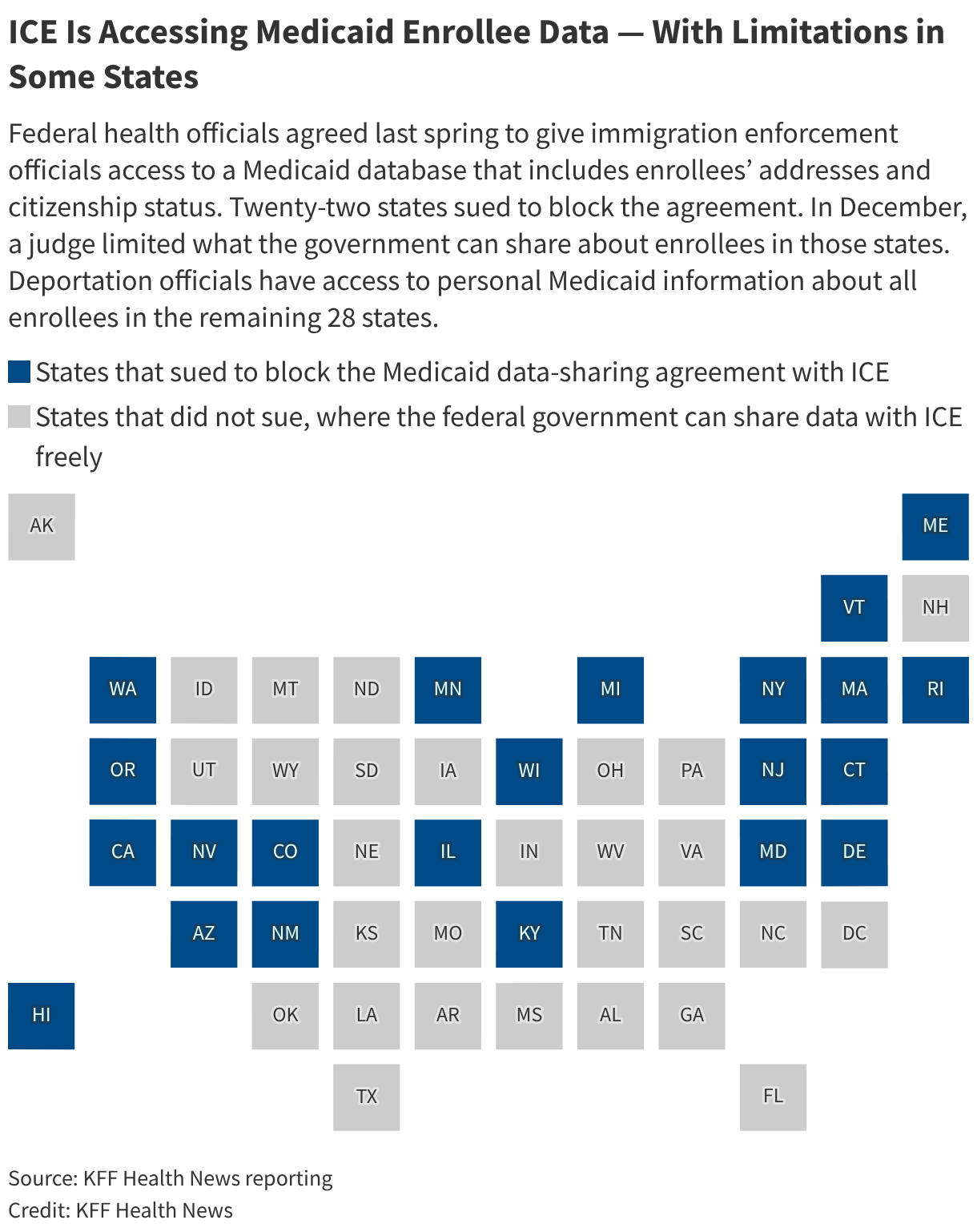
Twenty-two states, all but one led by Democratic governors, sued to block the Medicaid data-sharing deal, which the administration did not formally announce until a federal judge ordered it to do so last summer. The judge ruled in December that in those states, ICE could illegally access Medicaid database information only about people who were in the country. KFF Health News contacted more than a dozen hospitals and hospital associations in states and cities that have been targets of ICE sweeps. Many declined to say whether they had updated their disclosure policies after the ruling.
Of those who responded, none said they directly warn patients that their personal information might be shared with ICE when they apply for Medicaid coverage.
“We do not provide legal advice on sharing federal government data between agencies,” Aimee Jordon, a spokeswoman for M Health Fairview, a Minneapolis-based hospital system, said in an email to KFF Health News. “We encourage patients with questions about benefits or immigration-related concerns to seek advice from appropriate state resources and qualified legal counsel.”
Application information
Some states’ emergency Medicaid applications specifically ask about a patient’s immigration status — while assuring people that their information will be kept safe and out of the hands of immigration enforcement officials.
For example, as of February 3, California’s application still included language informing applicants that their immigration information is “confidential.”
“We only use this to see if you qualify for health insurance,” says the 44-page form posted to social media in January by the state’s Medicaid program, known as Medi-Cal.
California Department of Health Services spokesman Anthony Cava said in a statement that the agency, which oversees Medi-Cal, “will ensure Californians have accurate information about their data privacy, including reviewing additional publications as necessary.”
Until late January, Utah’s Medicaid website also claimed that its emergency Medicaid program did not share its information with immigration authorities. After KFF Health News contacted the state agency, Kolbi Young, a spokesperson, said Jan. 23 that the text would be removed immediately. It was removed that day.
Oregon Health & Science University, a Portland-based hospital system, offers immigrant patients a question-and-answer document developed by the state’s Medicaid program for those concerned about how their information might be used. The document does not directly say that Medicaid enrollee information is shared with ICE officials.
Hospitals rely on Emergency Medicaid to reimburse them for treating people who would be eligible for Medicaid without their citizenship status — those in the country illegally and legally presenting immigrants, such as those on student or work visas. Coverage only covers emergency medical care and pregnancy-related care. Typically, hospital representatives help patients apply while they are still at the medical facility.
The main Medicaid program, which covers a much broader range of services for more than 77 million low-income and disabled people, does not cover people living in the country illegally.
Reviewing emergency Medicaid enrollment is therefore the most obvious way for deportation officials to identify immigrants, including those who may not legally reside in the United States.
HHS spokesperson Rich Danker said in an email that CMS — which oversees Medicaid, a joint state-federal program — was sharing data with ICE after the judge’s ruling. But he would not explain how the agency ensures it shares information only about people who are not legally present, as the judge required.
With ICE now having direct access to the personal information of millions of Medicaid enrollees, hospitals — while “definitely in a difficult position” — should be upfront about the changes, said Sarah Grusin, an attorney at the National Health Law Program, an advocacy group.
“They need to tell people that the judge allowed information, including their address, to be shared with people who are not legal residents,” she said. “Once that information is submitted, you cannot protect it from disclosure at that point.”
Grusin said she advises families to weigh the importance of seeking medical care against the risk of sharing their information with ICE.
“We want to give open and honest information, even if it means the decision people have to make is really difficult,” she said.
Those who have already enrolled in Medicaid or can easily look up their address online should assume immigration officials already have their information, she added.
Emergency medical help
Medicaid emergency coverage was established in the mid-1980s, when a federal law began requiring hospitals to treat and stabilize all patients who showed up at their doors with a life-threatening illness.
Federal government spending on emergency Medicaid was nearly $4 billion in 2023, or about 0.4% of total federal spending on Medicaid.
States send monthly reports to the federal government with detailed information about who is enrolled in Medicaid and the services they receive. The judge’s ruling in December limited what CMS can share with ICE to only basic information, including addresses, about Medicaid enrollees in the 22 states that sued over the data-sharing agreement. ICE officials are not supposed to access information about the medical services people receive, according to the judge’s order.
The judge also barred the agency from sharing the data of U.S. citizens or legally profiling immigrants from those states.
Expulsion officials have access to the personal Medicaid information of all enrollees in the remaining 28 states.
The federal health agency has not said how it ensures that certain states’ information on citizens and legal residents is not shared with ICE. But Medicaid experts say it would be nearly impossible for the agency to separate the data, raising questions about whether the Trump administration is complying with the judge’s order.
The Trump administration’s efforts to deport immigrants living in the country illegally have taken a toll on immigrant families seeking care. About a third of adult immigrants reported ignoring or delaying their health care in the past year, according to a KFF/New York Times poll released in November. (KFF is a nonprofit health information organization that includes KFF Health News.)
Bethany Pray, legal and policy manager for the Colorado Center on Law and Policy, warned that sharing Medicaid data directly with eviction officials would force some families to make even tougher decisions.
“It’s very concerning,” Pray said. “People shouldn’t have to choose between giving birth in hospital and wondering if that means they risk being deported. »


