WNBA players call out officiating, but league trusts its process

With Red Welts dispersed as well as war marks it had just waged, Kelsey Plum let the microphone have it.
“I drive more than anyone in the league,” said the stretch keeper, the tense voice. “So, to shoot six free throws is F – absurd. And I had stripes on my face, I have stripes on my body, and these guards on the other teams have these Ticky faults, and I’m fed up.”
Plum played 41 minutes during a defeat in overtime against the Golden State Valkyries, during which she received these six free throws. She is one of the many players, coaches and WNBA fans who have evacuated what they consider as an inconsistent and unreliable officiant this season.
However, within the walls of the official office of the League, there is a firm conviction that the referees do their job well.

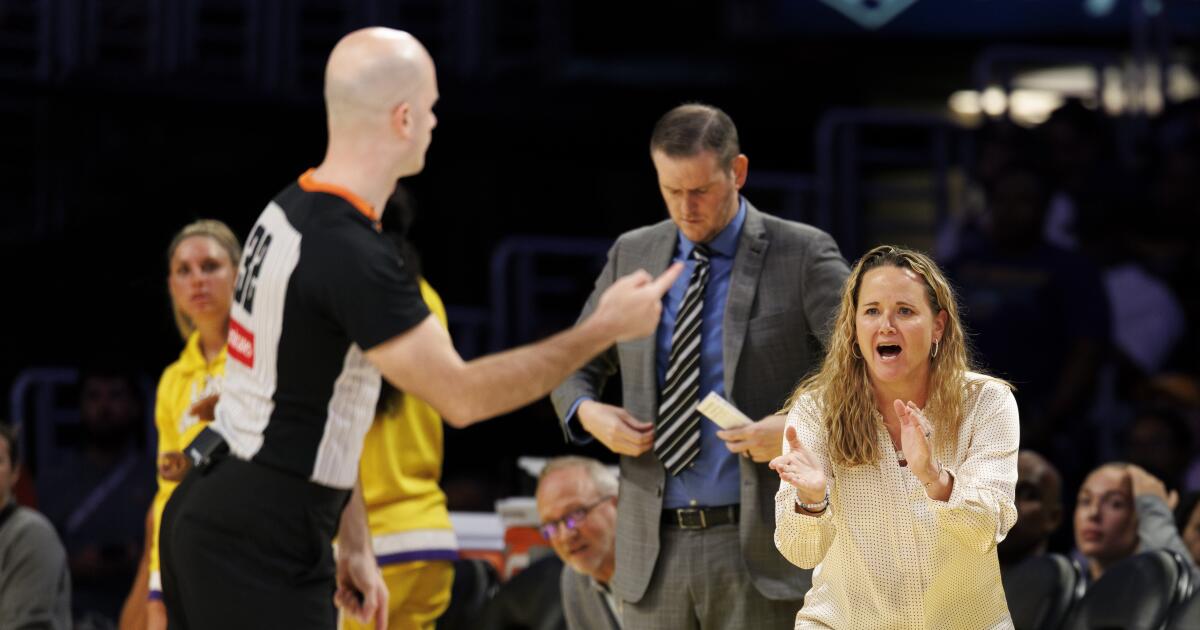
Las Vegas Aces coach Becky Hammon questions a referee’s call during the match against the crypto.com sparks on July 29.
(Gina Ferazzi / Los Angeles Times)
“Overall, I am very satisfied with work this year,” said Monty McCutchen, responsible for the training and development of arbitrators for all the NBA leagues.
But McCutchen and Sue Blauch, who oversees the performance and development of WNBA referees, are not blind to the reaction – recognizing “high -level failures that we must have on our side”.
To do this, they underlined an analysis program officiating through which 95% of the games are watched live, each game classified by internal and independent examiners. These evaluations are used to draw the performance of each referee over time.
The teams can report up to 30 games for examination per game via a league portal – including isolated calls or themes covering several games. League officials respond with decisions on each clip and compile the reading lists organized by type of call, delivering them directly to the referees.
“There is no shortage of comments,” said McCutchen.
But the structural backbone of the WNBA is differs from the NBA significantly. With only 35 referees, who all made a light in the light $ 1,538 per match as recruitsEach official calling for 20 to 34 competitions per season.
“You work three very different basketball types,” said Jacob Tingle, director of sports management at Trinity University, who has conducted research on networks and officiant roads. “The reason why the NBA or the MLB works is because that’s all you do – you only work the same type of game.”
The WNBA does not have a centralized rereading center, a development league to prepare the talent crew combinations and mixes teams from one game to another – a patchwork system that can reduce referees that should offer consistency.

The goalkeeper of the Sparks Kelsey Plum questions the non -limits of the civil servant during a match against the AS of Las Vegas in Crypto.com Arena on July 29.
(Gina Ferazzi / Los Angeles Times)
“When you do not have group cohesion, you do not have the same level of confidence in your partners,” said David Hancock, a teacher who studies the psychology of the sports commission. “We did a study – when the referees felt more connected to their group, they also felt that they had performed better.”
McCutchen said the teams get a verdict on the calls they send for examination. But beyond that, there is no overview of the rating or transparency concerning the models that the league has sought. So, when it seems that a whistle was swallowed during a match, players and coaches remain in search of consistency.
“You no longer know in the WNBA,” said Joshua Jackson, professor at the State University of Louisiana who studies the media and the perception of athletes. “I can’t say when I watch a game exactly what this call for fault will be. I will hear the whistle and I think:” Ok, it may be a yield and then suddenly, it’s a view for a blatant instead? Wait, how did we get here? “”
The whistle has become one of the biggest WNBA jokers. Angel Reese called him “diabolical”. Lynx coach Cheryl Reeve said that after a disappointment in the fourth quarter, led to a defeat that the match had “stolen”. The Belgian Guard Julie German told Times that she felt more “protected” playing Eurobasket. And Napheesa Collier, one of the stars of the 2025 season, warned “it gets worse”.
The whistle, or its absence, could echo stronger in 2026, when the WNBA begins an agreement of $ 2.2 billion and 11 years with Disney, Amazon and Nbcuniversal – each broadcast more than 125 games per year in television and streaming networks.
Nicole Lavoir, who directs the Tucker Center – A Research Center focused on girls and women in sport – said that the story surrounding female athletes forces them to walk on a tightrope: to speak and risk being rejected as an emotional woman or to remain silent and to leave the image of the League.
“This is a broader, contextual and systemic problem,” said lavoir. “These are not only bad references that make bad calls. This is a much more important problem in a system where women’s sport has been undervalued and underestimated for decades. ”
Many players have ignored the concerns about the perception they complain too much of an officer, arguing that the inconsistency of calls is dangerous.
Lucas Seehafer, professor and kinesiologist at the South Carolina Medical University following WNBA injuries, said The players have suffered 173 injuries this season And missed 789 games, entering the matches on Saturday.

The Sparks striker Cameron Brink reacts to an official after no fault was called after the ball was stripped of her while she went to the basket in Crypto.com Arena on July 29.
(Gina Ferazzi / Los Angeles Times)
The injuries are undoubtedly multifactorial, said Seehafer. However, the incoherent whistles can leave the players do not know how much the contacts expect – forcing them to unknown movements or hesitations. And this can lend itself to clumsy landing, a key contributor in low expression injuries.
“Athletes are trying to consider consistency and mechanical efficiency,” said Nirav Pandya, a pediatric orthopedic surgeon and specialist in sports medicine at UC San Francisco. “When you don’t know how many contacts will be allowed, this eliminates this rhythm, which increases your risk of injury.”
When Caitlin Clark suffered a groin injury in mid -July, his brother – in a post X now deleted – accused officials of having left too much contact.
“People are going to watch the WNBA because of the talent,” said Lavoir, “and when the talent is seated on the bench, it is not very exciting for fans.”
While criticism is quick to call by offering, referees navigate in a stretched structure.
Brenda Hilton, founder of Human Human – an organization dedicated to improving the treatment of sports managers – said that 70% to 80% of those in charge left in their first three years, largely because of online abuse.
“The people who do the work are people, they are fallible,” said lavoir. “The players are also fallible, the coaches too. So, so we can recover a certain compassion for the humanity of the people who do it, and appreciate the fact that they like what they do? They don’t do it because they get enormous offers and brand opportunities.”
The leaders of the NBA and the officiating WNBA have not announced any plan to modify their system, so the stress will probably continue among the players, the coaches, the fans and those who control the whistles.


