
If you’re looking for something to lift your spirits this month, you’ll have no problem finding entertainment high in the sky. Throughout the rest of February, the sky will be putting on an awe-inspiring show, although it may require a good pair of binoculars.
The month kicked off with the Snow Moon, a bright full moon that rose on the evening of February 1, 2026. But even if you missed this event, there’s much more to come over the next few weeks, including a solar eclipse that will briefly show a “ring of fire” in the sky and a planetary parade that involves a close gathering of six planets.
Read More: A Rogue Planet the Size of Saturn Detected 10,000 Light-Years From Earth
A Ring of Fire Solar Eclipse
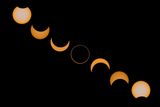
The next event to look forward to in the sky will be an annular solar eclipse on February 17, 2026, when the moon will pass between the Earth and the sun.
During most solar eclipses, the moon appears large enough in the sky to blot out the sun entirely. The upcoming eclipse, however, will display a different scene; this is because the moon will be at its apogee, or the point in its orbit where it’s farthest from Earth. Because of this, it will appear smaller in the sky — so small, in fact, that it won’t be able to cover the whole sun.
The result is a ring (or annulus) of visible sunlight that can be seen as the moon passes over the sun. This ring of light is often referred to as the “ring of fire,” according to The Planetary Society.
Where to See the Eclipse
There’s a catch to the upcoming annular solar eclipse: Its ring of fire will only be visible in Antarctica, which is where the path of annularity will cross, according to National Eclipse. However, a partial solar eclipse can be observed in the southern portions of South America and Africa as the moon passes the sun.
Although it appears different from a normal solar eclipse, the upcoming annular solar eclipse still requires eye protection to view. It won’t be visible to many people, but fortunately, there will be another opportunity to view a total solar eclipse later this year, on August 12, 2026.
This solar eclipse will be visible in Greenland, Iceland, Spain, Russia, and a small area of Portugal (a partial solar eclipse, meanwhile, will be visible in Europe, Africa, and North America, according to NASA).
February’s Planetary Parade
Another event in the sky worth marking on the calendar is a planetary parade at the end of February 2026. This spectacle entails the alignment of six planets in our solar system: Mercury, Venus, Saturn, Jupiter, Neptune, and Uranus, according to Star Walk.
The best time to see the six planets closely aligned will be around an hour after sunset on February 28, 2026. Seeing them all at once will be quite the challenge, though.
Mercury will only be visible for a short amount of time, sitting low on the western horizon. To see it, you’ll need to keep a close eye on the horizon just after sunset. The same goes for Venus, which will be located close to Mercury; since it’s going to be significantly brighter than Mercury, it should be much easier to spot.
Saturn, the next planet up in the alignment, will show up slightly higher in the sky. Its soft glow will be visible to the naked eye. Nestled right next to Saturn, Neptune can’t be seen without binoculars or a small telescope.
Uranus will appear much higher in the sky, positioned by the Pleiades star cluster. Binoculars are recommended for an ideal view of Uranus as well.
Rounding out the planetary parade is Jupiter, set to emerge high in the southeast sky. Its position and brightness will make it the easiest planet to spot. The moon will also join as a guest in the parade, below Jupiter.
If you want to catch the entire planetary parade in action on February 28, 2026, just remember to bring some binoculars and quickly look to the western horizon after sunset, before Mercury sets.
Read More: Planets With Two Suns Are Almost Impossible To Find — General Relativity May Be Why
Article Sources
Our writers at Discovermagazine.com use peer-reviewed studies and high-quality sources for our articles, and our editors review for scientific accuracy and editorial standards. Review the sources used below for this article:


