World’s Oldest Ankylosaur Had Uniquely Elaborate Dermal Armor


The armored ankylosaurian dinosaurs are best known in the ecosystems of the northern hemisphide of the upper Cretaceous, but their early evolution in the mid-Bien Jurassic at the start is surrounded by mystery due to a bad fossil file. SPICOMELLUS AFER It was suggested to be the oldest ankylosaur in the world and the first in Africa, but was based on a single partial coast of the average Jurassic in Morocco. Now, paleontologists have described a new much more complete specimen that confirms the ankylosaurian affinities of SpicomellusAnd demonstrated that he had a skin armor only elaborated unlike that of any other vertebrate, living or off.
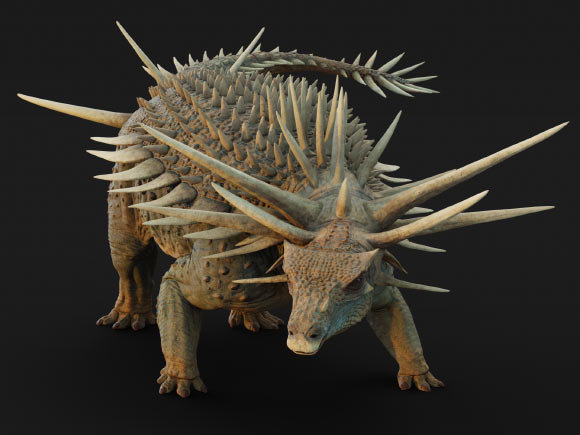
Reconstruction of the life of SPICOMELLUS AFER. Image credit: Matthew Dempsey.
SPICOMELLUS AFER Lived in what is now Morocco during the period of the average Jurassic, about 168 million years ago.
The initial description of this species was published in 2021 and was based on a fossilized coast bone.
“See and study the Spicomellus The fossils for the first time were the spine, “said Professor of the University of Birmingham, Richard Butler.
“We just couldn’t believe how weird it was and how much other dinosaur, or even any other animal that we know living or off.”
“It turns a large part of what we thought we knew about ankylosaurs and their evolution on his head and shows how much there is to learn about dinosaurs.”
Professor Butler and his colleagues discovered that SPICOMELLUS AFER If bone spikes have been merged and projected from all its ribs, a characteristic that is not seen in any other kind of vertebrate living or off.
The old animal had long points, measuring 87 cm, which, according to the authors, would have been even longer during the life of the animal, which is emerged from a bone collar which was seated around its neck.
“To find such an armor elaborated in an early ankylosaur, we modify our understanding of the evolution of these dinosaurs,” said Professor Susannah Maidment, paleontologist at the Natural History Museum, London and the University of Birmingham.
“This shows how important the dinosaurs of Africa are and how important it is to improve our understanding of them.”
“”Spicomellus Had a diversity of plates and tips extending from all over her body, including meter neck tips, huge projection tips up on the hips, and a whole range of long -shaped points, pieces of armor composed of two long tips and plates on the shoulder. “”
“We have never seen anything like such in an animal before.”
“It is particularly strange because it is known ankylosaur, so we can expect a subsequent species inherited from similar characteristics, but they did not do it.”
The researchers postulate that this range of points would have been used to attract friends and introduce themselves to rivals.
Interestingly, similar display armor has not yet been found in any other ankylosaurus, with subsequent species with armor that probably worked more for defense.
An explanation for this is that, as the greatest predatory dinosaurs have evolved in the Cretaceous period, as well as larger carnivorous, crocodiles and snakes, the growing risk of predation could have caused ankylosaur armor to become simpler and more defensive.
However, a characteristic of early ankylosaurs that would have survived is their tail armament.
While the end of Spicomellus“The tail was not found, the surviving bones suggest that he had a similar club or tail weapon.
Some of the tail vertebrae are merged to form a structure known as the handle, which was only found in ankylosaurs with a tail club.
However, all of these animals lived millions of years later in the Cretaceous.
The combination of a tail weapon and an armored shield that protected the hips suggest that many key adaptations of ankylosaurs already existed at the time of Spicomellus.
The discovery strengthens the importance of the fossil archives to resolve evolutionary puzzles and deepen our understanding of the geographic distribution of dinosaurs.
It also helps to trigger the public’s imagination in dinosaurs while we learn more about the confusing characteristics of species as Spicomellus.
“This study helps to advance Moroccan science,” said Professor Driss Ouarhache, paleontologist at Sidi Mohamed Ben Abdellah University.
“We have never seen dinosaurs like that before, and there is still much more than this region has to offer.”
An article on discovery has been published today in the review Nature.
_____
SCR Maidment and al. Extreme armor in the oldest ankylosaur in the world. Naturepublished online on August 27, 2025; DOI: 10.1038 / S41586-025-09453-6


