Two Enormous Blobs of Superheated Material Help Shape Earth’s Magnetic Field


Two huge, ultra-hot rock structures at the base of the Earth’s mantle, around 2,900 km beneath Africa and the Pacific, have shaped the Earth’s magnetic field for millions of years, according to a new study led by Professor Andy Biggin of the University of Liverpool.
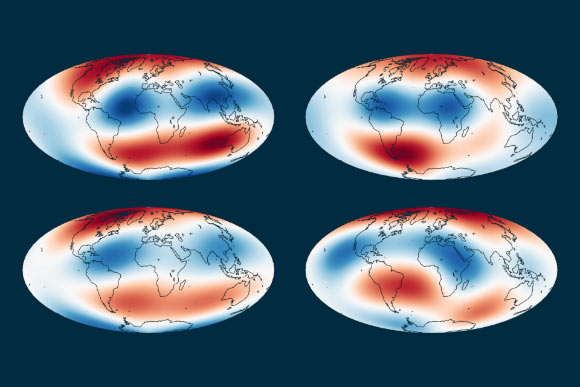
Two huge blobs of solid, superheated matter at the base of Earth’s mantle affect the underlying liquid outer core. Image credit: Biggin and others., doi: 10.1038/s41561-025-01910-1.
Measuring ancient magnetic fields and simulating the processes that generate them are technically demanding.
To study these features of the Earth’s depths, Professor Biggin and his colleagues combined paleomagnetic observations with advanced computer simulations of the geodynamo – the flow of liquid iron in the outer core that generates the Earth’s magnetic field like a wind turbine generates electricity.
Numerical models allowed them to reconstruct key observations of the behavior of the magnetic field observed over the past 265 million years.
Even with a supercomputer, running such simulations, especially over long periods of time, represents an immense computational challenge.
The results revealed that the upper boundary of the outer core is far from uniform in temperature.
Instead, it exhibits strong thermal contrasts, with localized warm regions capped by continent-sized rock structures.
It also showed that some parts of the magnetic field appear to have remained relatively stable for hundreds of millions of years, while others have changed significantly over time.
“These results suggest that there are strong temperature contrasts in the rocky mantle just above the core and that, beneath the warmer regions, liquid iron in the core may stagnate rather than participate in the vigorous flow observed beneath the cooler regions,” Professor Biggin said.
“Obtaining such information about Earth’s depths over very long time scales strengthens the case for using records of the ancient magnetic field to understand both the dynamic evolution of Earth’s depths and its more stable properties.”
“These findings also have important implications for questions surrounding ancient continental configurations – such as the formation and breakup of Pangea – and may help resolve long-standing uncertainties regarding ancient climate, paleobiology and the formation of natural resources.”
“These areas assumed that the Earth’s magnetic field, averaged over long periods, behaved like a perfect magnetic bar aligned with the planet’s axis of rotation.”
“Our findings show that this may not be entirely true.”
The study was published today in the journal Natural geosciences.
_____
AJ Biggin and others. The heterogeneity of the mantle influenced the ancient Earth’s magnetic field. Nat. Geosciespublished online February 3, 2026; doi: 10.1038/s41561-025-01910-1


