185,000-Light-Year-Long Bridge of Neutral Hydrogen Gas Connects Two Dwarf Galaxies


As part of the Widefield Askap L Band Legacy All-Sky Survey (Wallaby), an international team of astronomers observed the pair of dwarf galaxy NGC 4532 / DDO 137 (Wallaby J123424 + 062511), which is located around 53 million light years from the earth. Observations have revealed a huge neutral hydrogen bridge (185,000 light years) between the two galaxies, as well as many arms and clouds that connect with the even longer gas tail (1.6 million light years) previously discovered with the ARECIBO telescope.
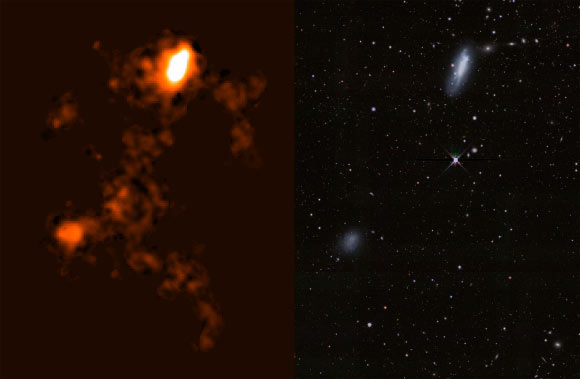
Radio (left) and optical (right) Images of NGC 4532 / DDO 137. Image credit: Icrar / D. Lang, Perimeter Institute.
“The discovery marked a significant step forward in understanding the interaction of galaxies,” said Professor Lister Staveley-Smith, astronomer of the University of Australia-Western Center at the International Research Center on Radio-Astronomy (ICRAR).
“Our modeling has shown that the tidal forces acting between these galaxies, as well as their proximity to the group of massive virgin galaxies, played a crucial role in the dynamics of the gas that we observed.”
“While the galaxies were spining one around one around the other and moved to the cloud of hot gas surrounding the cluster of the Virgin, which was 200 times warmer than the surface of the sun, they knew what is known as RAM pressure, which stripped and heated the gas of the galaxies.”
“The process is similar to atmospheric combustion when a satellite enters the high earth atmosphere, but has spread over a period of billions of years.”
“The density of the electrons and the speed at which the galaxies fall into the hot gas cloud are sufficient to explain why so much gases have been far from the galaxies and in the bridge and the surrounding areas.”
Observations were part of the Wallaby survey, a large -scale project that maps the sky and studies the distribution of gas hydrogen in galaxies, using CSIRO’s Askap radiotelescope.
“Neutral hydrogen plays a crucial role in the training of stars, which makes this discovery fundamental to understand how galaxies interact and evolve, in particular in dense environments,” said Professor Icrar Kenji Bekki.
“The system had solid similarities with our own milky system and Magellanic, offering a unique opportunity to study these interactions in detail,” said Professor Staveley-Smith.
“Understanding these gas bridges and their dynamics provides critical information on how galaxies evolve over time, how galactic gas is redistributed and the variable conditions in which galaxies can or not form stars.”
“This contributes to our broader understanding of the most massive structures of the universe and their life cycles, which helps us to grasp their vast complexities and their history of stars more.”
The results appear in the Monthly opinion from the Royal Astronomical Society.
_____
L. Staveley-Smith and al. 2025. Wallaby pilot survey: The in -depth interaction of NGC 4532 and DDO 137 with the Virgo cluster. Mnra 543 (1): 526-539; DOI: 10.1093 / Mnras / Staf1443


